The Illusion of the Simple Formula
A vehicle, motionless and axle-deep in mud, represents a failure not of machinery, but of physics. The driver, confident moments before, had done the math: Gross Vehicle Weight (GVW) multiplied by 1.5. The winch on their bumper exceeded that number. Yet, under the immense strain, its motor whines a high-pitched protest, and the vehicle remains stubbornly fixed.
This scene plays out countless times. It's the moment a simple rule of thumb collides with complex reality.
The industry standard—choosing a winch with a pulling capacity of at least 1.5 times your vehicle's GVW—is an elegant and useful starting point. It provides a baseline for safety. But it is not the answer; it is merely the beginning of the right question.
The formula assumes a free-rolling vehicle on flat, hard ground. A recovery situation is, by definition, the opposite of that.
The Invisible Enemies: What the Math Leaves Out
The forces that hold a vehicle captive are rarely accounted for in a simple weight calculation. A winch doesn't just pull the vehicle's mass; it fights the environment itself.
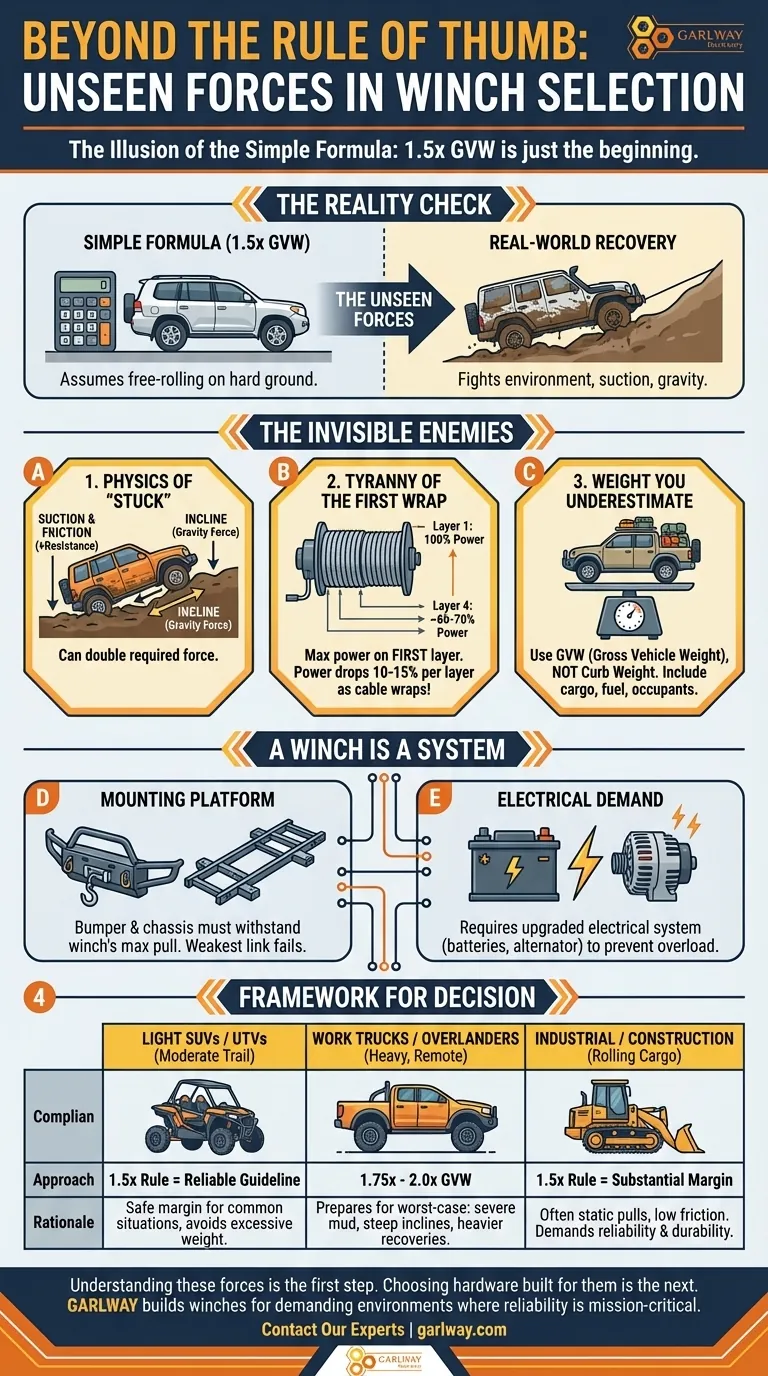
The Physics of "Stuck"
A vehicle mired in mud isn't just heavy; it's held by suction and friction. This resistance can effectively double the force required to move it. Pulling that same vehicle up a steep incline adds the force of gravity to the equation.
These are not small variables. They are immense, invisible forces that can overwhelm an undersized winch, turning a recovery into a hazardous component failure.
The Tyranny of the First Wrap
A winch's rated capacity—the big number on the box—applies only to the first layer of cable wrapped around the drum, when the line is nearly fully extended.
With each subsequent layer of cable that wraps onto the drum, the effective diameter of the drum increases, which reduces the winch's mechanical advantage and its pulling power. This loss can be 10-15% per layer. A 12,000 lb winch might only be capable of pulling 8,000 lbs on its final wrap. Your strongest pull is paradoxically when you have the most cable out.
The Weight You Underestimate
The calculation must start with Gross Vehicle Weight (GVW), not the lighter curb weight. GVW is the maximum operating weight, including the vehicle, fuel, occupants, and all your cargo. In a work or recovery scenario, you are always operating at or near GVW.
A Winch is Only as Strong as Its System
Choosing a winch is not about selecting a single component. It's about investing in a system. The winch is only one part of that system, and it is often not the weakest link.
The Mounting Platform
A 15,000 lb winch mounted on a bumper rated for 8,000 lbs is a recipe for catastrophic failure. The force generated by the winch must be safely transferred to the vehicle's frame. The mounting plate, bumper, and the vehicle's chassis must be engineered to withstand the winch's maximum pull.
The Electrical Demand
An electric winch under load is one of the most demanding accessories you can connect to a vehicle. It can draw hundreds of amps, a load that can overwhelm a stock battery and alternator.
Reliable winching, especially for high-capacity units used in professional construction or heavy recovery, often requires an upgraded electrical system—including high-output alternators and dual batteries—to supply the necessary power without compromise.
The Psychology of the Right Choice
The decision-making process is often clouded by two opposing fears: the fear of being under-equipped and the fear of over-spending.
The Danger of "Too Small"
Choosing a winch below the 1.5x minimum is not a calculated risk; it is a guarantee of eventual failure. An underpowered winch will strain its motor, gearbox, and line. Overheating becomes a serious risk, and a snapped winch line stores and releases enough kinetic energy to be lethal. Safety is the primary reason the 1.5x rule exists as an absolute floor.
The Burden of "Too Big"
While it seems safer, a vastly oversized winch introduces its own set of problems.
- Weight: It adds significant mass to the front of the vehicle, negatively impacting suspension performance, handling, and braking.
- Electrical Strain: It places a greater, often unnecessary, demand on the electrical system.
- Cost: It represents a misallocation of resources that could be better spent on other critical system components, like the mounting or electrical upgrades.
The goal is not brute force; it is to find the most efficient and elegant tool for the job.
A Framework for Your Decision
The 1.5x rule is your baseline. From there, your choice must be guided by your primary use case.
| Vehicle Type / Use Case | Recommended Approach | Rationale |
|---|---|---|
| Light SUVs / UTVs (Moderate trail use) |
The 1.5x rule is a reliable guideline. | Provides a safe margin for most common recovery situations without adding excessive weight. |
| Work Trucks / Overlanders (Heavy, remote use) |
Treat 1.5x as the absolute minimum. Strongly consider stepping up to the next capacity class (e.g., 1.75x - 2.0x GVW). | Prepares for the worst-case scenarios: severe mud, steep inclines, and the recovery of other, heavier vehicles. |
| Industrial / Construction (Loading rolling cargo) |
The 1.5x rule offers a substantial safety margin. Capacity is often dictated by load type, not just weight. | These are often static pulls with low friction, but professional environments demand reliability and durability. |
Understanding these forces is the first step. The next is choosing hardware built for them. As specialists in construction machinery, GARLWAY builds winches designed for the demanding environments where these calculations are mission-critical. Whether on a construction site or a remote work location, reliability isn't a feature; it's the entire point.
If your work depends on reliable pulling power, it's a conversation worth having. Contact Our Experts
Visual Guide
Related Products
- Warn Winch Windlass Boat Trailer Winch
- Electric and Hydraulic Winch for Heavy Duty Applications
- Small Electric Winch 120V and 240V for Compact Applications
- 12000 lb Electric Boat Trailer Winch with Windlass Anchor Warn
- Quick Windlass Portable Winch for Truck and Boat Best Boat Winch
Related Articles
- Beyond the Bumper: The Critical System Choice in Powering Your Trailer Winch
- Force vs. Mass: The Critical Difference in Sizing a Boat Winch
- Lines of Force: The Unseen Geometry of a Boat Winch
- More Than a Number: The Engineering Psychology of Choosing a Boat Winch
- How to Choose and Optimize Winch Speed for Maximum Efficiency