The Illusion of Simplicity
A winch installation looks straightforward. Four bolts, two cables. An afternoon's work.
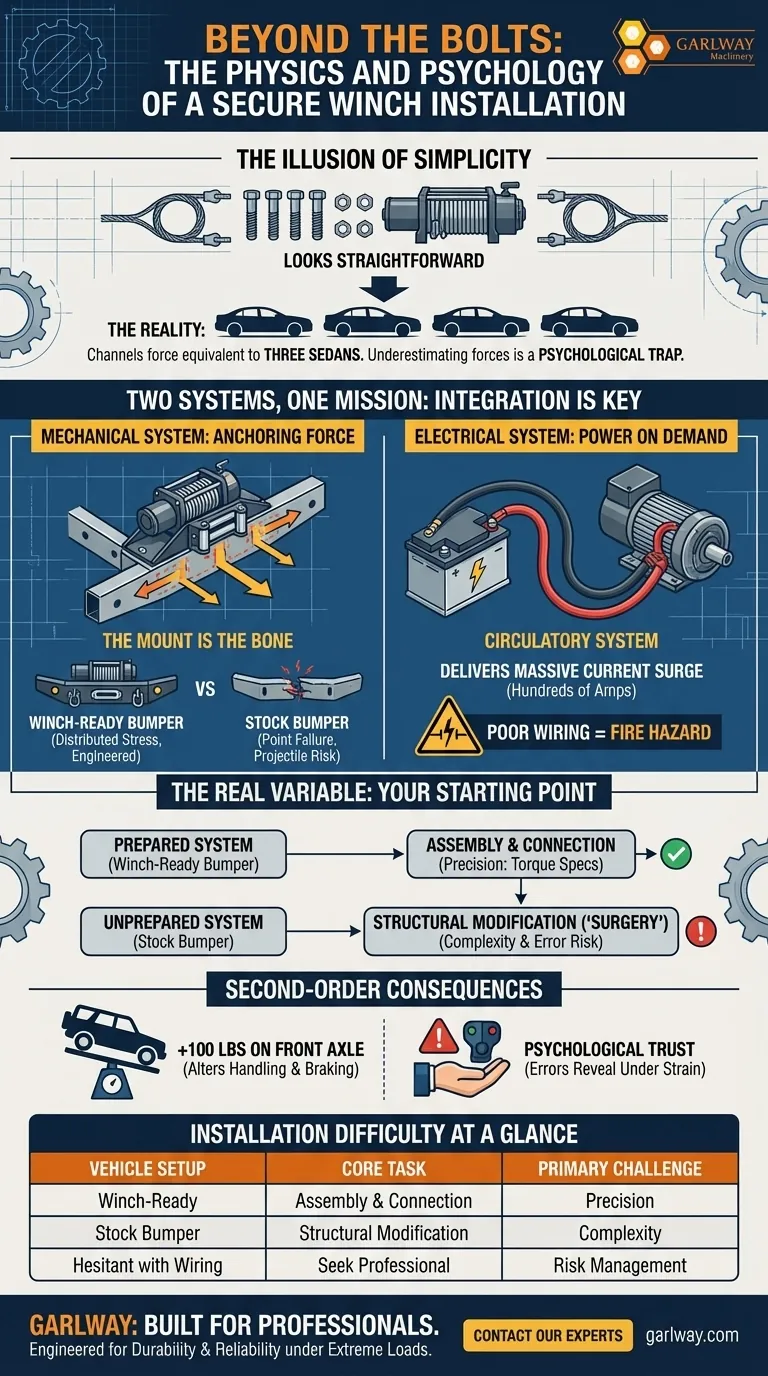
This perception is the project's greatest psychological trap. We see a simple mechanical object and underestimate the forces it commands. A 12,000-pound winch doesn't just pull a vehicle; it channels the equivalent weight of three sedans through a mounting plate the size of a dinner plate.
The challenge, therefore, isn't about the number of steps. It's about respecting the physics at play in every single connection.
Two Systems, One Mission
A successful installation isn't one task, but the integration of two distinct, interdependent systems: one mechanical, one electrical. Failure in either one renders the entire apparatus useless, or worse, dangerous.
The Mechanical System: Anchoring Force
The winch mount is not merely a bracket. It is the structural anchor responsible for transferring the entire load of a recovery operation to the vehicle's frame.
Imagine the winch line as a steel tendon. The motor is the muscle, but the mounting point is the bone it pulls against. If that connection is weak, the force has nowhere to go. A mount that fails under load doesn't just bend; it can shear off, turning a multi-ton recovery tool into an unguided projectile.
This is why "winch-ready" bumpers exist. They are engineered systems, designed with reinforced connection points and bracing to distribute immense stress across the strongest parts of the vehicle's chassis. Bolting a winch to a standard bumper is like anchoring a battleship with a fishing line.
The Electrical System: Power on Demand
The electrical system is the winch's circulatory system. It must deliver a massive surge of current—often hundreds of amperes—reliably and safely.
This is not like wiring a set of fog lights. Heavy-gauge cables are required to handle the amperage without overheating. Connections must be clean, tight, and protected to prevent voltage drop, which starves the motor of the power it needs right at its moment of peak demand.
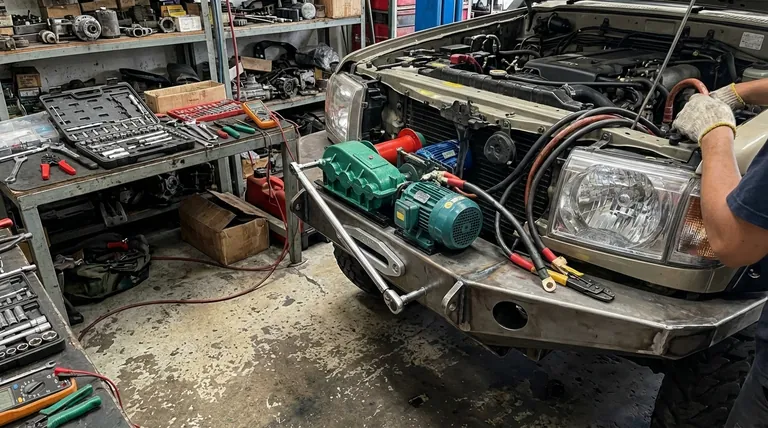
Routing these cables is a crucial detail. They must be kept away from sharp metal edges that can chafe through insulation and hot engine components that can melt it. A short circuit here doesn't just blow a fuse; it can destroy your vehicle's battery or start a catastrophic fire.
The Real Variable: Your Starting Point
The difficulty of an installation is determined less by your mechanical aptitude and more by the foundation you're building upon.
- The Prepared System: If your vehicle has a winch-ready bumper or an integrated mounting plate, the most complex engineering problems have already been solved for you. Your job is one of assembly and connection—following torque specifications and routing wires correctly.
- The Unprepared System: If you start with a stock bumper, your project is no longer just a winch installation. It is a major structural modification. You must first perform the "surgery" of installing a compatible mounting system before the primary job can even begin. This dramatically increases the complexity and potential for error.
The tools and workspace matter for the same reason. A level surface and a torque wrench aren't about convenience; they are about precision and ensuring that every bolt achieves its specified clamping force.
Second-Order Consequences
Adding a winch changes the vehicle as a system. These ripple effects are often an afterthought, but they are critical.
A winch and steel plate can add over 100 pounds directly over the front axle. This alters the vehicle's center of gravity, affecting suspension compression, braking distances, and overall handling dynamics.
But the most significant consequence is a psychological one. We trust the tool. We anchor our safety to it in a moment of crisis. The small error made on a sunny afternoon in the garage—a slightly loose bolt, a poorly routed cable—only reveals itself under the immense strain of a real-world recovery.
Installation Difficulty at a Glance
| Vehicle Setup | Core Task | Primary Challenge |
|---|---|---|
| Winch-Ready Bumper | Assembly & Connection | Precision: Following torque specs and wiring diagrams. |
| Stock Bumper | Structural Modification & Installation | Complexity: Major disassembly and reassembly required. |
| Hesitant with Wiring | Mechanical Mount Only | Risk Management: Knowing when to seek professional help. |
The integrity of any high-stress system begins with the quality of its core components. A winch must be engineered not just for pulling power, but for seamless and secure integration into the vehicle system it becomes a part of. This is why professionals in demanding fields like construction rely on equipment built for reliability under extreme loads.
GARLWAY winches are designed from the ground up for the harsh realities of the construction site, offering the durability and dependable power that contractors require. Our engineering philosophy ensures that our equipment provides not just strength, but a safe and solid foundation for your vehicle's recovery system.
If you are ready to equip your machinery with a winch built to professional standards, let's ensure it's done right. Contact Our Experts
Visual Guide
Related Products
- Warn Winch Windlass Boat Trailer Winch
- Electric and Hydraulic Winch for Heavy Duty Applications
- Small Electric Winch 120V and 240V for Compact Applications
- 12000 lb Electric Boat Trailer Winch with Windlass Anchor Warn
- Quick Windlass Portable Winch for Truck and Boat Best Boat Winch
Related Articles
- Beyond the Bumper: The Critical System Choice in Powering Your Trailer Winch
- Force vs. Mass: The Critical Difference in Sizing a Boat Winch
- Lines of Force: The Unseen Geometry of a Boat Winch
- More Than a Number: The Engineering Psychology of Choosing a Boat Winch
- How to Choose and Optimize Winch Speed for Maximum Efficiency