The Moment of Impossibility
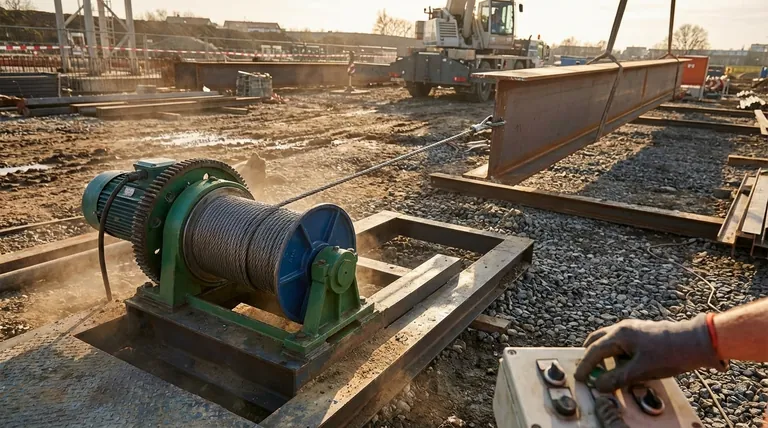
Picture a construction site. A multi-ton steel I-beam is suspended, needing to be eased into its final position with millimeter precision. Or imagine a heavy excavator, its tracks sunk deep into unforgiving mud after a downpour.
In these moments, raw human strength is irrelevant. The challenge isn't one of effort, but of physics. The problem seems impossibly large, yet the solution is elegantly simple.
The Psychology of Force Multiplication
We instinctively understand leverage. We know a long crowbar can move a boulder a short one can't. A winch operates on this same intuitive principle, but on an industrial scale.
It doesn't create energy from nothing. It performs a beautiful trade: it converts a long, low-force action (the spinning of a motor or the turning of a crank) into a short, high-force pull. This feels like magic to our minds, but it’s a disciplined application of one of humanity's oldest engineering discoveries.
Deconstructing the Machine: The Wheel and Axle at Heart
At its core, every winch—from a simple manual crank to a heavy-duty hydraulic unit—is a sophisticated expression of the wheel and axle principle. The terms are conceptual.
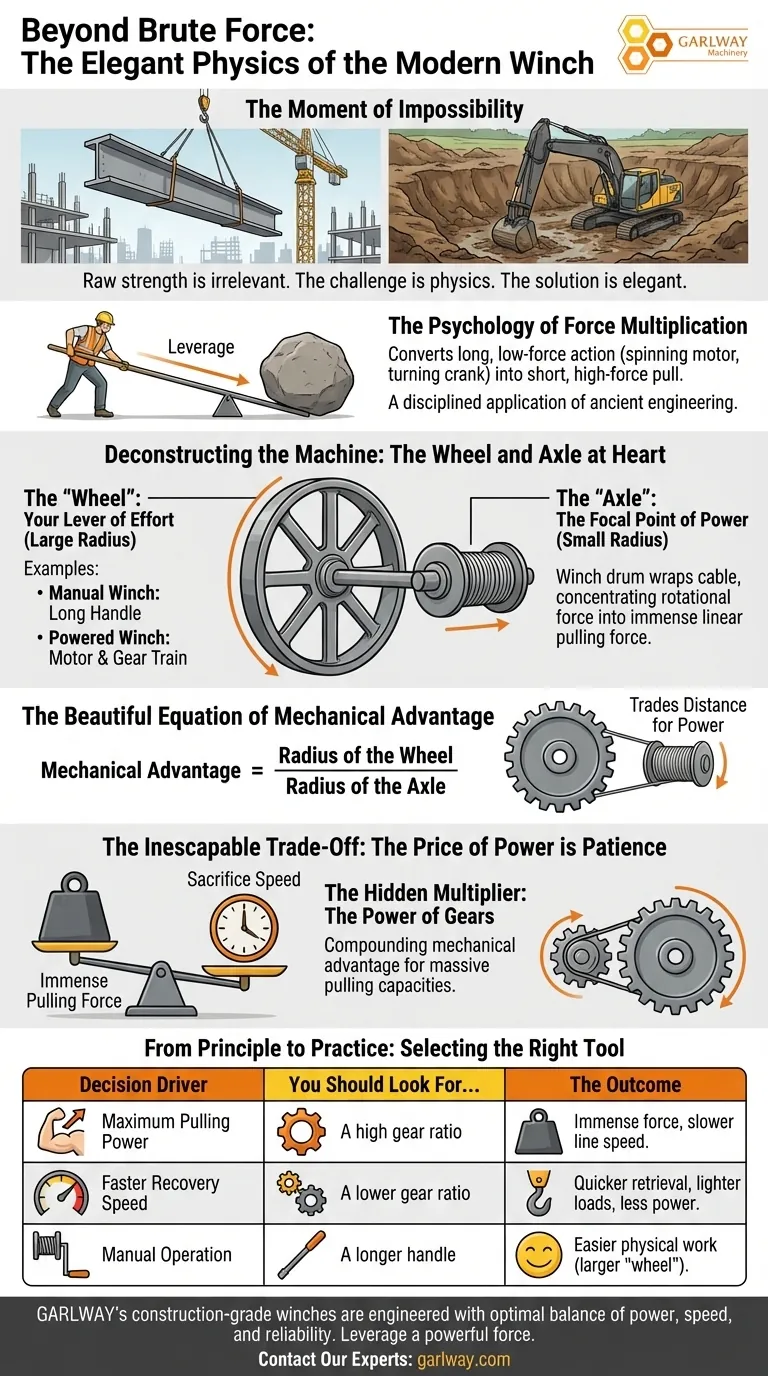
The "Wheel": Your Lever of Effort
The "wheel" is where you apply your input. Its defining characteristic is its large radius.
- In a manual winch, this is the handle. The longer the handle, the greater your leverage and the easier the work feels.
- In a powered winch, this role is played by a motor connected to a gear train, applying rotational force over a conceptual "large wheel."
The "Axle": The Focal Point of Power
The "axle" is where the work gets done. It's the winch drum, which has a much smaller radius.
As the cable wraps around this small-radius drum, the rotational force from the "wheel" is concentrated into an immense linear pulling force. This is where the magic happens.
The Beautiful Equation of Mechanical Advantage
The power of a winch is defined by the ratio between these two components.
Mechanical Advantage = Radius of the Wheel / Radius of the Axle
If the effective radius of your input (the handle's swing or the final gear's size) is 20 times larger than the radius of the drum, you multiply your input force by 20 (minus small losses to friction).
You are trading distance for power. You perform an easy action over a long distance to achieve a difficult action over a short one.
The Inescapable Trade-Off: The Price of Power is Patience
This force multiplication isn't free. The fundamental law of this trade-off is power versus speed.
To gain the immense pulling force needed to move that I-beam, you must sacrifice speed. The motor runs, or you turn the crank many times, to pull the cable in just a few inches. This is why winching is a slow, deliberate, and safe process. It's the physical embodiment of "slow and steady wins the race."
The Hidden Multiplier: The Power of Gears
Most modern construction winches add another layer of force multiplication: a gear train. A small gear spun rapidly by a motor turns a larger gear slowly, but with far greater torque.
This is a "wheel and axle" system driving another "wheel and axle" system, compounding the mechanical advantage into the massive pulling capacities required on professional job sites.
From Principle to Practice: Selecting the Right Tool
Understanding this core principle moves the winch from a black box to a predictable tool. It empowers you to choose the right equipment for the job, transforming physics theory into practical results.
| Decision Driver | You Should Look For... | The Outcome |
|---|---|---|
| Maximum Pulling Power | A high gear ratio | Immense force multiplication for heavy, static pulls. Slower line speed. |
| Faster Recovery Speed | A lower gear ratio | Quicker cable retrieval for lighter loads or vehicle recovery. Less power. |
| Manual Operation | A longer handle | Increases the "wheel" radius, making the physical work feel significantly easier. |
When your project's success hinges on moving massive loads safely and efficiently, you need more than just a winch; you need the right one. GARLWAY's range of construction-grade winches are engineered with these principles in mind, offering robust solutions for contractors who understand that the right tool is the one with the optimal balance of power, speed, and reliability.
By understanding the simple physics at play, you can leverage a powerful and predictable force to achieve what once seemed impossible. If you're ready to apply these principles with the right equipment, our team is here to help. Contact Our Experts
Visual Guide
Related Products
- Warn Winch Windlass Boat Trailer Winch
- Electric and Hydraulic Winch for Heavy Duty Applications
- Small Electric Winch 120V and 240V for Compact Applications
- 12000 lb Electric Boat Trailer Winch with Windlass Anchor Warn
- Quick Windlass Portable Winch for Truck and Boat Best Boat Winch
Related Articles
- Beyond the Bumper: The Critical System Choice in Powering Your Trailer Winch
- Force vs. Mass: The Critical Difference in Sizing a Boat Winch
- Lines of Force: The Unseen Geometry of a Boat Winch
- More Than a Number: The Engineering Psychology of Choosing a Boat Winch
- How to Choose and Optimize Winch Speed for Maximum Efficiency