The Illusion of Effortless Power
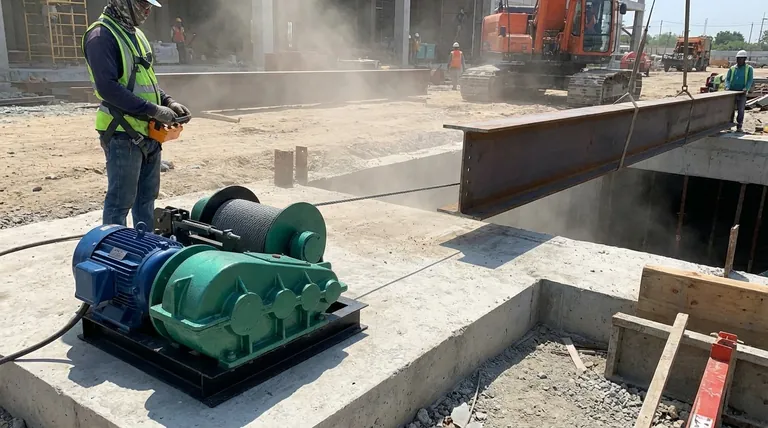
Picture a construction site. A multi-ton steel beam hangs suspended, needing to be eased into a frame with millimeter precision. Below, a single operator stands, calmly managing the immense tension with a small controller. There is no grunting, no straining, no brute force.
This scene is a quiet testament to one of engineering's most elegant solutions. It’s a physical problem solved not with more muscle, but with smarter force. This is the world of the electric winch.
Deconstructing the Force Multiplier
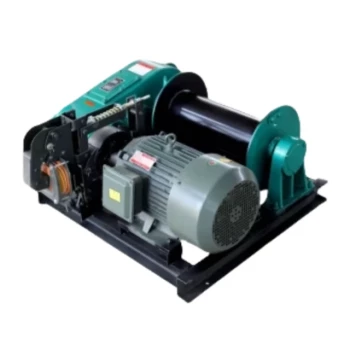
At its heart, an electric winch is a translator. It doesn't create power; it converts it from a chaotic, high-speed rotation into a calm, controlled, and incredibly powerful linear pull.
The process is a masterpiece of mechanical leverage.
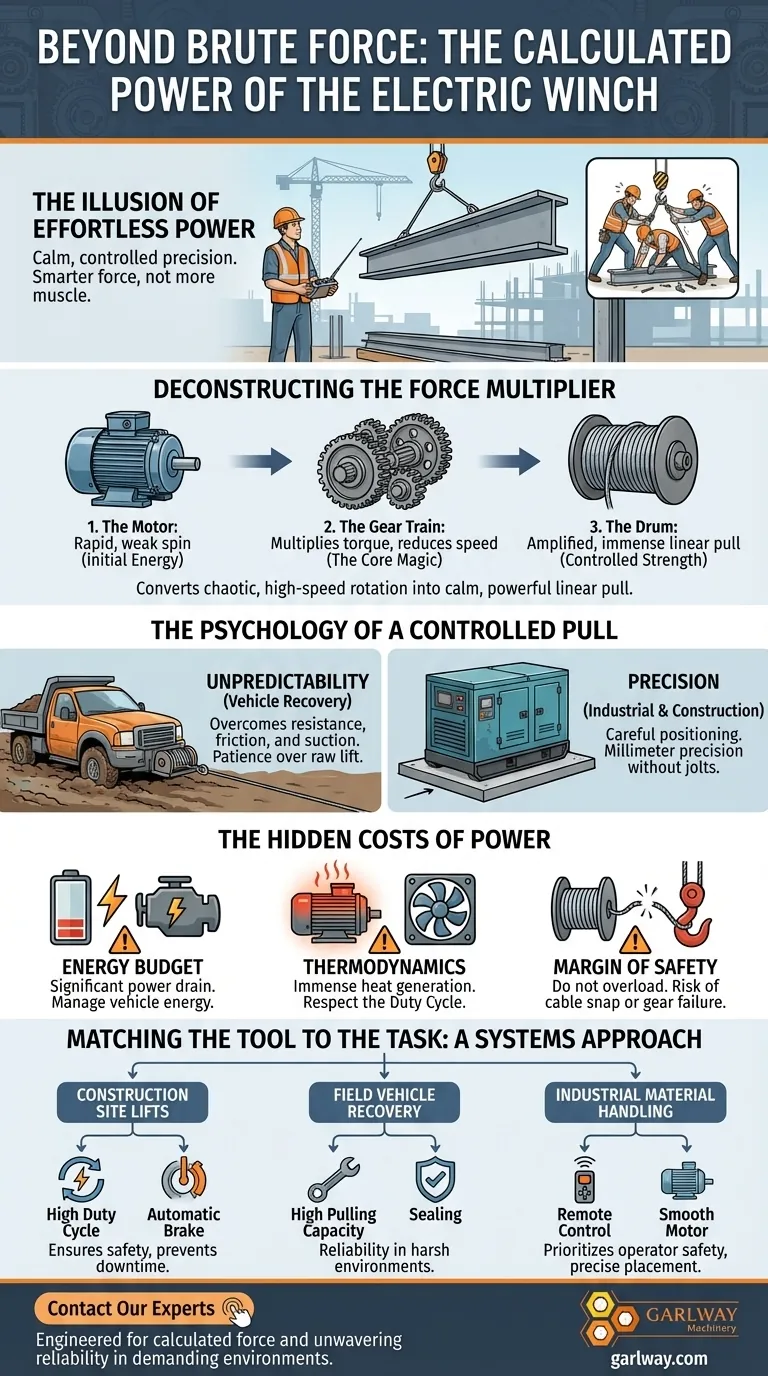
- The Motor: An electric motor provides the initial energy, a rapid but relatively weak spin.
- The Gear Train: This is the core of the magic. A series of gears drastically reduces the motor's speed, and in doing so, multiplies its torque—its rotational force—by orders of magnitude.
- The Drum: This amplified, high-torque force turns a drum, which spools a steel cable or synthetic rope. The result is an immense and steady pulling force.
It grants one person the controlled strength of a dozen, but with a level of precision that raw human power could never achieve.
The Psychology of a Controlled Pull
Understanding a winch requires a mental shift. It's not primarily for lifting dead weight straight up—that's a job for a hoist or crane. A winch is designed to overcome resistance. It’s a tool for managing the forces of friction, gravity on an incline, and the sheer inertia of massive objects.
This distinction shapes its most critical applications.
The Problem of Unpredictability
In vehicle recovery, a winch is an insurance policy against chaos. When a truck is mired in mud, the challenge isn't just its weight, but the immense suction and friction. A winch doesn't just lift; it pulls steadily, patiently overcoming the resistance until the vehicle is free.
The Problem of Precision
On an industrial floor or construction site, a winch provides control. It allows for the careful positioning of heavy machinery or building components. It's the tool you use when you need to slide a 10-ton generator onto its mounting pad without a single jolt.
The Hidden Costs of Power
This incredible capability isn't free. The power a winch wields is governed by strict physical and electrical laws. Ignoring them is not just inefficient; it's dangerous. This is where operator psychology meets engineering reality.
The Energy Budget
An electric winch is a significant drain on its power source. On a vehicle, it can easily deplete a battery if the engine isn't running. This forces the operator to think of the task as part of a larger system, managing the vehicle's energy budget, not just the pull itself.
The Laws of Thermodynamics
Winches generate immense heat. Their "duty cycle"—the ratio of time they can work before needing to cool down—is not a suggestion. It's a hard limit. Exceeding it is a cognitive error, assuming the machine's limits can be bent by willpower. They cannot. Overheating leads to permanent motor damage.
The Margin of Safety
A winch's capacity rating is its most important number. The temptation to "just pull a little more" is a common psychological trap that underestimates risk. Overloading a winch can snap a cable or strip its gears, turning a tool of control into an unpredictable source of danger.
Matching the Tool to the Task: A Systems Approach
Choosing a winch is not about finding the "strongest" one. It's about matching the engineering of the tool to the specific problem you are solving. It's a systems-level decision.
| Application Context | Critical Design Feature | Why It Matters |
|---|---|---|
| Construction Site Lifts | High Duty Cycle, Automatic Brake | Ensures safety and prevents downtime in high-frequency use. |
| Field Vehicle Recovery | High Pulling Capacity, Sealing | Guarantees reliability in unpredictable, harsh environments. |
| Industrial Material Handling | Remote Control, Smooth Motor | Prioritizes operator safety, visibility, and precise placement. |
In professional settings like construction, where schedules are tight and safety is non-negotiable, the reliability of every component is paramount. The winch isn't just a piece of equipment; it's a critical link in the chain of productivity.
At GARLWAY, we engineer construction machinery for this reality. Our electric winches are built for the demanding environments faced by contractors and construction companies, where calculated force and unwavering reliability are the standard. If your work involves moving the unmovable, let's ensure you have the right system for the job. Contact Our Experts.
Visual Guide
Related Products
- Electric 120V Boat Winch by Badlands
- Electric and Hydraulic Winch for Heavy Duty Applications
- Small Electric Winch 120V and 240V for Compact Applications
- 12000 lb Electric Boat Trailer Winch with Windlass Anchor Warn
- Electric Hoist Winch Boat Anchor Windlass for Marine Applications
Related Articles
- How to Choose Between Reversible and Friction Electric Winches: A Transmission Guide
- The Unseen System: How an Electric Winch Manages Force and Eliminates Fear
- How to Choose Between Manual and Electric Winches for Your Project
- When Automation Fails: The Critical Role of Manual Override in Electric Winches
- How Electric Winches’ Engineering Enhances Efficiency and Safety in Heavy-Duty Applications