
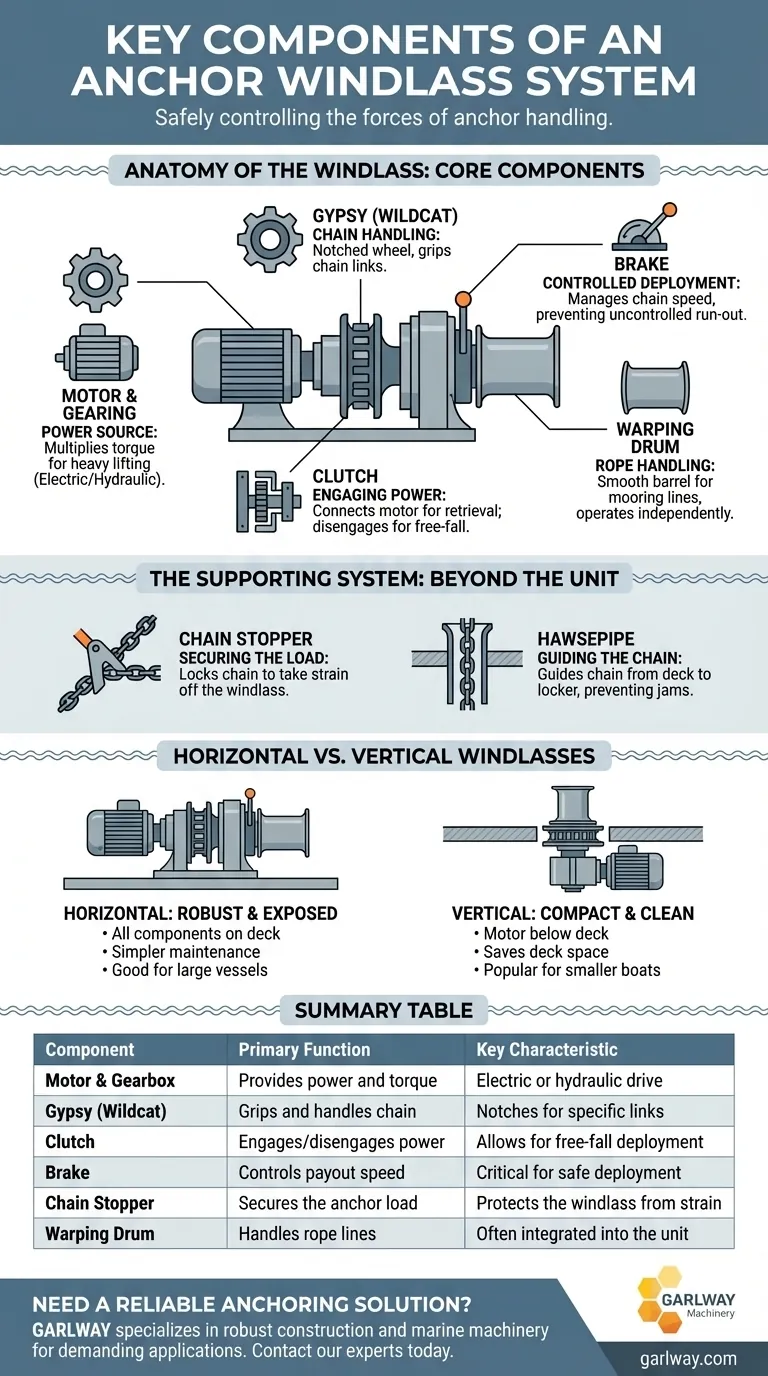
At its core, an anchor windlass is a system of interconnected components designed for one purpose: to safely control the immense forces involved in handling an anchor and its chain. The primary components are the motor, the gypsy (or chain wheel) that grips the chain, a clutch to engage the motor, a brake to control deployment, and a chain stopper to secure the load.
A windlass is more than just a winch; it is a complete system where each component plays a critical role. Understanding how these parts interact is essential for safe and efficient anchoring, moving beyond a simple parts list to a functional understanding of the entire operation.
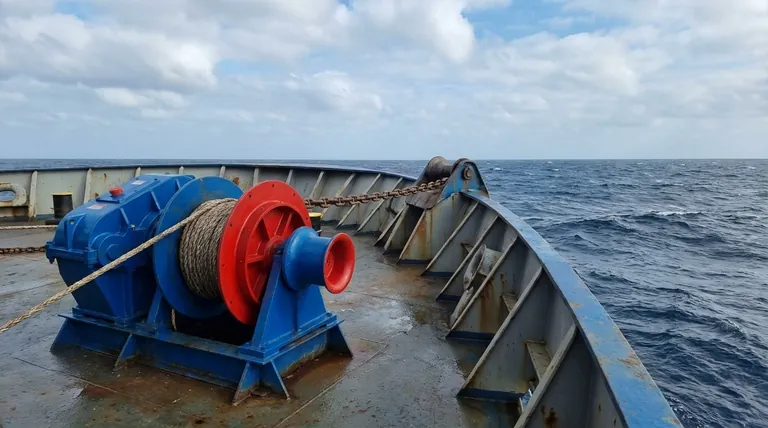
Anatomy of the Windlass: Core Components Explained
The components mounted directly on the windlass unit are responsible for converting power into controlled movement for both chain and rope.
The Power Source: Motor and Gearing
The system is driven by a powerful motor, typically electric or hydraulic. This motor connects to a gearbox that multiplies torque, providing the immense strength needed to lift a heavy anchor and chain from the seabed.
The Gypsy (or Wildcat): The Heart of Chain Handling
The gypsy is a specialized, notched wheel that is the primary point of contact with the anchor chain. The notches, or "pockets," are precisely sized to match the links of the chain, allowing the windlass to grip and pull it in a controlled manner.
The term wildcat is often used interchangeably with gypsy, particularly in commercial shipping.
The Clutch: Engaging the Power
The clutch is a crucial mechanism that engages or disengages the gypsy from the gearbox. When the clutch is engaged, the motor can power the gypsy to retrieve the anchor. When disengaged, the gypsy can spin freely, allowing the anchor to drop under its own weight.
The Brake: Ensuring Controlled Deployment
The brake provides precise control over the speed at which the anchor chain pays out. This is a critical safety feature that prevents the chain from running out uncontrollably, which could damage the vessel or endanger the crew. It is applied to the gypsy when the clutch is disengaged.
The Warping Drum: Handling Rope Lines
Many windlasses also feature a smooth, barrel-shaped warping drum (or capstan). This component is used for handling rope lines, such as mooring lines, and operates independently of the gypsy.
The Supporting System: Beyond the Windlass Unit
A windlass does not operate in isolation. It relies on other essential hardware to function as a complete and safe anchoring system.
The Chain Stopper: Securing the Load
A chain stopper (such as a pawl bar or devil's claw) is a separate, heavy-duty device mounted between the windlass and the bow roller. Its sole purpose is to lock the anchor chain in place and take the load off the windlass itself once the anchor is set or fully stowed.
This protects the windlass's internal components from the constant strain and shock loads experienced while at anchor.
The Hawsepipe: Guiding the Chain
The hawsepipe is the tube that guides the anchor chain from the deck down into the chain locker below. It ensures the chain feeds smoothly without piling up or kinking, preventing jams during retrieval.
Understanding the Trade-offs: Horizontal vs. Vertical Windlasses
The physical arrangement of these components defines the two primary types of windlasses, each with distinct advantages.
Horizontal Windlass: Robust and Exposed
In a horizontal configuration, the motor, gearbox, and gypsy are all mounted above the deck in a single housing. This makes installation and maintenance simpler.
Their robust, self-contained design is often favored on larger vessels where deck space is less of a concern and durability is paramount.
Vertical Windlass: Compact and Clean
In a vertical design, only the gypsy and warping drum are visible on deck. The motor and gearbox are installed below deck, which provides a cleaner look and frees up valuable deck space.
This compact footprint makes vertical windlasses extremely popular for smaller recreational and sailing boats.
Making the Right Choice for Your System
Selecting and understanding your windlass components depends entirely on your vessel and operational needs.
- If your primary focus is maximum durability and easy maintenance on a larger vessel: A horizontal windlass is typically the more robust and serviceable choice.
- If your primary focus is saving deck space and achieving a clean look on a smaller boat: A vertical windlass offers a more compact and aesthetically pleasing solution.
- If your primary focus is operational safety (which should always be a priority): Ensure you understand the distinct functions of the brake for controlled deployment and the chain stopper for securing the load.
Ultimately, a reliable anchor windlass is a system where every component works in concert to provide control.
Summary Table:
| Component | Primary Function | Key Characteristic |
|---|---|---|
| Motor & Gearbox | Provides power and torque | Electric or hydraulic drive |
| Gypsy (Wildcat) | Grips and handles the anchor chain | Notches sized for specific chain links |
| Clutch | Engages/disengages power to the gypsy | Allows for free-fall deployment |
| Brake | Controls payout speed of the chain | Critical for safe deployment |
| Chain Stopper | Secures the anchor load | Protects the windlass from strain |
| Warping Drum | Handles rope lines (mooring lines) | Often integrated into the unit |
Need a reliable anchoring solution for your vessel?
GARLWAY specializes in robust construction and marine machinery, including winches and heavy-duty components perfect for demanding marine applications. Our expertise ensures your equipment is built for safety, durability, and peak performance.
Let us help you specify or build a system that meets your exact needs. Contact our experts today for a consultation.
Visual Guide
Related Products
- Electric Hoist Winch Boat Anchor Windlass for Marine Applications
- Heavy Duty Electric Boat Winch Windlass Anchor
- 12000 lb Electric Boat Trailer Winch with Windlass Anchor Warn
- Quick Windlass Portable Winch for Truck and Boat Best Boat Winch
- Warn Winch Windlass Boat Trailer Winch
People Also Ask
- How does an electric anchor winch work? Power, Safety, and Reliable Operation Explained
- What are the advantages of installing an electric anchor winch on a boat? Boost Safety & Ease for Boaters
- What are the operational differences between electric hoists and winches? A Guide to Safe Lifting vs. Pulling
- What are the main benefits of a boat anchor winch? Boost Safety & Efficiency for Your Vessel
- How does a boat anchor winch work? A Guide to Reliable Anchor Handling


