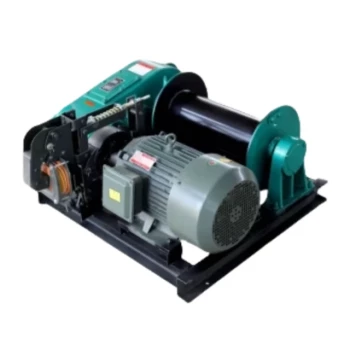
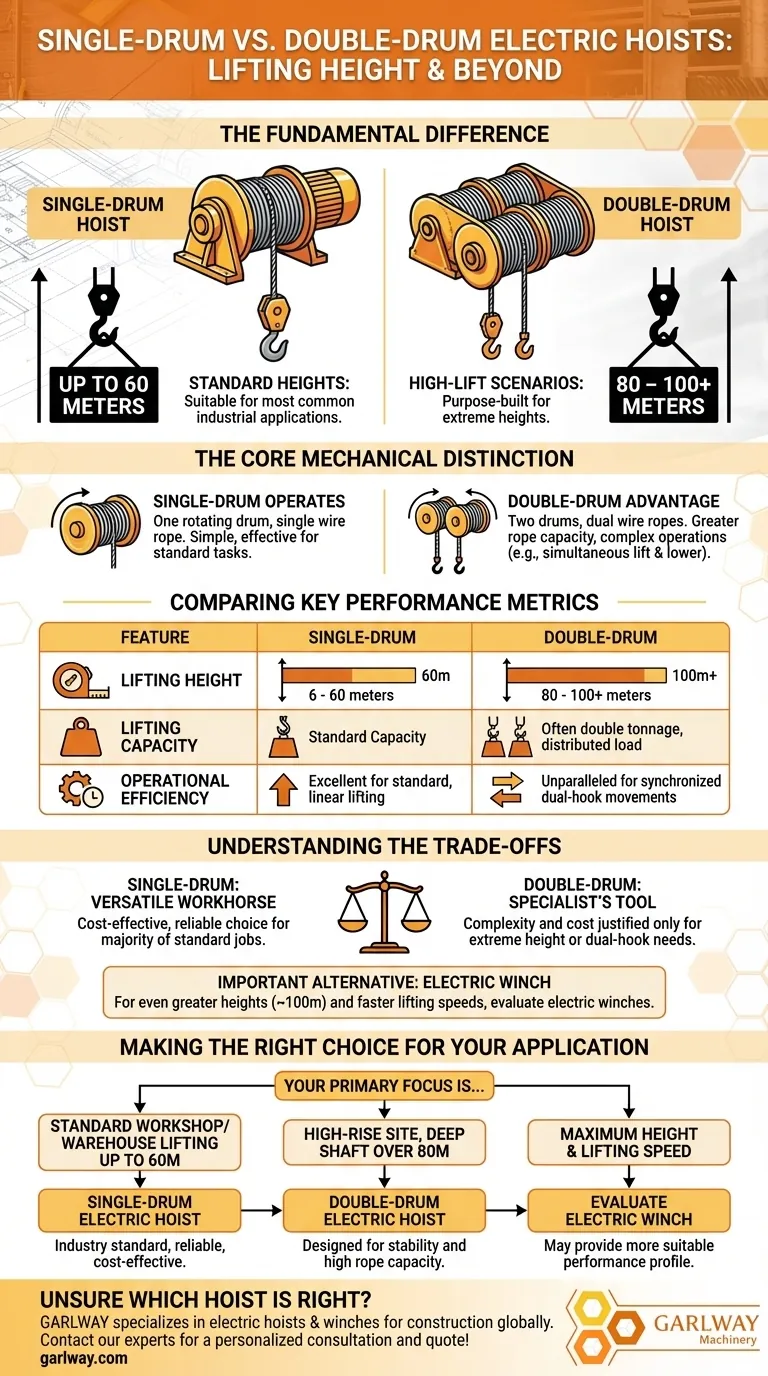
The fundamental difference is that single-drum electric hoists are designed for standard lifting heights, typically up to 60 meters, making them suitable for most common industrial applications. Double-drum electric hoists are purpose-built for high-lift scenarios, capable of reaching heights of 80 to 100 meters or more due to their specialized design.
The choice between a single-drum and a double-drum hoist is not just about reaching a specific height. It is a decision rooted in the hoist's mechanical design, which dictates its capacity, stability, and suitability for specialized, high-demand applications versus general-purpose lifting.
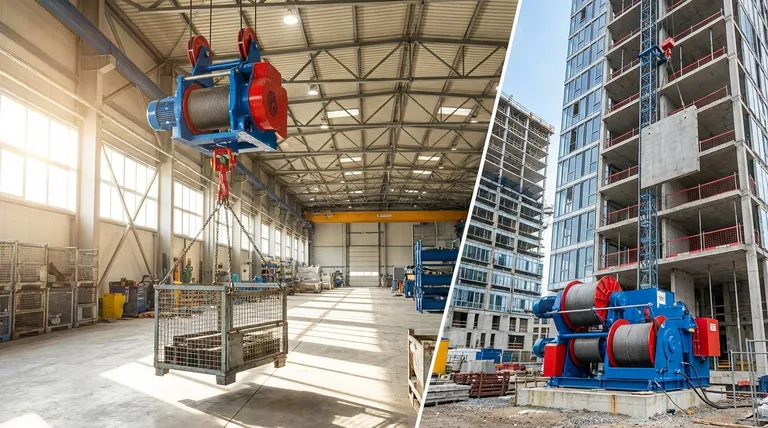
The Core Mechanical Distinction
To understand the difference in lifting height, we must first look at the core design of each hoist. The number of drums directly impacts how much wire rope can be stored and managed safely.
How a Single-Drum Hoist Operates
A single-drum hoist is the industry standard. It features one rotating drum onto which a single wire rope is wound.
This simple, effective design is perfect for the vast majority of lifting tasks in workshops, warehouses, and manufacturing plants. Its limitation is the physical capacity of the drum.
The Double-Drum Advantage
A double-drum hoist features two drums that can operate simultaneously. This configuration provides a significant advantage for specialized tasks.
The dual-drum setup allows for much greater wire rope capacity, which is essential for achieving greater lifting heights. It also enables more complex operations, such as one drum lifting while the other lowers, which is ideal for specific material handling or gate-control systems.
Comparing Key Performance Metrics
While height is the primary differentiator, the underlying design changes impact other critical performance characteristics.
Lifting Height
As established, this is the most distinct difference. Single-drum hoists are typically used for heights between 6 and 60 meters.
Double-drum hoists are specifically engineered for high-lift applications, commonly serving heights of 80 meters to 100 meters.
Lifting Capacity
The double-drum design doesn't just add height; it can also significantly increase lifting capacity. By distributing the load and using two rope systems, these hoists can often handle double the tonnage of a comparable single-drum unit.
Operational Efficiency
For certain applications, a double-drum hoist offers unparalleled efficiency. The ability to have two hooks moving in opposite directions simultaneously can drastically reduce cycle times in specific, repetitive tasks.
Single-drum hoists offer excellent efficiency for standard, linear lifting operations, which is why they are so common.
Understanding the Trade-offs
Choosing a hoist is not simply about picking the one with the highest lift. It involves balancing capability with complexity and cost.
An Important Alternative: The Electric Winch
When considering high-lift applications, it is crucial to also evaluate electric winches. The references note that winches are often designed for even greater heights, with rope lengths around 100 meters.
Winches also typically offer faster lifting speeds (e.g., 16/8 m/min) compared to the more moderate speeds of a hoist (e.g., 8/0.8 m/min). However, hoists often provide more precise vertical lifting, while winches are also adept at pulling loads horizontally.
Application Specificity
A single-drum hoist is a versatile workhorse. It is the cost-effective, reliable, and correct choice for the majority of standard lifting jobs.
A double-drum hoist is a specialist's tool. Its complexity and cost are only justified in applications that specifically require extreme height, high capacity, or synchronized dual-hook movements.
Making the Right Choice for Your Application
Your final decision should be guided by the specific demands of your project.
- If your primary focus is standard workshop or warehouse lifting up to 60 meters: A single-drum electric hoist is the industry standard, offering the most reliable and cost-effective solution.
- If your primary focus is a high-rise construction site or a deep shaft requiring lifts over 80 meters: A double-drum electric hoist is specifically designed for the stability and rope capacity these demanding tasks require.
- If your primary focus is maximum height and lifting speed over pure vertical precision: You should also evaluate an electric winch, as it may provide a more suitable performance profile for your needs.
Ultimately, understanding the mechanical design behind each hoist empowers you to select the right tool for the job's specific height and operational demands.
Summary Table:
| Feature | Single-Drum Hoist | Double-Drum Hoist |
|---|---|---|
| Typical Lifting Height | Up to 60 meters | 80 to 100+ meters |
| Primary Use Case | Standard industrial lifting | High-lift, high-capacity applications |
| Key Advantage | Cost-effective, versatile | Extreme height, stability, dual-hook capability |
Unsure which hoist is right for your project's height requirements?
GARLWAY specializes in construction machinery, offering a full range of electric hoists and winches for construction companies and contractors globally. We can help you select the perfect equipment—whether a standard single-drum hoist or a high-capacity double-drum model—to ensure safety, efficiency, and performance on your job site.
Contact our experts today for a personalized consultation and quote!
Visual Guide
Related Products
- Electric Hoist Winch Boat Anchor Windlass for Marine Applications
- Electric and Hydraulic Winch for Heavy Duty Applications
- Hydraulic Winding Engine Harbor Freight Winch
- 12000 lb Electric Boat Trailer Winch with Windlass Anchor Warn
- Heavy Duty Electric Boat Winch Windlass Anchor
People Also Ask
- How does an electric anchor winch work? Power, Safety, and Reliable Operation Explained
- What are the advantages of installing an electric anchor winch on a boat? Boost Safety & Ease for Boaters
- What are the operational differences between electric hoists and winches? A Guide to Safe Lifting vs. Pulling
- What are the main benefits of a boat anchor winch? Boost Safety & Efficiency for Your Vessel
- How does a boat anchor winch work? A Guide to Reliable Anchor Handling