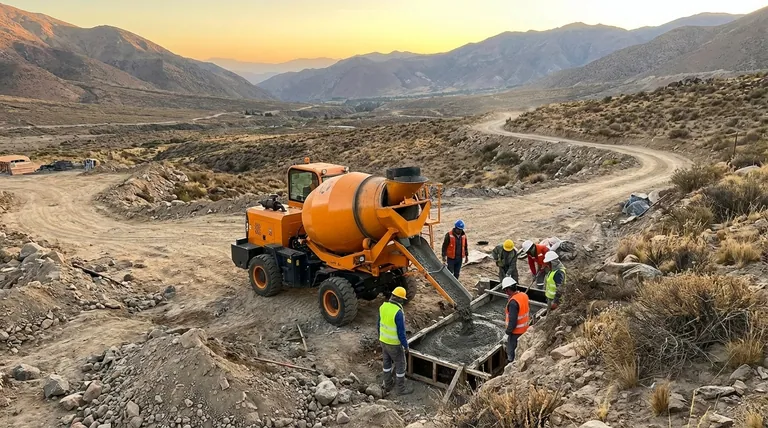
At their core, self-loading mixers are ideal for remote projects because they combine the functions of a wheel loader, a batching plant, and a concrete mixer into a single, highly mobile machine. This all-in-one capability eliminates the logistical dependence on external concrete plants and the challenge of transporting ready-mix concrete over difficult terrain.
The true value of a self-loading mixer in a remote setting is not just its mobility, but its operational independence. It transforms the challenge of getting finished concrete to a site into the much simpler task of getting raw materials there, guaranteeing fresh, high-quality concrete exactly when and where it's needed.
The Problem with Traditional Concrete in Remote Areas
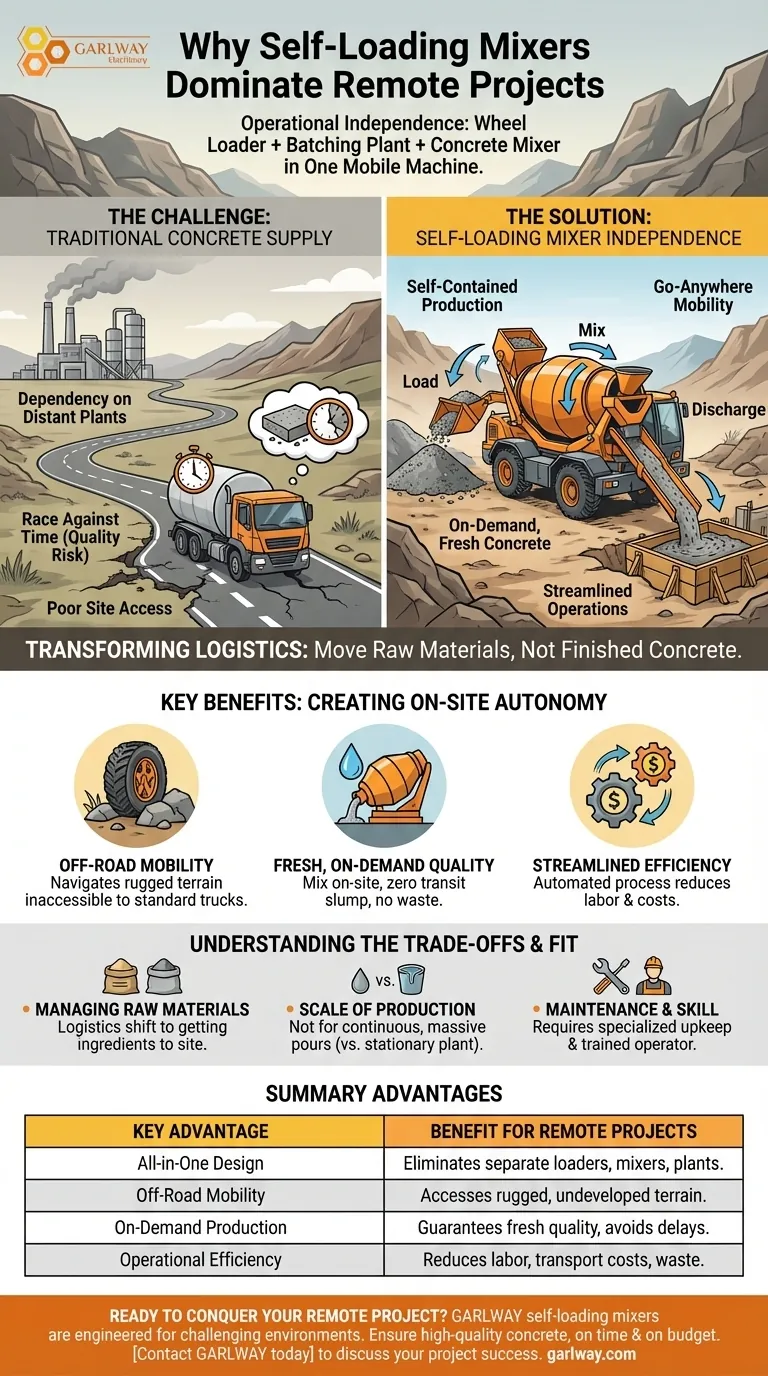
Before understanding the solution, it's crucial to appreciate the problem. Sourcing concrete for remote projects is a significant logistical and financial challenge.
Dependency on Distant Plants
Traditional projects rely on centralized batching plants. The further your project is from a plant, the higher the transportation costs and the greater the risk of traffic or other delays.
The Race Against Time
Ready-mix concrete has a limited working life. A long journey over poor roads to a remote location can cause the concrete to begin setting in the truck, severely compromising its quality and strength upon arrival.
Site Access and Infrastructure
Standard concrete trucks are designed for paved roads. They lack the off-road capability to navigate the rugged, undeveloped terrain common in remote construction, power generation, or infrastructure projects.
How Self-Loading Mixers Create On-Site Independence
A self-loading mixer fundamentally changes the supply chain by bringing the entire concrete production process directly to the job site.
A Self-Contained Production Unit
These machines handle every step: loading aggregates and cement with their own bucket, mixing the materials in the drum, and discharging the finished concrete. This eliminates the need for a separate wheel loader and a stationary batching plant.
Go-Anywhere Mobility
Designed with a sturdy chassis and rugged, off-road tires, self-loading mixers can traverse difficult terrain that would be impassable for a standard mixer truck. They can deliver concrete precisely where it's needed on the site, not just at the entrance.
On-Demand, Fresh Concrete
Since the concrete is mixed on-site, it is always fresh. This guarantees maximum quality and strength, removing the risk of degradation during transit. It also allows crews to produce concrete in the exact quantities needed, minimizing waste.
Streamlined Operations
By integrating loading, mixing, and transport into one automated process, these mixers reduce the need for manual labor and streamline the entire operation. This leads to significant savings in both time and operational costs.
Understanding the Trade-offs
While highly effective, self-loading mixers are a specific tool for a specific job. It's important to understand their limitations.
Managing Raw Materials
The mixer solves the problem of transporting finished concrete, but you still face the logistical challenge of getting the raw materials—cement, sand, aggregate, and water—to the remote site.
Scale of Production
For massive, continuous pours requiring thousands of cubic meters of concrete per day, a dedicated, high-capacity stationary batching plant will still be more efficient, assuming the infrastructure exists to support it.
Maintenance and Skill
These are complex pieces of equipment. In a truly remote location, a mechanical breakdown can cause significant delays if specialized technicians or parts are not readily available. They also require a skilled operator to ensure proper mix ratios and efficient operation.
Making the Right Choice for Your Project
The decision to use a self-loading mixer should be based on your project's specific logistical realities.
- If your primary focus is accessibility: For projects in rugged terrain, with poor road access, or spread across a large, undeveloped area, the self-loading mixer is the definitive solution.
- If your primary focus is cost control on small-to-midsize projects: The ability to produce concrete on-demand without waste or reliance on expensive, long-distance deliveries makes it highly economical.
- If your primary focus is concrete quality: When transit times from the nearest plant are long, a self-loading mixer is the only way to guarantee a fresh, high-quality mix for every pour.
By providing autonomy from the traditional concrete supply chain, the self-loading mixer empowers projects to succeed in the most challenging and isolated environments.
Summary Table:
| Key Advantage | Benefit for Remote Projects |
|---|---|
| All-in-One Design | Eliminates need for separate loaders, mixers, and batching plants. |
| Off-Road Mobility | Navigates rugged terrain inaccessible to standard concrete trucks. |
| On-Demand Production | Guarantees fresh, high-quality concrete, avoiding transit delays. |
| Operational Efficiency | Reduces labor, transportation costs, and material waste. |
Ready to conquer your next remote project?
GARLWAY self-loading mixers are engineered for construction companies and contractors working in challenging environments. We provide the operational independence you need to deliver high-quality concrete, on time and on budget, no matter the location.
Contact GARLWAY today to discuss how our self-loading mixers can empower your remote project success.
Visual Guide
Related Products
- Skid Steer Self Loading Concrete Mixers for Construction
- Belle Mixer Drum Self Loading Mortar Mixers JS3000
- Portable Cement Mixer with Lift Concrete Machine
- Portable Concrete Mixer Machine Equipment for Mixing Concrete
- Portable Ready Mix Concrete Mixer Equipment
People Also Ask
- How does the control system improve production efficiency in a self loading concrete mixer? Automate Mixing for Speed & Quality
- What is the purpose of keeping the drum rotating during transportation in a self loading concrete mixer? Ensure Quality & Consistency
- How does the weighing process work in a self loading concrete mixer? Achieve Precise, On-Site Concrete Batching
- What components are involved in the loading process of a self loading concrete mixer? A Guide to the Key Systems
- How should materials be loaded into a self-loading concrete mixer? Master the Step-by-Step Process