
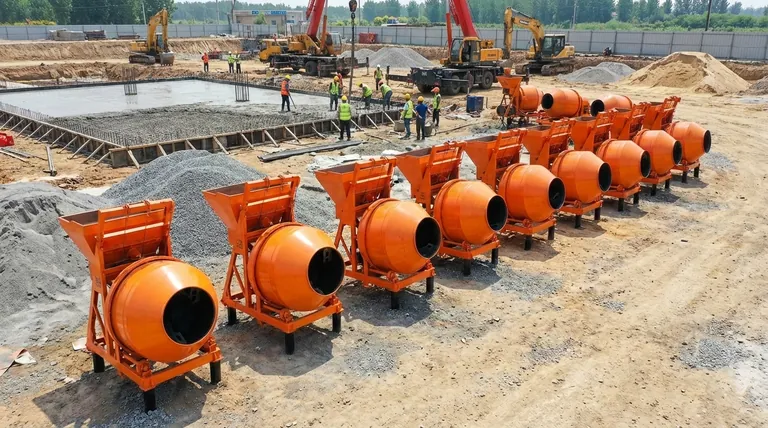
The primary advantages of using drum mixers are their high-volume production capability, operational efficiency, and low maintenance costs. They are designed to mix large quantities of concrete quickly and consistently, reducing the need for manual labor and accelerating project timelines.
A drum mixer's core value lies in its simplicity and scale. It is the workhorse for projects where the priority is producing a large volume of standard concrete efficiently and cost-effectively.
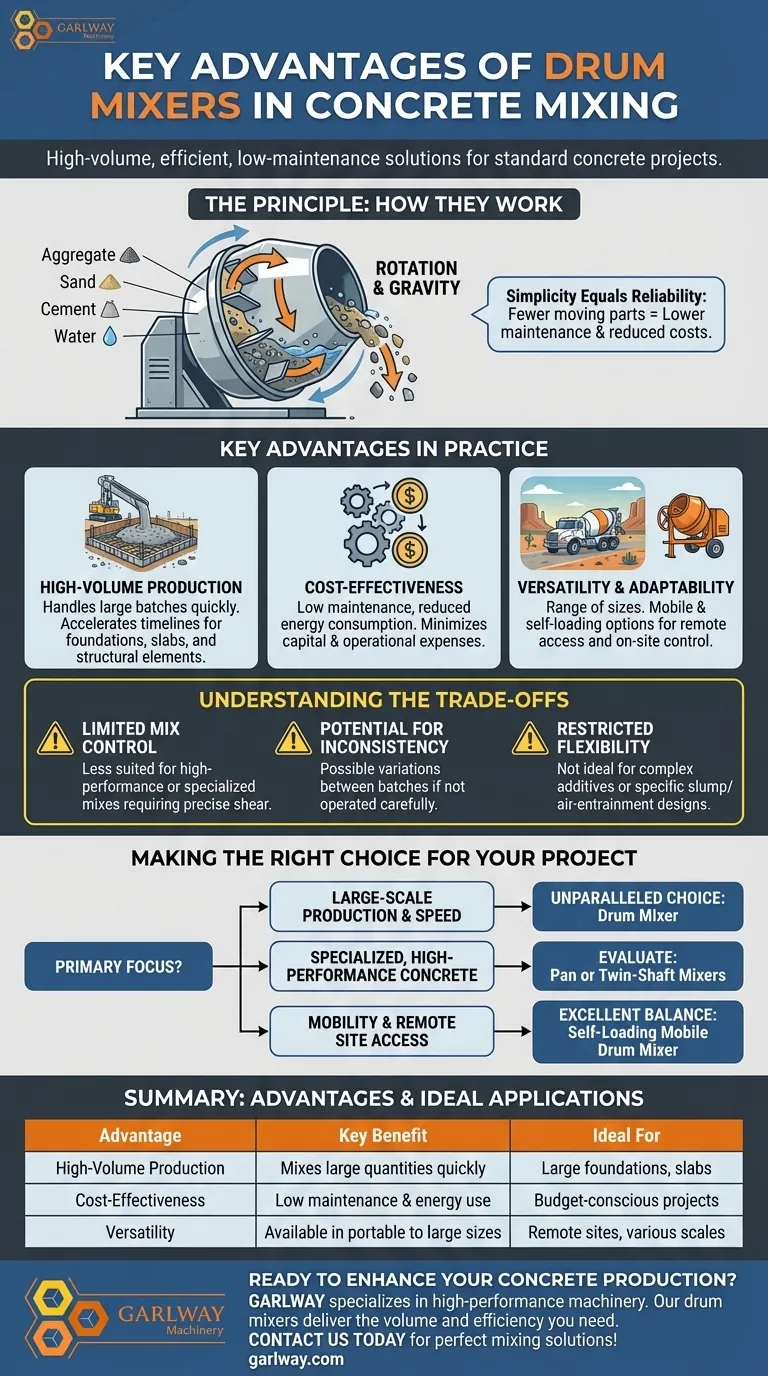
The Principle: How Drum Mixers Work
A drum mixer’s effectiveness comes from its straightforward and robust mechanical design. Understanding this is key to appreciating its role on a job site.
The Role of Rotation and Gravity
The defining feature is a rotating drum, or cone, tilted at an angle. As the drum spins, internal fins or paddles lift the aggregate, sand, cement, and water.
Gravity then causes the materials to fall back down, creating a continuous, folding mixing action that ensures all components are uniformly blended. This simple process requires less energy than more complex mixing systems.
Simplicity Equals Reliability
The mechanical design of a drum mixer is relatively simple. Fewer moving parts translate directly into lower maintenance requirements and reduced operating costs over the mixer's lifespan.
Key Advantages in Practice
In real-world applications, the design of a drum mixer translates into several significant operational benefits.
High-Volume Production
Drum mixers are built for scale. They can handle large quantities of concrete in a single batch, which is essential for large pours in foundations, slabs, and other significant structural elements.
This capability allows for much faster completion of construction work compared to smaller or manual mixing methods.
Cost-Effectiveness
The combination of low maintenance needs, reduced energy consumption, and high output makes the drum mixer a highly cost-effective solution for many projects. It minimizes both capital investment and ongoing operational expenses.
Versatility and Adaptability
Drum mixers come in a wide range of sizes, from small, portable units for minor repairs to large, self-loading trucks.
These mobile, self-loading variants are particularly adaptable, capable of accessing remote or difficult terrains and enabling on-site mix control for jobs of all sizes.
Understanding the Trade-offs
To be a trusted advisor, it's critical to acknowledge that no single tool is perfect for every job. The drum mixer's strengths in volume and simplicity come with clear trade-offs.
Limited Mix Control
The mixing action, while effective for general use, offers limited control over the final quality. It is less suited for high-performance or specialized concrete mixes that require precise shear and homogenization.
Potential for Inconsistency
If not operated carefully, drum mixers can produce slight variations from one batch to the next. This potential for inconsistency can be a significant drawback for projects with stringent quality specifications.
Restricted Flexibility for Custom Designs
The simple mixing action is not ideal for incorporating complex additives or achieving the specific slump and air-entrainment required for many modern, custom concrete designs. Other mixer types, like pan or twin-shaft mixers, offer superior performance in these areas.
Making the Right Choice for Your Project
Selecting the right mixer depends entirely on the demands of your project.
- If your primary focus is large-scale production and speed: The drum mixer is an unparalleled choice for its high output, reliability, and cost-efficiency in standard concrete applications.
- If your primary focus is specialized, high-performance concrete: You should evaluate pan or twin-shaft mixers that provide the precise control necessary for complex mix designs.
- If your primary focus is mobility and remote site access: A self-loading mobile drum mixer offers an excellent balance of production capacity and logistical flexibility.
By understanding its strengths in volume and its limitations in precision, you can deploy the drum mixer as an effective and powerful tool for the right application.
Summary Table:
| Advantage | Key Benefit | Ideal For |
|---|---|---|
| High-Volume Production | Mixes large quantities quickly | Large foundations, slabs |
| Cost-Effectiveness | Low maintenance & energy use | Budget-conscious projects |
| Versatility | Available in portable to large sizes | Remote sites, various project scales |
Ready to enhance your concrete production with a reliable drum mixer?
At GARLWAY, we specialize in high-performance construction machinery, including durable concrete mixers and batching plants designed for contractors and construction companies worldwide. Our drum mixers deliver the volume and efficiency you need to accelerate project timelines and reduce costs.
Contact us today to discuss your project requirements and find the perfect mixing solution!
Visual Guide
Related Products
- Concrete Cement Mixer Machine Drum Mixer for Construction
- Belle Mixer Drum Self Loading Mortar Mixers JS3000
- Portable Concrete Mixer Machine Equipment for Mixing Concrete
- HZS25 Best Cement Mixer for Quick Mix Concrete at Bunnings
- JDC350 Small Cement Concrete Mortar Mixer
People Also Ask
- What are the key components that maintain concrete mix consistency in the drum? Ensure Uniform Quality from Plant to Site
- How do cement mixers enhance safety on construction sites? Reduce Strain, Hazards, and Accidents
- When was the first concrete mixer developed and by whom? Discover the 1900 Breakthrough
- What is the average lifespan of a concrete mixer? Maximize Your Equipment's Lifespan & ROI
- What are the two broad types of concrete mixers? Choose the Right Mixer for Your Project





