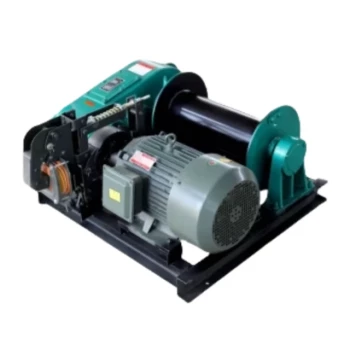
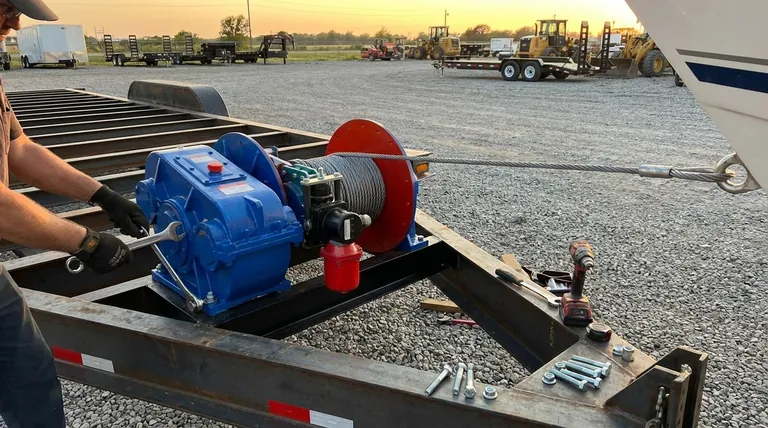
To secure a winch to a trailer, you must first position it so the cable or strap has a perfectly straight line to the object being pulled. You will then mark the mounting location, drill holes slightly larger than your bolts, and fasten the winch firmly to the trailer frame using high-quality bolts, nuts, and washers.
The most critical factor in mounting a trailer winch is not the hardware, but the alignment. Proper positioning—centered, straight, and at the correct height—ensures the winch operates safely and effectively, preventing damage to the cable, winch, and your cargo.
Foundational Principle: Proper Winch Alignment
Before drilling a single hole, understanding the geometry of the pull is essential. Incorrect alignment is the primary cause of operational failure and equipment damage.
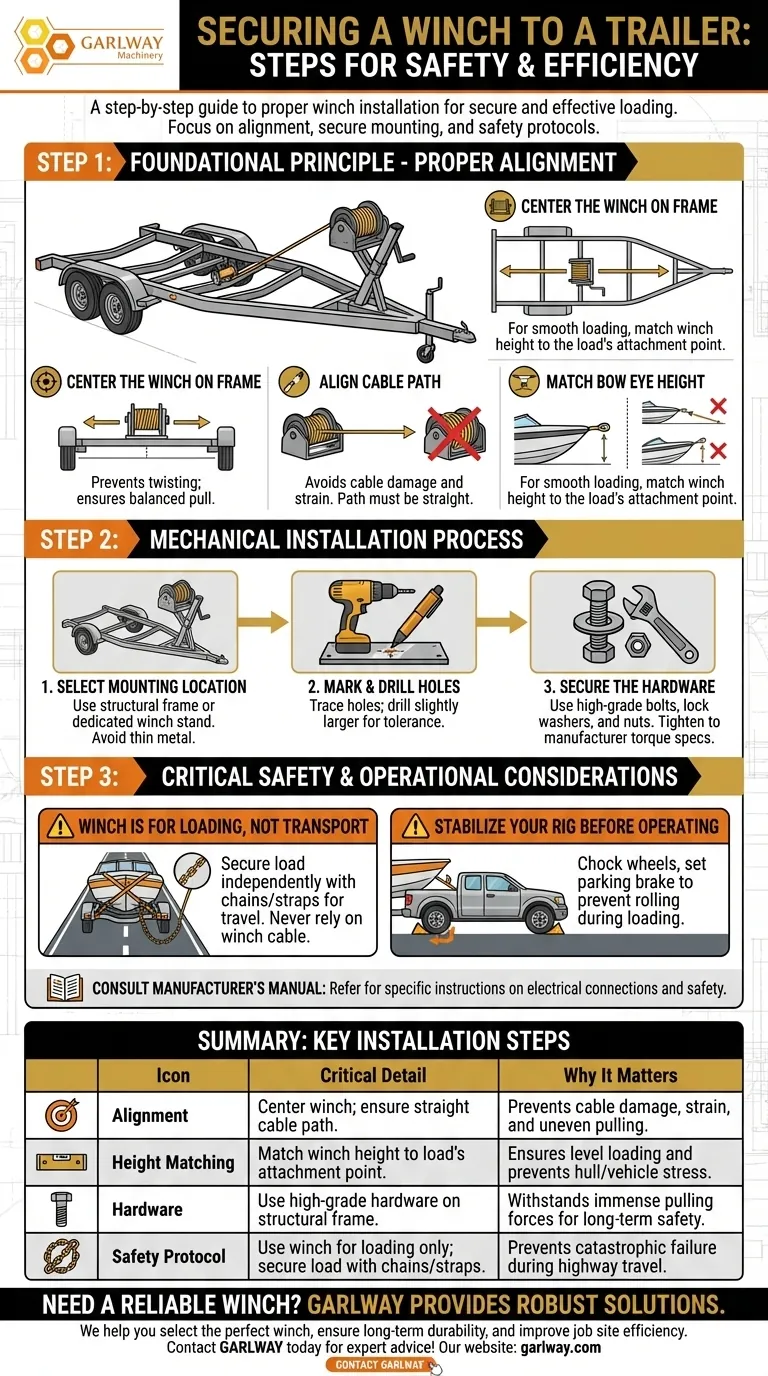
Center the Winch on the Frame
The winch must be mounted directly on the centerline of the trailer. This ensures an even, balanced pull that distributes force correctly through the trailer's frame.
An off-center winch can cause the trailer to twist under load and will make guiding a boat or vehicle onto the trailer significantly more difficult.
Align the Cable Path
The path from the winch drum to the attachment point (like a boat's bow eye or a car's tow hook) must be a straight, unobstructed line.
Any deviation will cause the cable or strap to pile up on one side of the drum. This "bunching" can damage the cable, strain the winch motor, and dramatically reduce its pulling capacity.
Match the Bow Eye Height
When loading a boat, the winch should be mounted at a height that perfectly matches the boat's bow eye when it rests on the forward roller or bunk.
If the winch is too low, it will pull the bow down. If it's too high, it will pull the bow up. Both scenarios create improper loading angles and place unnecessary stress on the winch and the boat's hull.
The Mechanical Installation Process
Once you have determined the optimal position based on alignment principles, the mechanical attachment is straightforward.
Step 1: Select the Mounting Location
The winch must be secured to a structural part of the trailer frame or a dedicated, heavy-duty winch stand. Do not bolt it to a thin piece of sheet metal or a decorative element.
Some trailers require a separate winch mounting plate or bracket to achieve the correct position and provide a solid foundation.
Step 2: Mark and Drill Holes
With the winch held firmly in its final position, use a marker to trace the bolt hole locations onto the trailer frame or mounting plate.
Drill holes that are slightly larger than the diameter of your mounting bolts. This provides a small amount of tolerance, making it easier to insert the hardware.
Step 3: Secure the Hardware
Secure the winch using appropriately graded bolts, lock washers, and nuts. Ensure washers are used on both the bolt-head and nut side to distribute the clamping force and prevent the hardware from pulling through the metal.
Tighten all bolts to the torque specifications recommended by the winch manufacturer.
Critical Safety and Operational Considerations
A properly installed winch enhances safety, but only when used correctly. Misunderstanding its purpose can lead to significant danger.
The Winch is for Loading, Not Transport
The primary function of the winch is to pull the boat or vehicle onto the trailer. It is not designed to secure the load for highway travel.
Once loaded, the winch strap should be slightly slackened. The load must be independently secured using a bow safety chain and heavy-duty transom or axle straps. Relying on the winch cable during transit can lead to catastrophic failure.
Stabilize Your Rig Before Operating
Before winching, ensure the trailer is stable by chocking its wheels. The tow vehicle should be in park (or in gear for manual transmissions) with the parking brake firmly set.
This prevents the trailer from rolling or shifting during the loading process, which could cause the load to become misaligned or fall.
Consult the Manufacturer's Manual
Always refer to the specific instructions provided with your winch. The manual will contain critical details on electrical connections, hardware requirements, and operational safety features unique to your model.
Making the Right Choice for Your Setup
Your specific application will determine which installation detail requires the most attention.
- If your primary focus is loading a boat: Pay closest attention to matching the winch height with the boat's bow eye to ensure a smooth, level entry onto the trailer bunks.
- If your primary focus is loading a vehicle: Prioritize a perfectly straight, centered pull to the vehicle's designated recovery point to prevent cable binding and ensure even spooling.
- If your primary focus is long-term durability: Confirm you are mounting to a thick, structural part of the trailer frame and use high-grade (Grade 8 or better) hardware to resist the immense forces involved.
Ultimately, a successful winch installation is defined by precise alignment and an unwavering commitment to safety protocols.
Summary Table:
| Key Installation Step | Critical Detail | Why It Matters |
|---|---|---|
| Alignment | Center the winch; ensure a straight cable path. | Prevents cable damage, strain, and uneven pulling. |
| Height Matching | Match winch height to the load's attachment point (e.g., bow eye). | Ensures level loading and prevents hull/vehicle stress. |
| Hardware | Use high-grade bolts, nuts, and washers on a structural frame. | Withstands immense pulling forces for long-term safety. |
| Safety Protocol | Use winch for loading only; secure load with chains/straps for transport. | Prevents catastrophic failure during highway travel. |
Need a Reliable Winch for Your Trailer?
Proper installation starts with a high-quality, durable winch. GARLWAY specializes in construction machinery, offering robust winches, concrete mixers, and batching plants designed for the demanding needs of construction companies and contractors globally.
We can help you:
- Select the perfect winch for your specific trailer and load requirements.
- Ensure long-term durability with equipment built to withstand heavy use.
- Improve job site efficiency with reliable machinery that gets the job done right.
Contact GARLWAY today for expert advice and to find the ideal winch solution for your business!
Visual Guide
Related Products
- Portable Small Trailer Winch
- 12000 lb Electric Boat Trailer Winch with Windlass Anchor Warn
- Warn Winch Windlass Boat Trailer Winch
- Best 18000 Pound Drum Anchor Trailer Winch
- Quick Windlass Portable Winch for Truck and Boat Best Boat Winch
People Also Ask
- What features were incorporated into the upgraded portable winch system? Boost Your Recovery Power & Safety
- What are some uses mentioned for portable winches beyond vehicle recovery? Essential Versatility for Property & Work
- How could the twisting issue with a portable winch be mitigated? Achieve Safe, Centered Pulls with Proper Rigging
- What is the significance of trailer winches in the boating industry? Ensure Safe and Efficient Boat Recovery
- What should be considered when mounting a winch on a trailer? Ensure a Safe, Aligned Installation