Yes, absolutely. An anchor and its related equipment require regular maintenance. This is not merely a best practice but a critical safety procedure, as the entire anchoring system—known as ground tackle—is only as strong as its weakest component.
Your anchor is likely the strongest part of your ground tackle. True maintenance, therefore, involves a systematic inspection of the entire system—from the shackle to the windlass—because failure almost always occurs at a connection point, not the anchor itself.
Beyond the Anchor: Inspecting the Entire System
Thinking you are safe because your anchor looks robust is a common and dangerous mistake. A pristine anchor is useless if the shackle connecting it fails. A thorough inspection must cover every component.
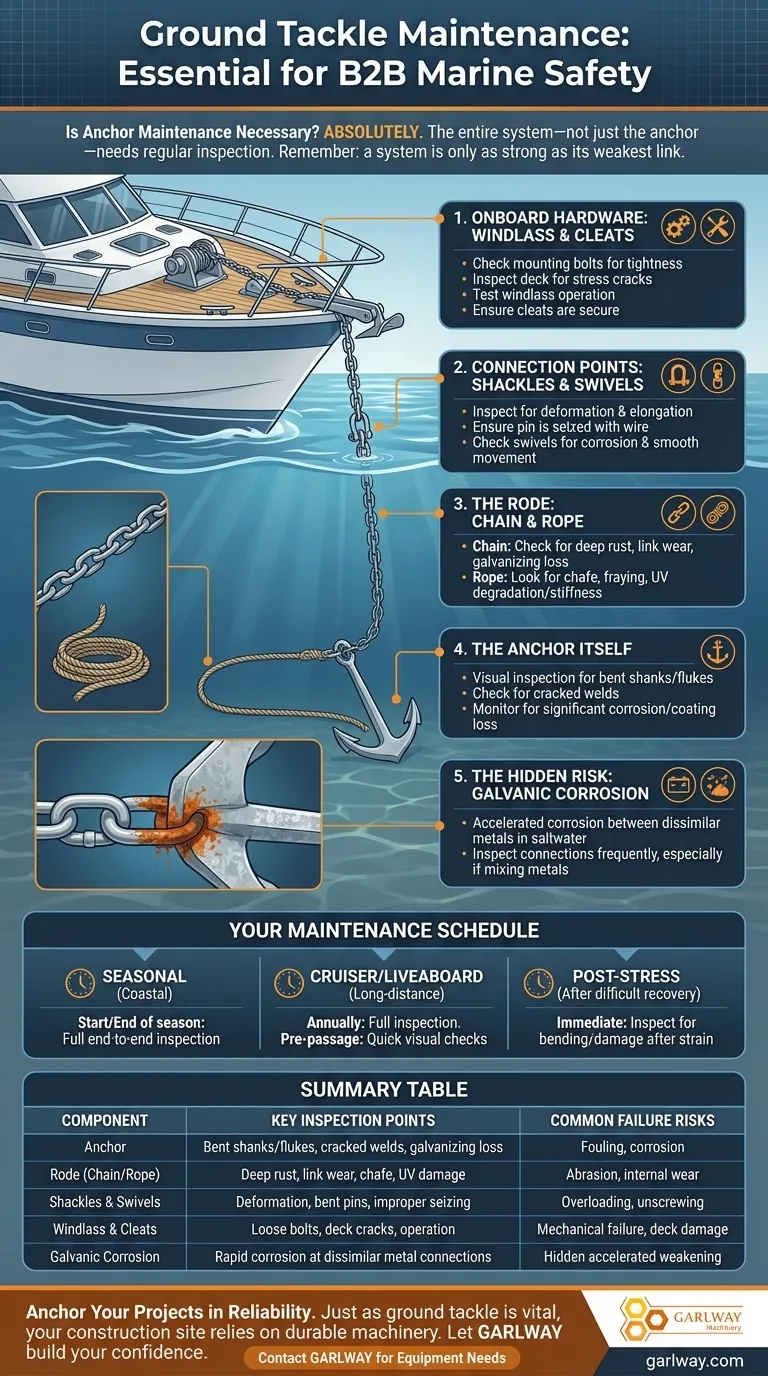
The Anchor Itself
While anchors are incredibly durable, they are not immune to damage. A visual inspection is your first line of defense.
Look for bent shanks or flukes, which can happen after being fouled on a rock. Also, check for cracks in the welds and significant corrosion or loss of the protective galvanizing coating.
The Rode: Chain and Rope
The line connecting you to the anchor, or rode, is a frequent point of wear.
For an all-chain rode, inspect links for deep rust or wear, especially where they rub together. Ensure links move freely and that the galvanizing is mostly intact.
For a rope rode (or the rope portion of a chain/rope combination), look for signs of chafe, which appears as fraying or abrasion. Feel the line for stiffness or discoloration, which can indicate UV degradation or internal wear.
The Connection Points: Shackles and Swivels
These small components bear immense loads and are critical failure points.
Every shackle should be inspected for deformation, especially elongation, which indicates it has been overloaded. Ensure the pin is not bent and is properly seized with stainless wire so it cannot unscrew under load.
Swivels, if used, add a point of mechanical complexity. They must be disassembled and inspected for corrosion and smooth operation, as a frozen swivel can induce dangerous twisting forces on your chain.
Onboard Hardware: Windlass and Cleats
The system's integrity extends to the boat itself.
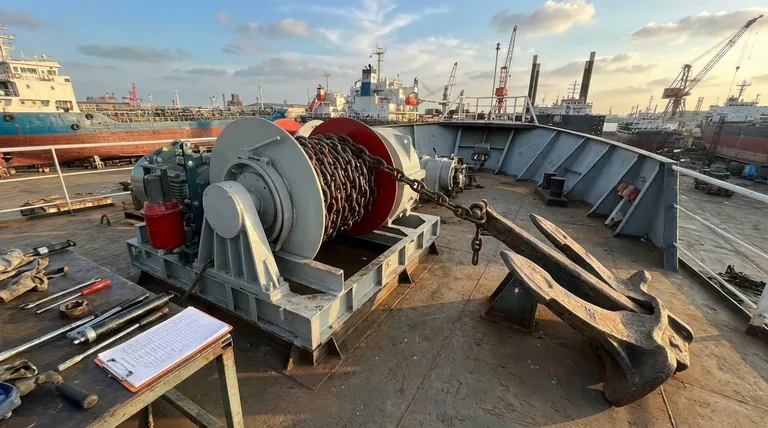
Check the mounting bolts of your anchor windlass or bow roller to ensure they are tight and the deck shows no signs of stress cracks. Test the windlass operation to confirm it runs smoothly.
Inspect your deck cleats for any signs of movement, corrosion, or loose fasteners. The cleat you tie off to must be as secure as the anchor itself.
The Critical Failure Point: Galvanic Corrosion
A hidden risk in any anchoring system is galvanic corrosion. This occurs when two different metals (like a stainless steel shackle and a galvanized anchor) are in contact in saltwater.
The less noble metal—in this case, the galvanizing on the anchor—will corrode at an accelerated rate, sacrificing itself to protect the stainless steel.
While using all galvanized components is ideal, if you must mix metals, inspect the connection points frequently for rapid corrosion. This is often the true "weakest link" that goes unnoticed.
Your Maintenance Schedule: From Annual Review to Pre-Departure Glance
Your approach to maintenance should match your boating style. A consistent schedule is the key to preventing unexpected failure.
- If you are a coastal or seasonal boater: Perform a complete, end-to-end inspection of the entire ground tackle system at the beginning or end of each season.
- If you are a long-distance cruiser or liveaboard: Conduct a full system inspection annually, with additional quick visual checks of the anchor, shackle, and first 20 feet of rode before any major passage.
- If you have just recovered from a difficult anchoring: Always inspect the anchor and shackle for bending or damage after it has been heavily strained or fouled on an obstruction.
Proactive inspection turns potential emergencies into routine maintenance tasks.
Summary Table:
| Component | Key Inspection Points | Common Failure Risks |
|---|---|---|
| Anchor | Bent shanks/flukes, cracked welds, loss of galvanizing | Fouling on rocks, corrosion |
| Rode (Chain/Rope) | Deep rust, link wear (chain); chafe, UV damage (rope) | Abrasion, hidden internal wear |
| Shackles & Swivels | Deformation, bent pins, improper seizing, corrosion | Overloading, unscrewing under load |
| Windlass & Cleats | Loose mounting bolts, deck stress cracks, operation | Mechanical failure, deck damage |
| Galvanic Corrosion | Rapid corrosion at dissimilar metal connections | Hidden, accelerated weakening |
Ensure your construction projects are anchored in safety and reliability.
Just as a boater depends on their ground tackle, your construction site relies on durable, well-maintained machinery. GARLWAY specializes in robust construction equipment, including winches, concrete mixers, and batching plants, designed for the demanding needs of construction companies and contractors.
Let us help you build with confidence. Contact GARLWAY today to discuss your equipment needs and discover how our solutions can enhance the safety and efficiency of your operations.
Visual Guide
Related Products
- Heavy Duty Electric Boat Winch Windlass Anchor
- Electric Hoist Winch Boat Anchor Windlass for Marine Applications
- Best 18000 Pound Drum Anchor Trailer Winch
- 12000 lb Electric Boat Trailer Winch with Windlass Anchor Warn
- Hydraulic Winding Engine Harbor Freight Winch
People Also Ask
- How do electric boat winches work? Unlock Effortless Launching & Retrieval
- How much current does an electric boat winch draw? Plan Your Electrical System for Peak Performance
- Can an electric winch be used as a hoist? Understand the Critical Safety Differences
- What is the major advantage of an electric-powered winch? Unmatched Self-Recovery When Your Engine Fails
- What makes electric winches suitable for off-road use? Key Features for Reliable Vehicle Recovery