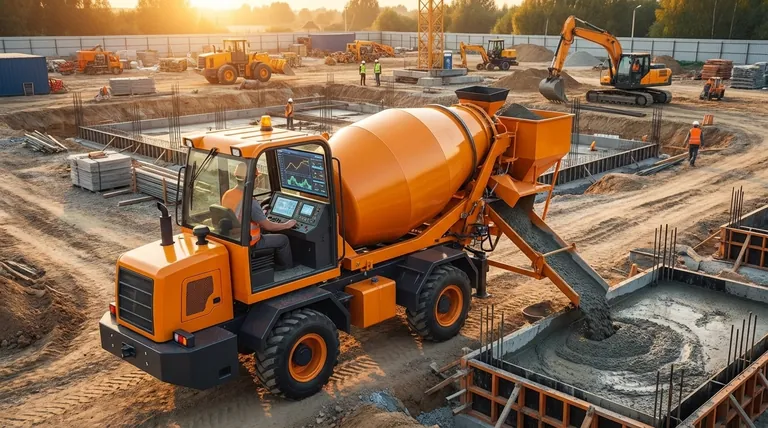
At its core, the control system is the brain of the self-loading concrete mixer. It acts as the central command unit that integrates every mechanical function, from loading raw materials to discharging the final product. This system allows an operator to monitor and manage the entire production process in real-time from the cabin.
The true role of the control system is to elevate the self-loading mixer from a simple piece of machinery into a precision instrument. It is the key to achieving consistent quality, maximizing operational efficiency, and reducing reliance on manual guesswork.
Orchestrating the Production Cycle
A self-loading mixer's value comes from its ability to manage the entire concrete production process on-site. The control system is what makes this integration seamless and effective.
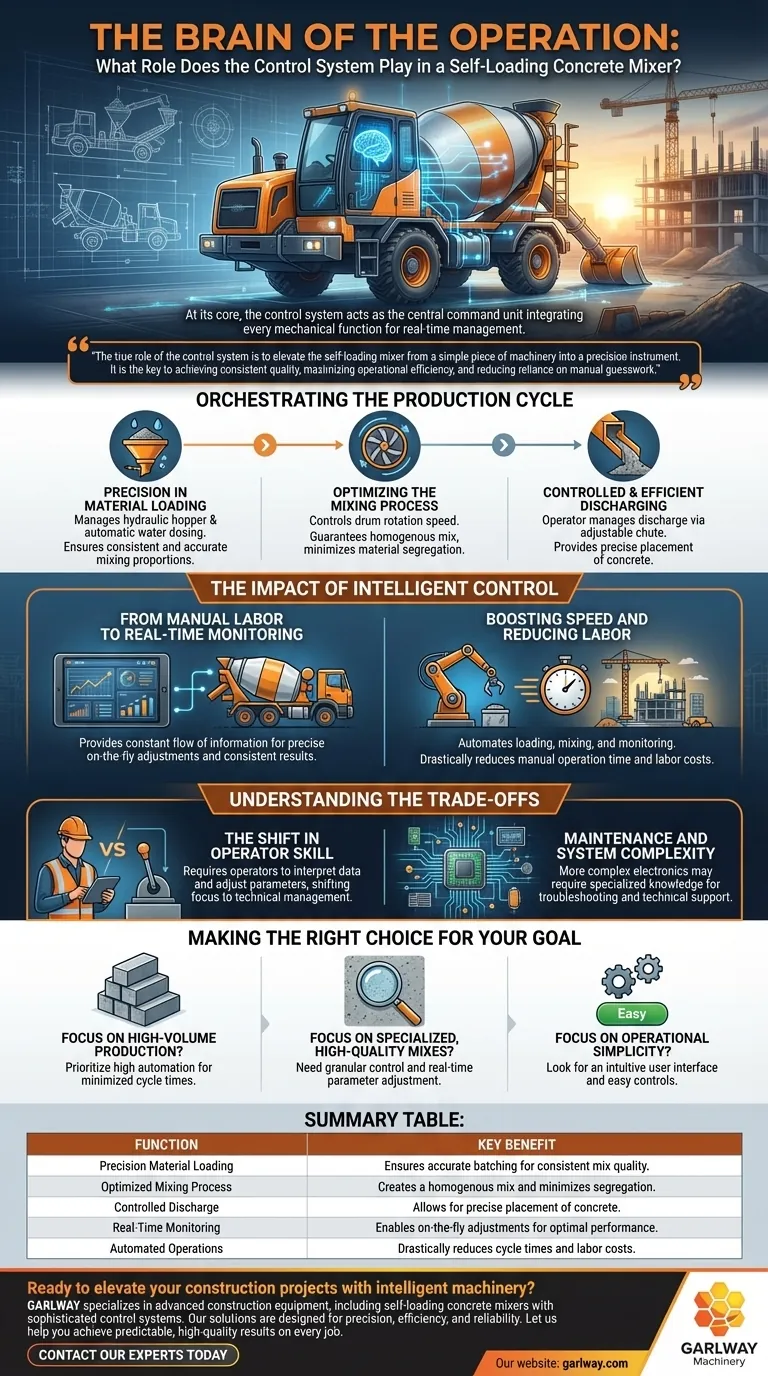
Precision in Material Loading
The process begins with accuracy. The control system manages the hydraulic hopper for loading aggregates and the automatic water dosing system.
This ensures consistent and accurate mixing proportions for every batch, which is fundamental to producing high-quality concrete.
Optimizing the Mixing Process
Once loaded, the system controls the rotation of the mixing drum. It maintains a specific speed to ensure the ingredients are blended thoroughly.
This controlled agitation, managed by the system, is crucial for creating a homogenous mix and minimizing material segregation.
Controlled and Efficient Discharging
When the concrete is ready, the control system allows the operator to manage the discharge through an adjustable chute.
This provides precision in placing the concrete, ensuring it goes exactly where it's needed while the drum continues to mix if necessary.
The Impact of Intelligent Control
An advanced control system moves beyond simple on/off functions. It provides the intelligence that translates mechanical action into predictable, high-quality results.
From Manual Labor to Real-Time Monitoring
The system provides a constant flow of information to the operator. This allows for precise adjustments to be made on the fly in response to changing conditions.
This capability is essential for maintaining consistency and addressing potential issues before they impact the final product.
Boosting Speed and Reducing Labor
Automation is a primary benefit. By managing loading, mixing, and monitoring, the control system drastically reduces manual operation time.
This directly translates to faster production cycles and lower labor costs, speeding up the entire construction project.
Understanding the Trade-offs
While a sophisticated control system offers immense benefits, it's important to understand its implications.
The Shift in Operator Skill
An advanced system requires an operator who understands how to interpret data and adjust parameters, not just how to operate basic mechanical levers.
The focus shifts from physical labor to technical management of the production process.
Maintenance and System Complexity
More intelligent systems can have more complex electronics and sensors. While reliable, troubleshooting may require specialized knowledge compared to purely mechanical systems.
Proper training and access to technical support become more important factors in maintaining uptime.
Making the Right Choice for Your Goal
The ideal control system depends entirely on your project's specific demands.
- If your primary focus is high-volume production: Prioritize a system with a high degree of automation to minimize cycle times and maximize output.
- If your primary focus is producing specialized, high-quality mixes: You need a system that offers granular control and real-time adjustment of all critical parameters.
- If your primary focus is operational simplicity and rapid deployment: Look for a system with an intuitive user interface and straightforward, easy-to-learn controls.
Ultimately, the control system is what empowers the operator to deliver the right mix, at the right time, with predictable and repeatable results.
Summary Table:
| Function | Key Benefit |
|---|---|
| Precision Material Loading | Ensures accurate batching for consistent mix quality. |
| Optimized Mixing Process | Creates a homogenous mix and minimizes segregation. |
| Controlled Discharge | Allows for precise placement of concrete. |
| Real-Time Monitoring | Enables on-the-fly adjustments for optimal performance. |
| Automated Operations | Drastically reduces cycle times and labor costs. |
Ready to elevate your construction projects with intelligent machinery? GARLWAY specializes in advanced construction equipment, including self-loading concrete mixers with sophisticated control systems. Our solutions are designed for construction companies and contractors who demand precision, efficiency, and reliability. Let us help you achieve predictable, high-quality results on every job. Contact our experts today to find the perfect mixer for your needs!
Visual Guide
Related Products
- Skid Steer Self Loading Concrete Mixers for Construction
- Belle Mixer Drum Self Loading Mortar Mixers JS3000
- Portable Cement Mixer with Lift Concrete Machine
- Portable Concrete Mixer Machine Equipment for Mixing Concrete
- Portable Ready Mix Concrete Mixer Equipment
People Also Ask
- How does the control system improve production efficiency in a self loading concrete mixer? Automate Mixing for Speed & Quality
- What is the purpose of keeping the drum rotating during transportation in a self loading concrete mixer? Ensure Quality & Consistency
- How does the weighing process work in a self loading concrete mixer? Achieve Precise, On-Site Concrete Batching
- What components are involved in the loading process of a self loading concrete mixer? A Guide to the Key Systems
- How should materials be loaded into a self-loading concrete mixer? Master the Step-by-Step Process