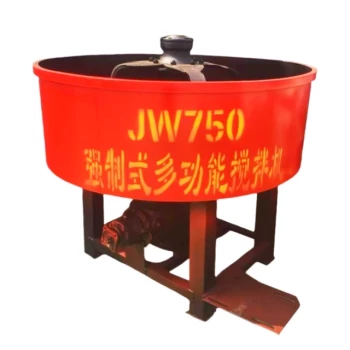
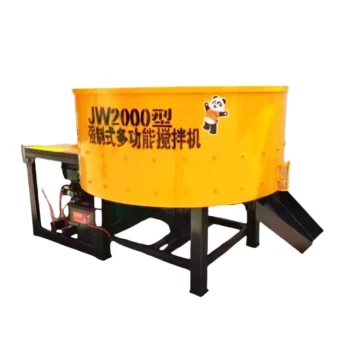
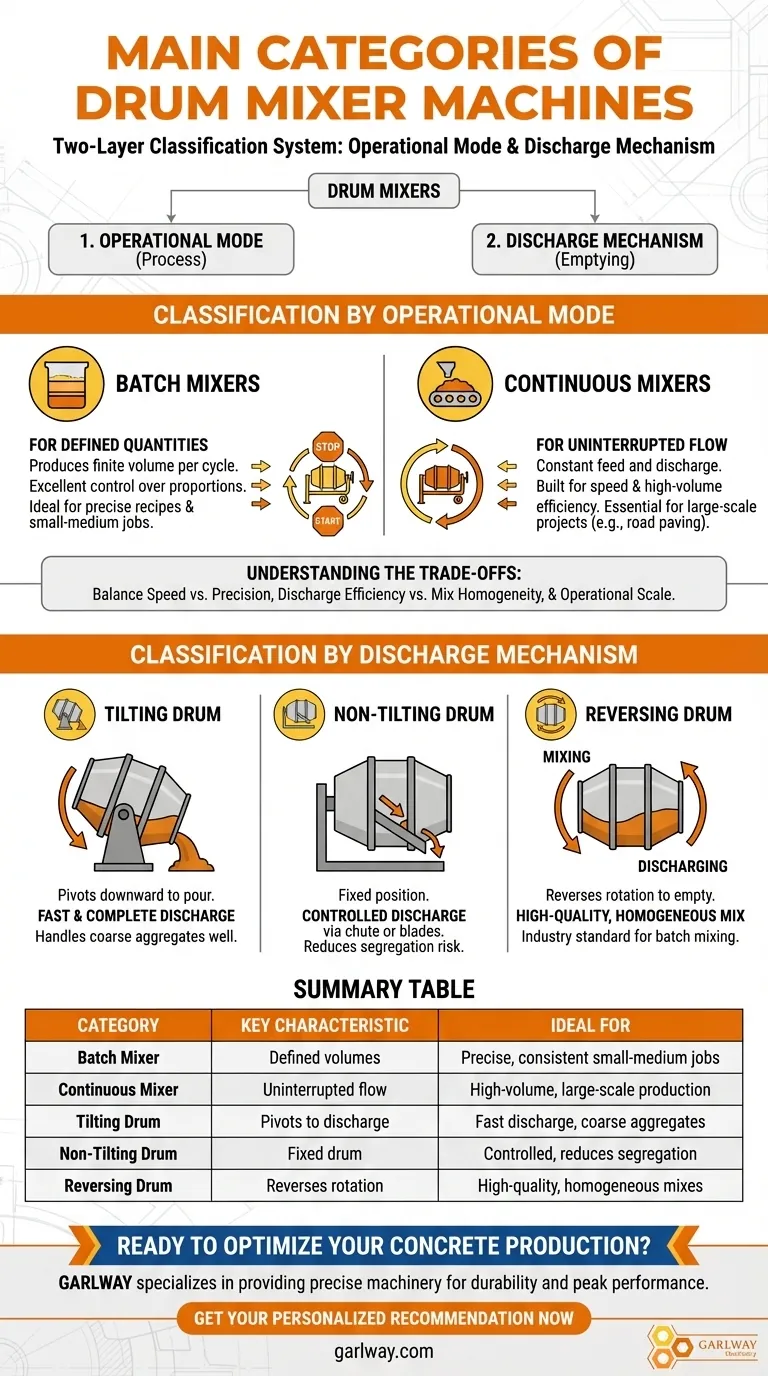
The main categories of drum mixers are defined by two key characteristics: their operational mode (how they process material) and their discharge mechanism (how they empty the mix). This means they are classified as either batch or continuous mixers, and further sub-categorized as tilting, non-tilting, or reversing drum mixers.
The most effective way to understand drum mixers is not to see these categories as mutually exclusive, but as two distinct layers of classification. First, you determine if you need to mix in batches or a continuous flow, and second, you select a discharge design that fits your material and workflow.
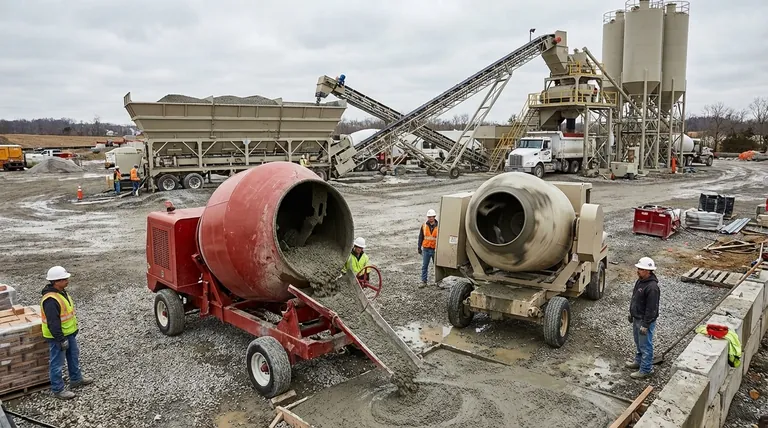
Classification by Operational Mode
The most fundamental distinction between drum mixers is their production method. This choice directly impacts project scale, speed, and consistency.
Batch Mixers: For Defined Quantities
Batch mixers produce a specific, finite volume of material at a time. All ingredients are loaded into the drum, mixed for a set period, and then the entire batch is discharged before the next cycle begins.
This method offers excellent control over mix proportions and is ideal for projects requiring precise, consistent recipes. It is the most common type for small to medium-sized construction jobs.
Continuous Mixers: For Uninterrupted Flow
Continuous mixers are designed for high-volume production. Raw materials are continuously fed into one end of the mixer and a finished mix is constantly discharged from the other.
These machines are built for speed and efficiency, making them essential for large-scale operations like road paving, pre-cast concrete factories, and major infrastructure projects where an uninterrupted supply of material is critical.
Classification by Discharge Mechanism
The second layer of classification is based on the physical design of the drum and how it empties the mixed material.
Tilting Drum Mixers
As the name implies, the entire drum pivots or tilts downward to pour out the concrete. This design allows for a very fast and complete discharge.
Tilting mixers are effective at handling mixes with large, coarse aggregates and are generally simple to operate and maintain.
Non-Tilting Drum Mixers
In a non-tilting mixer, the drum remains in a fixed position. To discharge the material, either a chute is introduced into the drum or the internal blades are designed to push the mix out when the drum's rotation is reversed.
This design can reduce the risk of material segregation during discharge, but the process is typically slower than that of a tilting mixer.
Reversing Drum Mixers
A reversing drum mixer is a specific and highly common type of non-tilting mixer. The drum rotates in one direction for mixing and in the opposite direction for discharging.
The internal blade configuration is engineered to draw materials inward during mixing and efficiently push them outward during the reverse rotation. This provides a clean, controlled discharge and produces a high-quality, homogeneous mix.
Understanding the Trade-offs
Choosing the right drum mixer involves balancing competing priorities. There is no single "best" type; there is only the best fit for a specific application.
Speed vs. Precision
Continuous mixers offer unmatched production speed, but batch mixers provide superior control over the consistency and quality of each individual load.
Discharge Efficiency vs. Mix Homogeneity
Tilting mixers discharge material very quickly, which is ideal for rapid cycle times. However, non-tilting and reversing mixers often provide a more controlled discharge that helps prevent segregation of aggregates and cement paste.
Operational Scale
The choice between batch and continuous is almost entirely driven by the project's scale. Using a batch mixer for a highway project would be impossibly slow, while using a continuous mixer for a small foundation pour would be inefficient and wasteful.
Making the Right Choice for Your Project
Your decision should be guided by the primary demands of your work.
- If your primary focus is large-scale, high-volume production: A continuous mixer is the necessary choice for its uninterrupted output.
- If your primary focus is mix precision and project versatility: A batch mixer provides the control needed for a wide range of jobs, from small repairs to mid-sized construction.
- If your primary focus is a balance of quality and efficient discharge: A reversing drum batch mixer is often the industry standard, offering excellent mix homogeneity and controlled emptying.
- If your primary focus is rapid cycle times with coarse materials: A tilting drum batch mixer excels at quickly discharging stiff or large-aggregate mixes.
Understanding these fundamental categories allows you to select not just a machine, but the right process for your specific application.
Summary Table:
| Category | Key Characteristic | Ideal For |
|---|---|---|
| Batch Mixer | Mixes specific, finite volumes | Projects requiring precise mix proportions and consistency (small to medium jobs) |
| Continuous Mixer | Uninterrupted material flow | High-volume production (major infrastructure, road paving) |
| Tilting Drum | Drum pivots to discharge | Fast discharge, handling coarse aggregates |
| Non-Tilting Drum | Fixed drum; chute or blades discharge | Controlled discharge to reduce material segregation |
| Reversing Drum | Drum reverses rotation to discharge | High-quality, homogeneous mixes; industry standard for batch mixing |
Ready to Optimize Your Concrete Production?
Choosing the right drum mixer is critical to your project's efficiency, cost, and final quality. The wrong machine can lead to delays, inconsistent mixes, and wasted resources.
GARLWAY specializes in providing construction companies and contractors with the precise machinery they need to succeed. We offer a range of robust and reliable equipment, including concrete mixers and batching plants, designed for durability and peak performance on any job site.
Let our experts help you select the perfect drum mixer for your specific application and scale. Contact us today for a personalized consultation and discover how GARLWAY can be your trusted partner in construction machinery.
Get Your Personalized Recommendation Now
Visual Guide
Related Products
- Concrete Cement Mixer Machine Drum Mixer for Construction
- Belle Mixer Drum Self Loading Mortar Mixers JS3000
- Portable Concrete Mixer Machine Equipment for Mixing Concrete
- JZC400 Mobile Small Concrete Mixer Cement Mixer Machine
- Portable Ready Mix Concrete Mixer Equipment
People Also Ask
- What are the key advantages of using drum mixers in concrete mixing? Boost Volume & Efficiency on Your Site
- What are the key components that maintain concrete mix consistency in the drum? Ensure Uniform Quality from Plant to Site
- How do cement mixers enhance safety on construction sites? Reduce Strain, Hazards, and Accidents
- When was the first concrete mixer developed and by whom? Discover the 1900 Breakthrough
- What is the average lifespan of a concrete mixer? Maximize Your Equipment's Lifespan & ROI