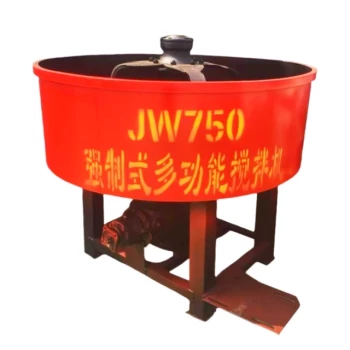
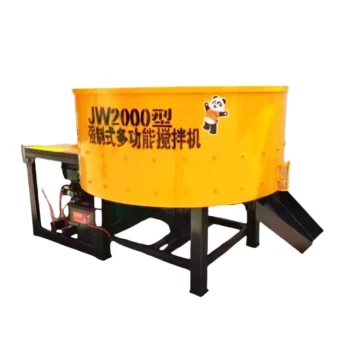
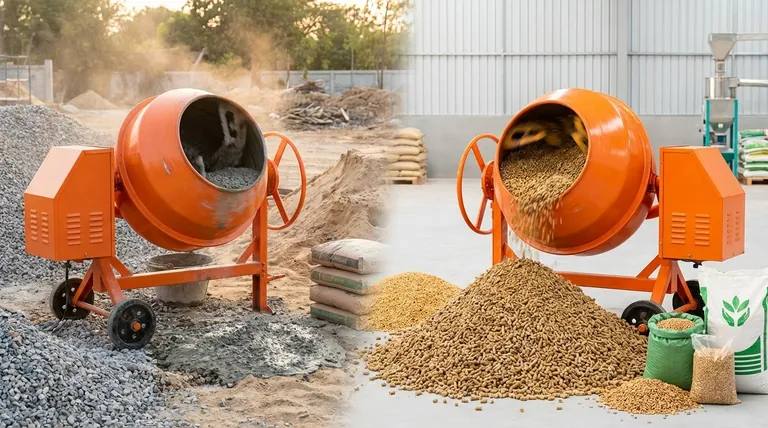
Beyond concrete, the applications for drum mixers are remarkably diverse, spanning agriculture, food production, landscaping, and chemical processing. They are the go-to solution for blending a wide range of free-flowing solid materials, from animal feed and fertilizers to coffee beans and snack mixes.
The core function of a drum mixer is gentle, large-volume blending. Its tumbling action makes it ideal for combining materials that do not require high-intensity shearing, making it a versatile workhorse across numerous industries far beyond the construction site.
The Core Principle: Gentle Tumble Mixing
A drum mixer’s effectiveness comes from its simple and reliable design. Understanding this mechanism is key to knowing where it excels.
How a Drum Mixer Works
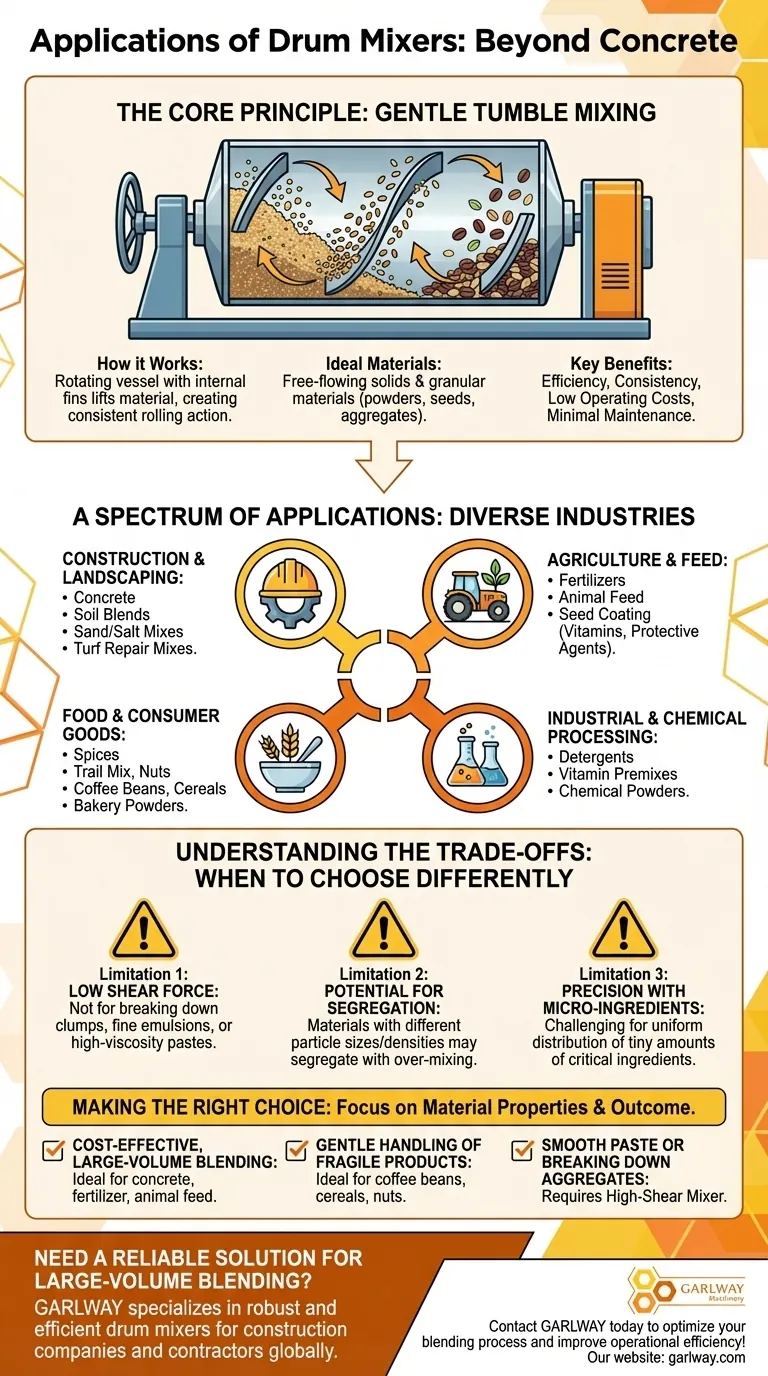
A drum mixer consists of a rotating vessel, often equipped with internal fins or baffles. As the drum turns, these baffles lift the material up the side before it gently tumbles back down, creating a consistent, rolling mixing action.
Ideal Material Properties
This tumbling motion is perfectly suited for free-flowing solids and granular materials. This includes powders, seeds, aggregates, and other components that can easily flow and cascade over one another inside the drum.
Key Benefits of This Design
The primary advantages are efficiency and consistency for the right kind of materials. The design also leads to low operating costs and minimal maintenance due to the simple mechanics involved.
A Spectrum of Applications: From Construction to Food Production
While most commonly associated with one industry, the drum mixer's utility is incredibly broad. Its applications can be grouped into several key sectors.
Construction and Landscaping
This is the most recognized application. Drum mixers are essential for combining cement, sand, gravel, and water to create concrete. They are also used for blending soil, mixing winter sand with salt, and preparing turf repair mixes.
Agriculture and Feed
In the agricultural sector, drum mixers are used for blending fertilizers, grass seed mixes, and animal feeds. Their gentle action is also perfect for coating seeds with vitamins or protective agents without causing damage.
Food and Consumer Goods
The food industry relies on drum mixers for their ability to gently handle fragile products. Common uses include blending spices, trail mix, nuts, coffee beans, and cereals. They are also used for combining dry ingredients like bakery powders.
Industrial and Chemical Processing
Drum mixers are employed for producing detergents, vitamin and mineral premixes, and various chemical powders. Their ability to handle large volumes makes them suitable for many stages of industrial production.
Understanding the Trade-offs: When to Choose a Different Mixer
No tool is perfect for every job. The drum mixer's strengths in gentle blending also define its limitations. Being aware of these trade-offs is crucial for making an informed decision.
Limitation 1: Low Shear Force
The tumbling action is a low-shear process. This means a drum mixer is not suitable for tasks that require breaking down clumps, creating fine emulsions, or blending high-viscosity pastes. It blends, but it doesn't forcefully homogenize materials.
Limitation 2: Potential for Segregation
If the materials being mixed have vastly different particle sizes, shapes, or densities, the gentle tumbling can sometimes lead to segregation. Over-mixing can cause heavier or smaller particles to settle at the bottom of the pile.
Limitation 3: Precision with Micro-Ingredients
While excellent for bulk blending, achieving perfect, uniform distribution of a tiny amount of a critical micro-ingredient can be challenging. For applications requiring extremely high levels of precision, other mixer types may be more appropriate.
Making the Right Choice for Your Goal
Selecting the correct mixer depends entirely on the material properties and your desired outcome.
- If your primary focus is cost-effective, large-volume blending of bulk solids: A drum mixer is an excellent choice for tasks like mixing concrete, fertilizer, or animal feed.
- If your primary focus is gentle handling of fragile products: The tumbling action is ideal for mixing delicate items like whole-bean coffee, cereals, or nuts without causing breakage.
- If your primary focus is creating a smooth paste or breaking down aggregates: You should investigate a high-shear mixer, as a drum mixer lacks the intensity required for these applications.
Understanding its core principle of gentle tumbling empowers you to leverage the drum mixer for its strengths in efficient, large-scale blending.
Summary Table:
| Industry | Common Applications | Key Material Types |
|---|---|---|
| Construction & Landscaping | Concrete, soil blends, sand/salt mixes | Aggregates, powders, granular materials |
| Agriculture & Feed | Fertilizers, animal feed, seed coating | Grass seeds, powders, granules |
| Food & Consumer Goods | Spices, trail mix, coffee beans, cereals | Fragile solids, nuts, beans, powders |
| Industrial & Chemical | Detergents, vitamin premixes, chemical powders | Free-flowing powders, granular chemicals |
Need a reliable solution for large-volume blending?
GARLWAY specializes in construction machinery, offering robust and efficient drum mixers for construction companies and contractors globally. Our equipment is designed to handle everything from concrete to agricultural feed with gentle, consistent tumbling action.
Contact GARLWAY today to discuss how our drum mixers can optimize your blending process and improve your operational efficiency!
Visual Guide
Related Products
- Belle Mixer Drum Self Loading Mortar Mixers JS3000
- Concrete Cement Mixer Machine Drum Mixer for Construction
- JDY350 Electric Hydraulic Mortar Mud Concrete Mixer
- Construction Products Concrete Plant Machine Mixing Concrete Mixer
- Harbor Freight JS1500 On Site Concrete Mixing Volumetric Cement Mixer
People Also Ask
- What are the features of mobile transporting in a self loading mixer? Boost On-Site Efficiency
- Why is timely cleaning important for a self loading mixer? Prevent Costly Downtime and Mix Failure
- How is discharging accomplished in a self loading mixer? Master Precise Concrete Placement
- What is the purpose of keeping the drum rotating during transportation in a self loading concrete mixer? Ensure Quality & Consistency
- What components are involved in the loading process of a self loading concrete mixer? A Guide to the Key Systems