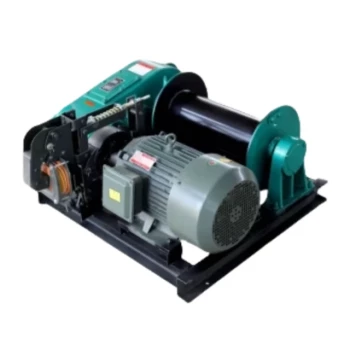
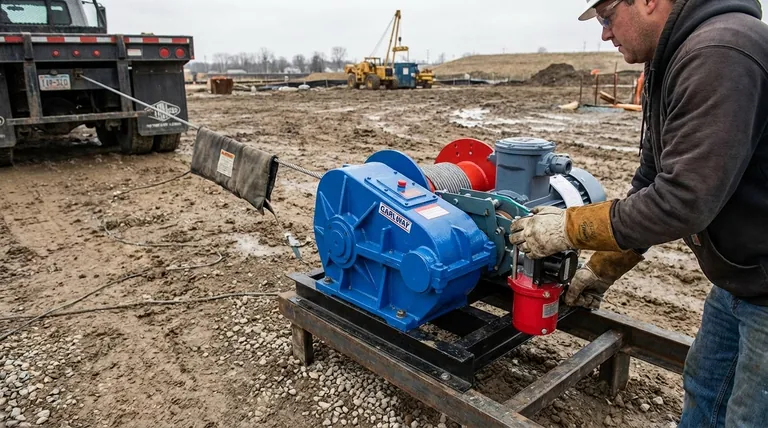
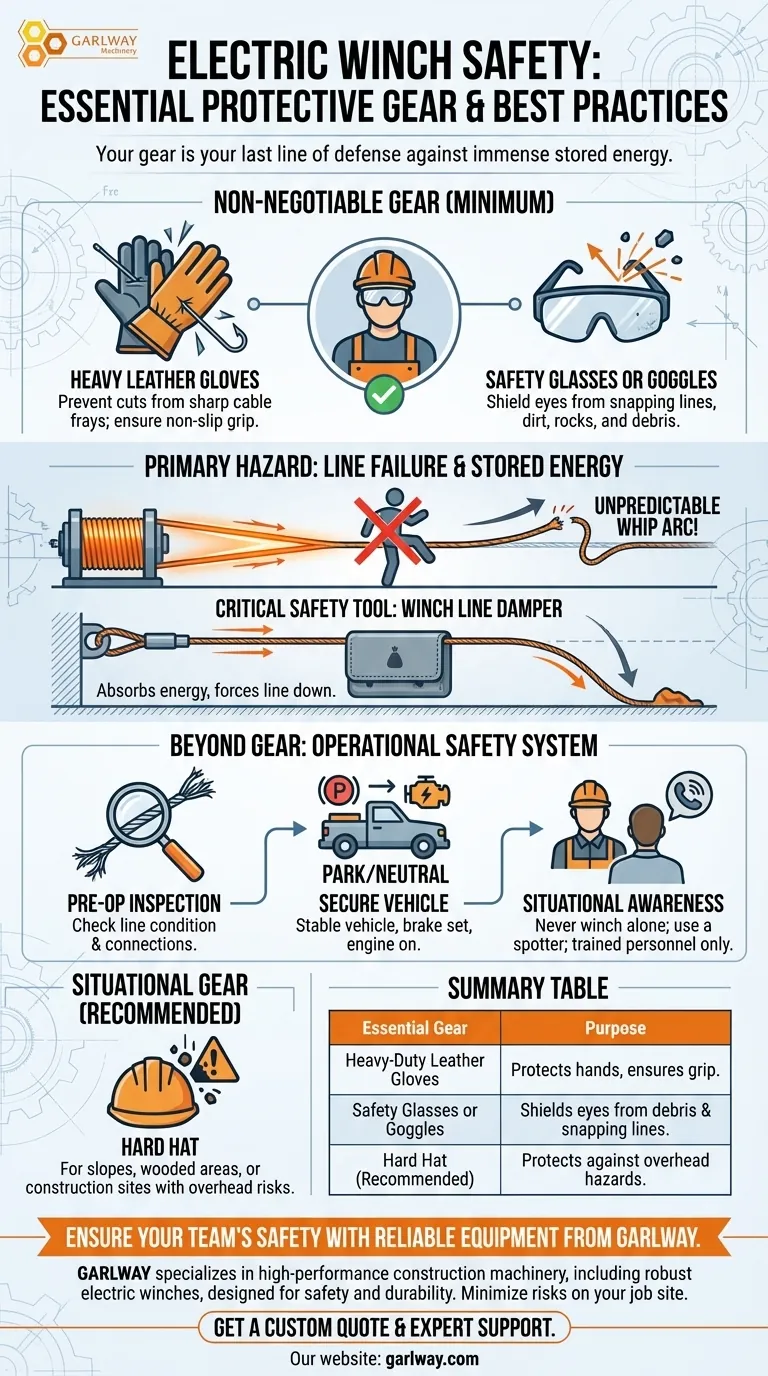
At a minimum, you must wear heavy-duty leather gloves and protective eyewear when operating an electric winch. These two pieces of gear protect you from the most common and severe risks associated with winching: hand injuries from the cable and eye injuries from a catastrophic line failure or flying debris.
The most effective safety strategy isn't just about wearing the right gear; it's about understanding that the gear is your last line of defense in a system designed to manage immense stored energy.
Why This Gear is Non-Negotiable
Operating a winch involves managing incredible forces. The required protective equipment is directly tied to mitigating the specific, high-consequence failures that can occur during this process.
Heavy Leather Gloves
The winch line, especially if it's steel cable, can develop small, sharp frays often called "fishhooks." These can easily cause deep, painful cuts.
Heavy leather gloves provide a critical barrier against these sharp wires. They also ensure you maintain a secure, non-slip grip when handling the line and its components.
Safety Glasses or Goggles
A winch line under thousands of pounds of tension stores a massive amount of kinetic energy. If a connection point fails or the line snaps, it can whip through the air faster than you can react.
Protective eyewear is essential to shield your eyes from a snapping line, as well as from any dirt, rocks, or debris that might be kicked up during the pull.
Hard Hat
In certain environments, a hard hat is also a wise addition. If you are working on a slope, in a wooded area, or on a construction site, a hard hat protects you from potential overhead hazards dislodged during the operation.
Beyond Gear: The Operational Safety System
Protective gear is just one component of a safe winching operation. True safety comes from a systematic approach that minimizes risk before the pull even begins.
Pre-Operation Inspection
Before any operation, conduct a thorough inspection. Ensure the wire rope or synthetic line is in good condition, free from significant frays, kinks, or damage. Verify that all shackles and connections are secure.
Securing the Vehicle
The vehicle powering the winch must be stable. Keep the engine running to avoid completely draining the battery. The parking brake must be firmly set, and for automatic transmissions, the vehicle should be in Park. For manual transmissions, put it in Neutral.
Maintaining Situational Awareness
Winching is not a solo activity. Ideally, have a spotter or someone in the driver's seat of the recovery vehicle who can react if it begins to move unexpectedly. Only personnel who are properly trained should ever operate a winch.
Understanding the Primary Hazard: Line Failure
The single greatest danger in any winching scenario is the sudden release of stored energy from a line failure. Your gear can protect you, but understanding the risk is what keeps everyone safe.
The Danger of Stored Energy
Think of a winch line under load as a massive, stretched rubber band. If it breaks, it will release all of its stored energy in an instant, lashing out in an unpredictable arc. This is why you should never step over a tensioned line.
Use a Winch Line Damper
A winch line damper—a weighted blanket or bag placed over the midpoint of the line—is a critical piece of safety equipment. If the line snaps, the damper absorbs a significant amount of the energy, forcing the broken ends to fall to the ground instead of whipping through the air.
Making the Right Choice for Your Goal
Your approach to safety should be consistent, but the emphasis can shift slightly based on the complexity of the recovery.
- If your primary focus is a basic, straight-line pull: Heavy leather gloves and safety glasses are the absolute, non-negotiable minimum.
- If your primary focus is a complex recovery with multiple angles or in a hazardous environment: Add a hard hat and place extra emphasis on a full pre-operation inspection and the use of a winch line damper.
Ultimately, safety is a system, not just a checklist of items to wear.
Summary Table:
| Essential Protective Gear | Purpose |
|---|---|
| Heavy-Duty Leather Gloves | Protects hands from sharp cable frays and ensures a secure grip. |
| Safety Glasses or Goggles | Shields eyes from snapping lines, debris, and flying particles. |
| Hard Hat (Recommended) | Protects against overhead hazards in complex or hazardous environments. |
Ensure your team's safety with reliable equipment from GARLWAY.
Operating an electric winch safely requires not only the right protective gear but also dependable machinery. GARLWAY specializes in high-performance construction machinery, including robust electric winches, concrete mixers, and batching plants designed for the demanding needs of construction companies and contractors worldwide.
Our winches are engineered for durability and safety, helping you minimize risks on the job site. Contact us today to find the perfect winch solution for your projects and enhance your operational safety.
Get a Custom Quote & Expert Support
Visual Guide
Related Products
- Electric 120V Boat Winch by Badlands
- Electric and Hydraulic Winch for Heavy Duty Applications
- Small Electric Winch 120V and 240V for Compact Applications
- 12000 lb Electric Boat Trailer Winch with Windlass Anchor Warn
- Electric Hoist Winch Boat Anchor Windlass for Marine Applications
People Also Ask
- How do electric boat winches work? Unlock Effortless Launching & Retrieval
- How much current does an electric boat winch draw? Plan Your Electrical System for Peak Performance
- Can I run a winch straight from a battery? Essential Power Setup for Safe Operation
- What are the types of electric winches available? Choose the Right Winch for Your Job
- What are the uses of electric winches in mining and tunneling? Enhance Safety and Efficiency Underground