
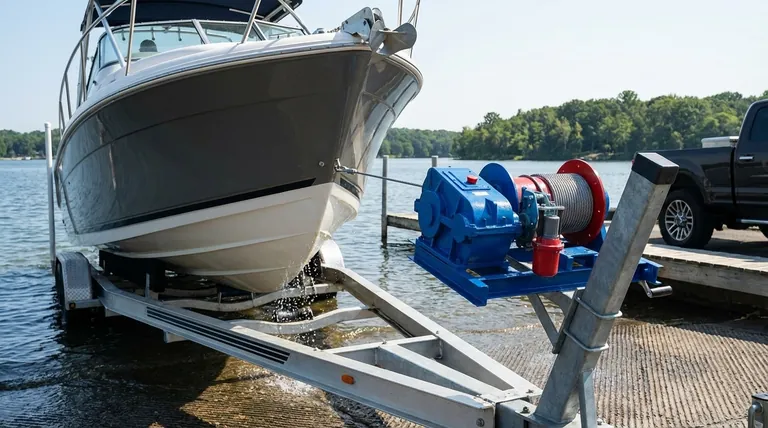
The primary purpose of a winch cable on a boat trailer is to provide a controlled mechanical force for loading and unloading your boat. It allows you to smoothly pull the boat from the water onto the trailer's bunks and guide it off during launch, preventing damage and making the entire process safer and more efficient.
A boat winch is not just a tool for convenience; it is a critical piece of equipment designed to protect your investment. It replaces manual effort with controlled leverage, safeguarding your boat's hull from accidental impact during the vulnerable process of trailering.
How a Winch System Works
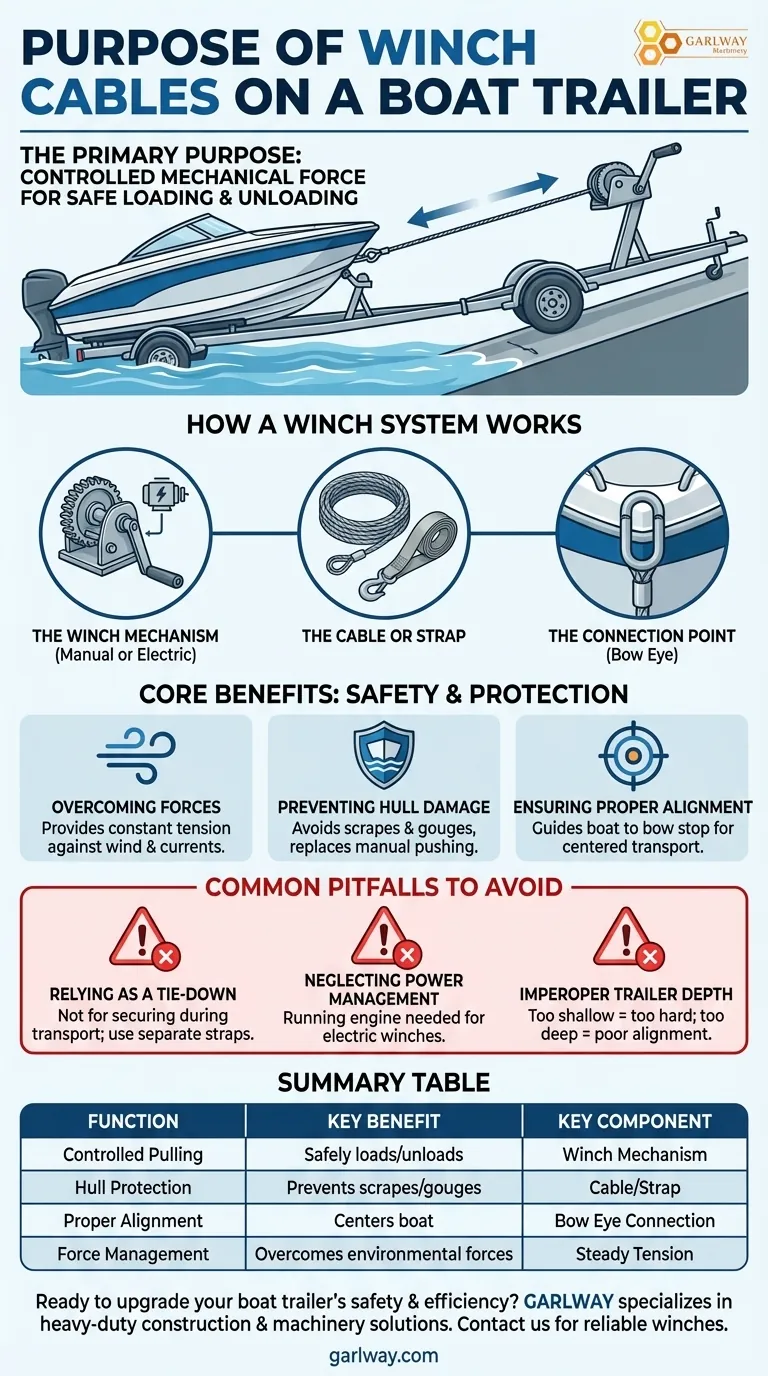
A boat trailer winch is a simple yet powerful mechanical system. Understanding its core components helps clarify its purpose.
The Winch Mechanism
The heart of the system is the winch itself, which is either operated manually with a crank or powered by an electric motor. This mechanism provides the gear reduction necessary to multiply your force, allowing one person to move a heavy boat with relative ease.
The Cable or Strap
A durable cable or strap is wound around a drum on the winch. This is the component that connects the force of the winch to the boat, pulling it forward.
The Connection Point
The winch cable attaches to the bow eye of your boat. This is a sturdy, reinforced U-bolt on the front of the boat designed specifically to handle the pulling forces exerted during trailering.
The Core Benefit: Controlled and Safe Loading
The fundamental role of the winch is to manage the boat safely when it's partially in and partially out of the water.
Overcoming Environmental Forces
At the boat ramp, you are often dealing with wind, currents, and the slope of the ramp. The winch provides constant, steady tension to pull the boat forward against these forces, preventing it from drifting sideways.
Preventing Hull Damage
Without a winch, loading a boat often involves powering it onto the trailer or pushing it manually. These methods can easily lead to the hull scraping against the trailer frame or missing the bunks, causing costly scratches, gouges, or structural damage.
Ensuring Proper Alignment
The winch guides the bow of the boat directly into the bow stop on the trailer. This ensures the vessel is perfectly centered and positioned correctly on the support bunks, which is critical for safe transport on the road.
Common Pitfalls to Avoid
Proper use is essential for safety and effectiveness. Misunderstanding the winch's role can lead to significant problems.
Relying on the Winch as a Tie-Down
A winch is a pulling tool, not a securing tool. Once the boat is fully loaded, the winch cable must be supplemented with separate, heavy-duty tie-down straps to secure the boat to the trailer for road travel. The winch gear can fail under the stresses of road bumps, which could be catastrophic.
Neglecting Power Management
For electric winches, it's crucial to manage the power source. If wired to the tow vehicle, the vehicle's engine should be running during operation to avoid draining the battery. A separate trailer battery must be kept properly charged.
Improper Trailer Depth
Positioning the trailer correctly in the water is key. If it's too shallow, the winch has to work too hard. If it's too deep, the boat may float over the bunks and be difficult to align. The goal is to have the rear of the trailer's bunks submerged so the boat can be guided onto them easily.
Applying This to Your Process
Use these principles to refine your loading and unloading technique.
- If your primary focus is safety: Always use the winch for controlled movement and secure the boat with separate tie-downs before driving away. Never treat the winch cable as a safety restraint for transport.
- If your primary focus is preventing boat damage: Rely on the winch to guide the boat smoothly and straight onto the trailer bunks, avoiding any need to "power load" with the boat's engine.
- If your primary focus is efficiency at the ramp: Position your trailer at the correct depth first, attach the winch cable securely, and use a steady cranking motion to make the loading process quick and predictable.
Properly using your winch cable transforms launching and retrieving your boat from a stressful challenge into a simple, repeatable, and safe procedure.
Summary Table:
| Function | Key Benefit | Key Component |
|---|---|---|
| Controlled Pulling | Safely loads/unloads the boat | Winch Mechanism (Manual/Electric) |
| Hull Protection | Prevents scrapes and gouges | Durable Cable or Strap |
| Proper Alignment | Centers the boat on the trailer | Bow Eye Connection |
| Force Management | Overcomes wind and current | Steady Tension |
Ready to upgrade your boat trailer's safety and efficiency?
GARLWAY specializes in heavy-duty construction and machinery solutions, offering reliable winches built for demanding applications. Our expertise in durable equipment translates directly to the marine industry, providing the controlled power and reliability you need for safe boat handling.
We help construction companies and contractors globally with robust machinery. Let us provide a winch solution that protects your valuable boat investment.
Contact GARLWAY today for a expert consultation and ensure your next trip to the ramp is smooth and secure.
Visual Guide
Related Products
- 12000 lb Electric Boat Trailer Winch with Windlass Anchor Warn
- Warn Winch Windlass Boat Trailer Winch
- Electric 120V Boat Winch by Badlands
- Heavy Duty Electric Boat Winch Windlass Anchor
- Portable Small Trailer Winch
People Also Ask
- How does an electric boat trailer winch differ from a manual one? Effort vs. Control Explained
- What size winch do I need for my boat? Get the Right Capacity for Safe Hauling
- How should a boat trailer winch be properly used? A Step-by-Step Guide for Safe Loading
- What maintenance steps are specific to boat trailer winches? Ensure Safety & Reliability at the Ramp
- How strong of a winch do I need for my boat? Get the Right Pulling Power for Trailering & Anchoring


