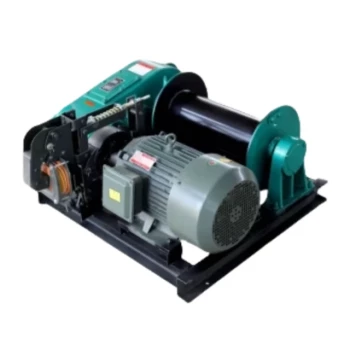
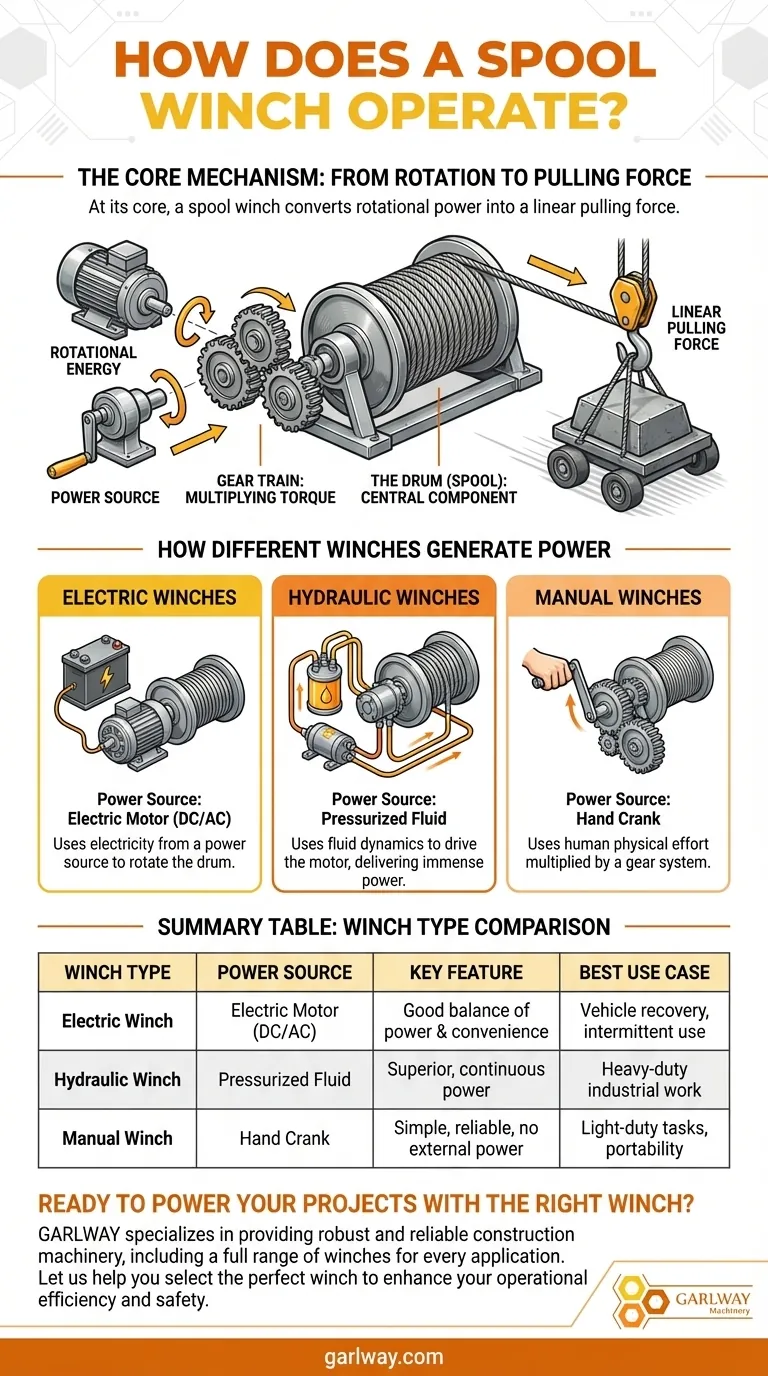
At its core, a spool winch operates by converting rotational power into a linear pulling force. A motor or hand crank turns a drum (the spool), which winds a cable or wire rope around itself, accumulating the line and pulling the attached load closer.
The essential principle behind any spool winch is the same: wrap a line around a rotating drum to pull a load. The key difference lies in the power source used to create that rotation—most commonly electric motors, hydraulic systems, or manual force.
The Core Mechanism: From Rotation to Pulling Force
Understanding a spool winch means understanding how it translates the energy from its power source into the immense force required to move heavy objects. This process involves a few key components working in unison.
The Central Component: The Drum (Spool)
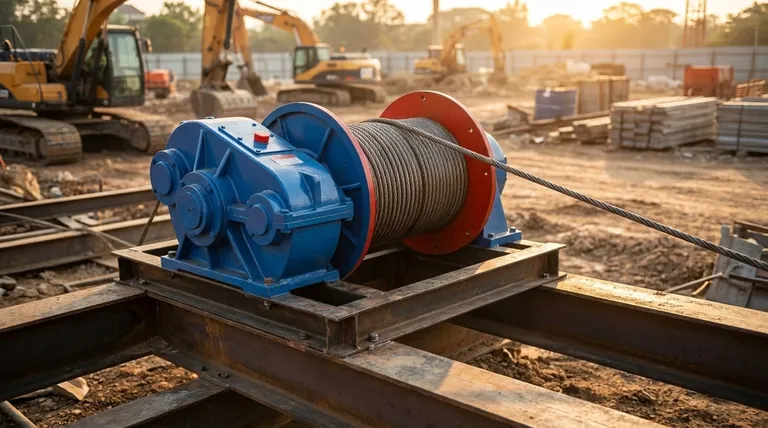
The drum, or spool, is the heart of the winch. It is the rotating cylinder that the wire rope or cable winds onto. As the drum turns, it effectively shortens the line between the winch and the load, creating the pull.
The Power Source: The Motor
The motor is what drives the drum's rotation. This is the primary distinction between winch types. The motor's job is to generate the initial rotational energy.
The Gear Train: Multiplying Torque
A motor spins very fast but with relatively low force. A planetary gear train sits between the motor and the drum to convert this high-speed, low-force rotation into the low-speed, high-force (high-torque) rotation needed to pull a heavy load.
How Different Winches Generate Power
While the end goal is the same, the method of generating rotational power defines the winch's capabilities and best-use cases.
Electric Winches
An electric winch uses an electric motor to drive the gear train. The process is straightforward: electricity flows from a power source to the motor, which then rotates the drum.
Most vehicle-mounted winches use Direct Current (DC) power, drawing from the vehicle's battery. Industrial or workshop winches may use Alternating Current (AC) from a standard power outlet.
Hydraulic Winches
A hydraulic winch operates on the principle of fluid dynamics. It uses a hydraulic motor powered by pressurized fluid to turn the drum.
This system requires a separate hydraulic pump, often driven by the vehicle's power steering pump. The pump pressurizes the fluid, a control valve directs its flow, and the fluid's force drives the hydraulic motor, delivering smooth and immense pulling power.
Manual (Hand-Operated) Winches
The simplest version uses human power. The operator turns a crank, which is connected to a gear system. This provides a mechanical advantage, allowing a person's physical effort to be multiplied into a significant pulling force.
Understanding the Trade-offs
No single winch type is perfect for every situation. The choice involves balancing power, complexity, and operational demands.
Electric Winch Limitations
Electric winches can draw a very large amount of current, placing a heavy load on a vehicle's battery and electrical system. They can also overheat during long, continuous pulls, requiring rest periods.
Hydraulic Winch Complexity
Hydraulic winches are exceptionally powerful and can run continuously without overheating as long as the vehicle's engine is running. However, they are more complex to install, requiring integration with the vehicle's hydraulic system.
Manual Winch Constraints
Hand-operated winches are reliable and require no external power. Their pulling power and speed, however, are limited entirely by the physical strength and endurance of the operator.
Making the Right Choice for Your Goal
Selecting the correct winch depends entirely on the intended application and the resources available.
- If your primary focus is vehicle recovery or general intermittent use: An electric DC winch offers the best balance of power, convenience, and ease of installation.
- If your primary focus is continuous, heavy-duty industrial work: A hydraulic winch provides superior, non-stop pulling power and durability.
- If your primary focus is simplicity, portability, and light-duty tasks: A hand-operated winch is a reliable and cost-effective tool.
Ultimately, understanding how each winch type creates its power is the key to choosing the right tool for the job.
Summary Table:
| Winch Type | Power Source | Key Feature | Best Use Case |
|---|---|---|---|
| Electric Winch | Electric Motor (DC/AC) | Good balance of power & convenience | Vehicle recovery, intermittent use |
| Hydraulic Winch | Pressurized Fluid | Superior, continuous power | Heavy-duty industrial work |
| Manual Winch | Hand Crank | Simple, reliable, no external power | Light-duty tasks, portability |
Ready to Power Your Projects with the Right Winch?
Understanding the mechanics is the first step. GARLWAY specializes in providing robust and reliable construction machinery, including a full range of winches for every application. Whether you're a construction company needing hydraulic power for continuous heavy lifting or a contractor requiring a dependable electric winch for vehicle recovery, we have the solution.
Let us help you select the perfect winch to enhance your operational efficiency and safety.
Contact GARLWAY today for a personalized consultation and discover how our expertise can drive your success.
Visual Guide
Related Products
- Portable Small Trailer Winch
- Warn Winch Windlass Boat Trailer Winch
- Electric and Hydraulic Winch for Heavy Duty Applications
- Hydraulic Winding Engine Harbor Freight Winch
- Small Electric Winch 120V and 240V for Compact Applications
People Also Ask
- What features were incorporated into the upgraded portable winch system? Boost Your Recovery Power & Safety
- What are some uses mentioned for portable winches beyond vehicle recovery? Essential Versatility for Property & Work
- How could the twisting issue with a portable winch be mitigated? Achieve Safe, Centered Pulls with Proper Rigging
- What is the significance of trailer winches in the boating industry? Ensure Safe and Efficient Boat Recovery
- What should be considered when mounting a winch on a trailer? Ensure a Safe, Aligned Installation