
The primary role of an industrial winch is to provide the controlled mechanical force required for heavy-duty lifting and pulling operations. These devices are the backbone of industries ranging from construction to mining, enabling the safe and efficient movement of massive loads that would otherwise be impractical or impossible to handle.
An industrial winch is more than just a motor and a rope; it is a critical system for applying immense power with precision. Its core purpose is to translate rotational energy into the linear force needed to lift or pull, ensuring safety, control, and productivity in demanding environments.
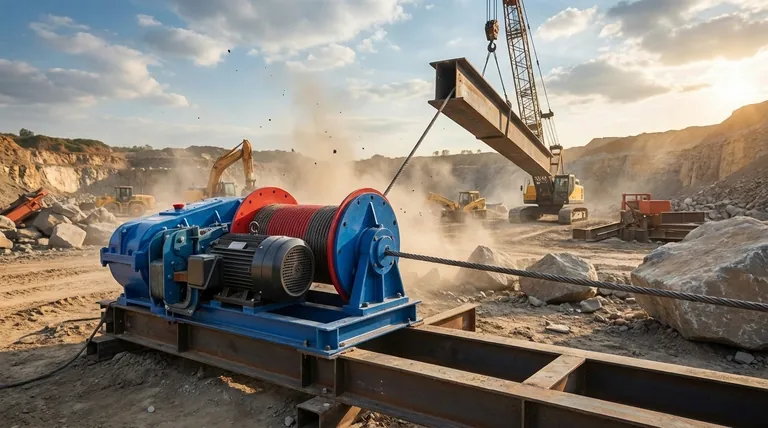
The Two Core Functions of an Industrial Winch
At its heart, an industrial winch serves two fundamental purposes, distinguished by the direction of the force it applies. Understanding these two roles clarifies its value across countless applications.
Heavy-Duty Lifting (Vertical Movement)
The most common application is hoisting materials vertically. This requires not just strength, but exceptional control to manage the load against gravity.
Industrial winches are engineered for this precision, allowing operators to lift steel beams at a construction site or maneuver heavy components within a manufacturing facility.
High-Force Pulling (Horizontal Movement)
Winches are also indispensable for horizontal pulling tasks that demand significant force. This can range from vehicle recovery to positioning massive equipment.
For example, on an oil rig or at a shipping dock, winches provide the raw power needed to drag and precisely position heavy machinery and materials.
Why Winches Are Essential in Modern Industry
The widespread adoption of industrial winches is due to the clear operational advantages they provide. They are not just tools but enablers of modern productivity and safety standards.
Enhancing Operational Safety
By mechanizing the movement of extreme loads, winches remove personnel from hazardous situations. This controlled application of force is inherently safer than manual alternatives.
Boosting Efficiency and Productivity
Winches dramatically accelerate project timelines. A critical feature for efficiency is good speed control, allowing an operator to quickly lower an empty hook but use a slow micro-speed for precise, delicate placements.
Unmatched Versatility Across Sectors
Their simple yet powerful design makes them adaptable. Winches are used in construction, forestry, mining, and water conservancy projects.
They can operate as standalone units or be integrated as essential components in larger machinery like cranes, road builders, and mine hoists.
Understanding Key Considerations and Trade-offs
Choosing the right winch involves more than just matching load capacity. The specific application dictates the ideal features and configuration.
Permanent vs. Portable Solutions
Weld-on winches are permanently attached to a frame, such as on a trailer. This provides unmatched stability and strength for dedicated, repetitive heavy-duty tasks where reliability is paramount.
The trade-off is a loss of mobility, which may be essential for other types of operations that require a more flexible, non-permanent setup.
The Critical Role of Speed Control
Raw power is useless without control. For applications involving fragile materials or requiring exact positioning, the ability to vary the winch speed is non-negotiable. The winch must be able to move quickly when unloaded but delicately when placing a load.
Advantages of Electric Winches
Modern electric winches offer significant benefits, including improved efficiency, reduced maintenance requirements, and greater ease of use compared to older mechanical or hydraulic systems. Their cost-effectiveness and versatility make them a popular choice for a wide range of industrial applications.
How to Apply This to Your Project
Your specific goal will determine the most important features to prioritize in a winch.
- If your primary focus is maximum stability for a recurring task: A permanent, weld-on winch will provide the robust and durable solution you need.
- If your primary focus is precision and handling sensitive loads: Prioritize a winch with advanced, variable speed control, including micro-speed capabilities.
- If your primary focus is versatility across different job sites: An electric winch often provides the best balance of power, ease of use, and reduced maintenance for general-purpose work.
Ultimately, selecting the correct industrial winch is a foundational step in ensuring your heavy-duty operations are performed safely, efficiently, and effectively.
Summary Table:
| Function | Key Feature | Ideal For |
|---|---|---|
| Heavy-Duty Lifting | Precision Control | Construction, Manufacturing |
| High-Force Pulling | Raw Power | Oil Rigs, Vehicle Recovery |
| Versatile Applications | Electric & Portable Options | Mining, Forestry, Water Conservancy |
Ready to power your heavy-duty projects with precision and safety? GARLWAY specializes in high-performance construction machinery, offering robust industrial winches, concrete mixers, and batching plants designed for construction companies and contractors globally. Our solutions are engineered to boost your productivity and ensure operational safety. Contact GARLWAY today for a tailored solution that meets your specific lifting and pulling needs!
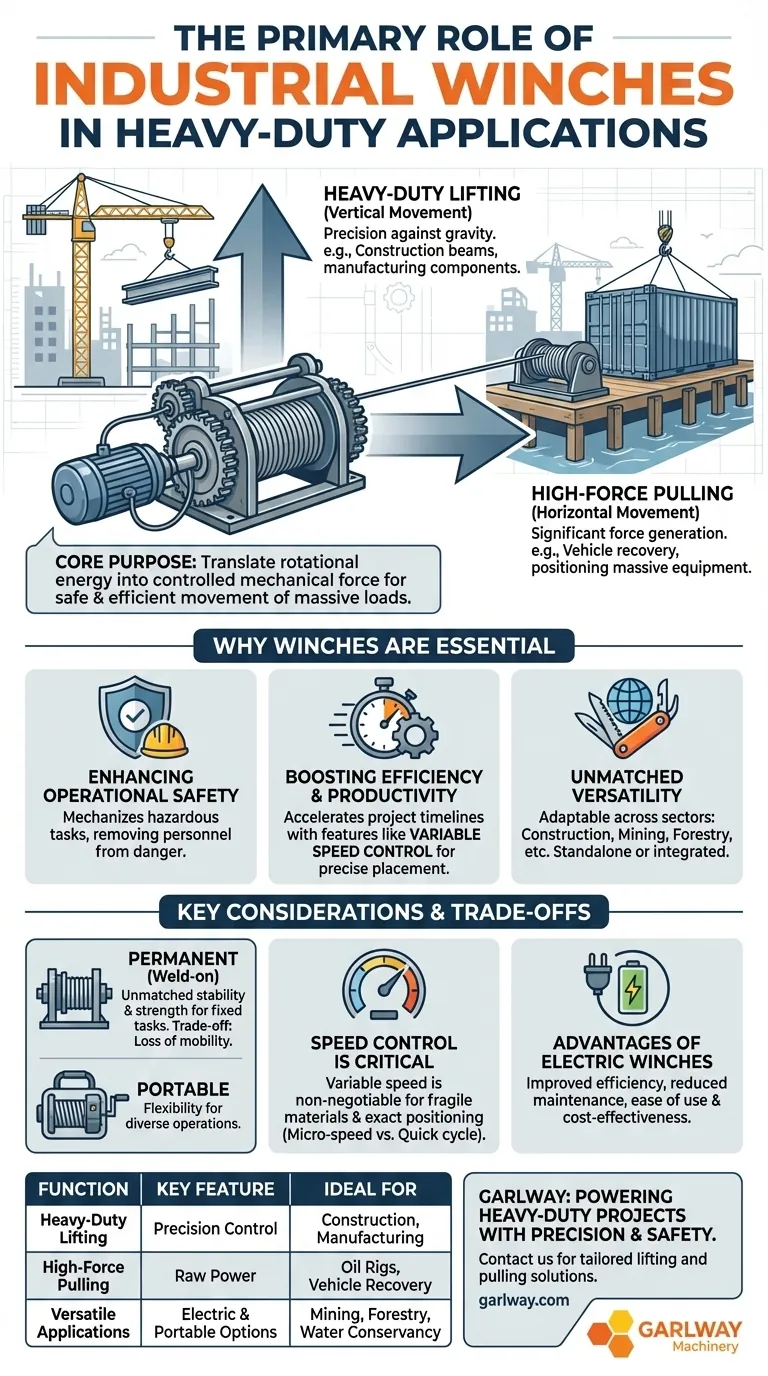
Visual Guide
Related Products
- Hydraulic Winding Engine Harbor Freight Winch
- Electric and Hydraulic Winch for Heavy Duty Applications
- Portable Small Trailer Winch
- Warn Winch Windlass Boat Trailer Winch
- 12000 lb Electric Boat Trailer Winch with Windlass Anchor Warn
People Also Ask
- What role does hydraulic fluid play in hydraulic winches? It's the Lifeblood of Your Heavy-Duty Pulling Power
- What vehicles commonly use hydraulic winches? For Industrial Trucks Needing Unmatched Power
- What are the features of hydraulic winches? Unmatched Power and Continuous Duty for Heavy Loads
- What preventive measures can be taken to avoid oil leakage in hydraulic winches? Ensure Long-Term Reliability
- What does 'power out' mean in a hydraulic winch? Achieve Absolute Control When Lowering Heavy Loads



