
At their core, modern control systems in wire rope hoists offer precise, software-driven command over the motor's speed and torque. The most significant features are variable speed control, soft start/stop functionality, and smooth acceleration and deceleration, which work together to transform a hoist from a simple lifting device into a highly accurate material handling tool.
The central purpose of modern hoist controls is to eliminate the sudden jerks and uncontrolled swings associated with older systems. By precisely managing the motor's power, these features provide superior load control, enhance operator safety, and significantly reduce mechanical wear on the hoist itself.
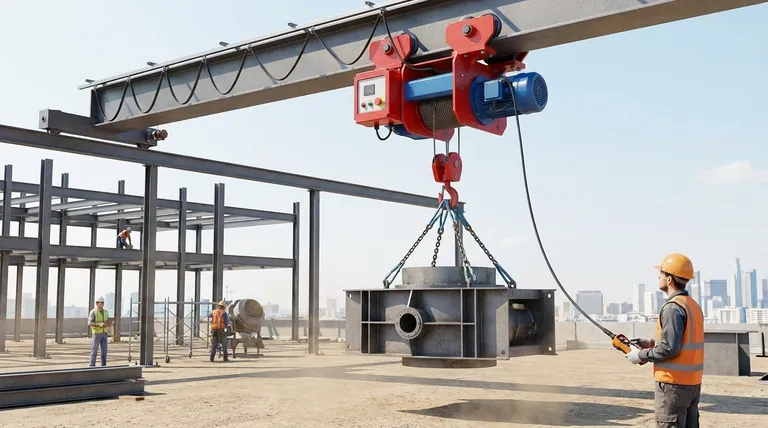
Beyond On/Off: The Shift to Intelligent Control
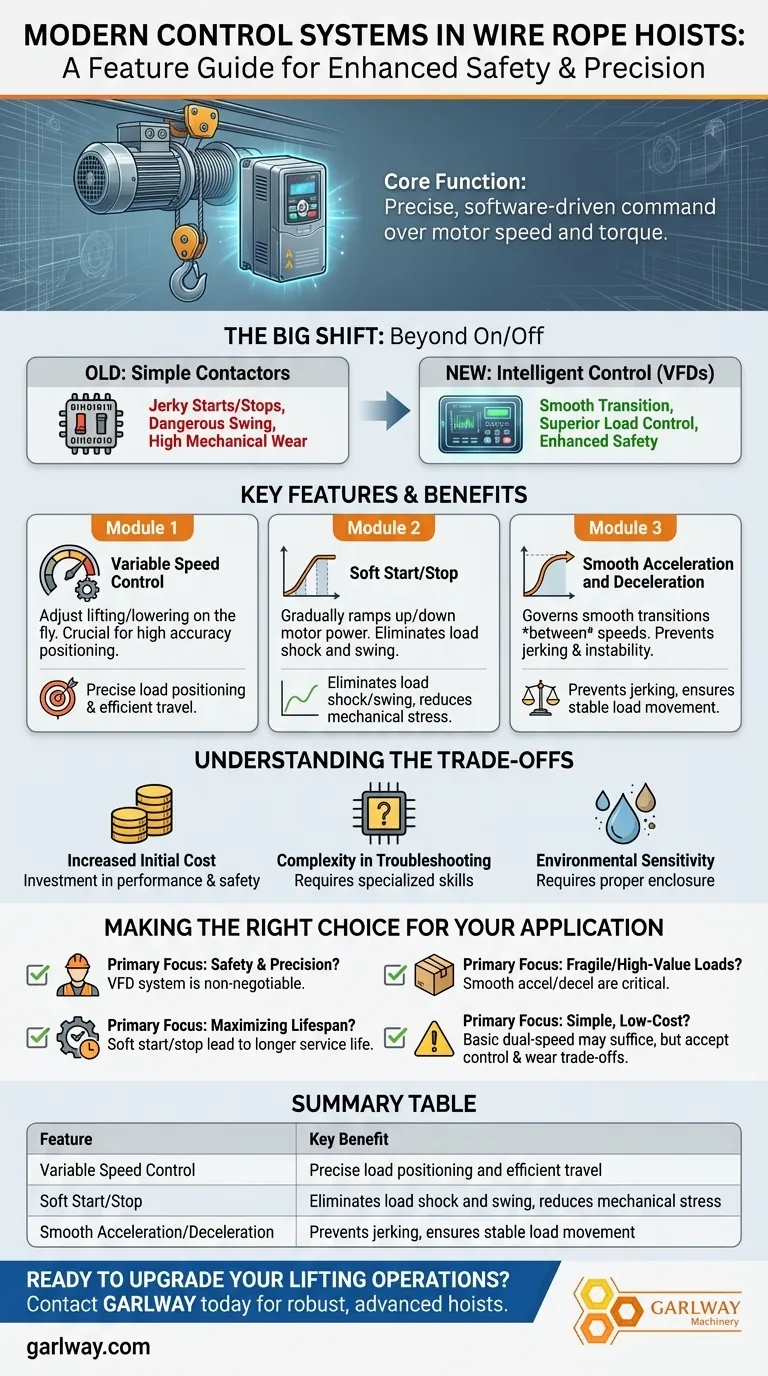
Older hoist systems often relied on simple contactors, essentially acting as on/off switches. This resulted in abrupt starts and stops, causing dangerous load swing and high stress on the gearbox, motor, and wire rope. Modern systems use advanced electronics, most commonly Variable Frequency Drives (VFDs), to move beyond this binary approach.
Variable Speed Control
This feature allows the operator to adjust the lifting and lowering speed on the fly. A slow speed is used for carefully positioning a load, while a higher speed can be used for long vertical travel, increasing efficiency.
This level of control is critical for tasks requiring high accuracy, such as placing machinery or aligning components.
Soft Start and Stop
Instead of applying full power instantly, a soft start feature gradually ramps up the motor's speed. The same principle applies in reverse for a soft stop.
This smooth transition is the single most important factor in preventing load shock and swing, which is a leading cause of accidents and damage to the payload. It also dramatically reduces the mechanical shock on the hoist's internal components.
Smooth Acceleration and Deceleration
Closely related to soft start/stop, this feature governs the transition between different speeds. When an operator changes from a slow positioning speed to a faster travel speed, the system ensures the change is smooth and predictable.
This prevents the load from jerking or becoming unstable during operation, giving the operator confidence and complete command over the load's movement at all times.
Understanding the Trade-offs
While the benefits are significant, adopting a modern control system involves considering key factors. These systems represent a fundamental shift in hoist technology.
Increased Initial Cost
Hoists equipped with VFDs and advanced electronic controls are more expensive than their traditional, single or dual-speed contactor-based counterparts. The investment is in performance, safety, and reduced long-term wear.
Complexity in Troubleshooting
The electronic nature of these controls requires a different skillset for maintenance and repair. Troubleshooting a VFD is more complex than diagnosing a simple mechanical contactor, potentially requiring a specialized technician.
Environmental Sensitivity
Advanced electronics can be more susceptible to extreme heat, dust, and moisture than older, robustly mechanical systems. Proper enclosure and environmental protection are crucial for ensuring reliability in harsh industrial settings.
Making the Right Choice for Your Application
Selecting the right control system depends entirely on the demands of your lifting tasks. By matching the features to your goals, you can ensure a safer and more productive operation.
- If your primary focus is safety and precision: A system with a VFD is non-negotiable for its variable speed and soft start capabilities.
- If your primary focus is handling fragile or high-value loads: Smooth acceleration and deceleration are critical to prevent shock, sway, and potential damage.
- If your primary focus is maximizing equipment lifespan: The reduced mechanical stress from soft start/stop functions will lead to longer service life for the motor, gearbox, and brakes.
- If your primary focus is simple, low-cost lifting: A basic dual-speed hoist may suffice, but you must accept the trade-offs in control and higher component wear.
By understanding these control features, you can select a hoist that not only lifts your load but also enhances the safety and efficiency of your entire operation.
Summary Table:
| Feature | Key Benefit |
|---|---|
| Variable Speed Control | Precise load positioning and efficient travel |
| Soft Start/Stop | Eliminates load shock and swing, reduces mechanical stress |
| Smooth Acceleration/Deceleration | Prevents jerking, ensures stable load movement |
Ready to upgrade your lifting operations with superior control?
GARLWAY specializes in providing robust construction machinery, including advanced wire rope hoists and winches, designed for construction companies and contractors who demand safety, precision, and durability. Our solutions help you handle loads more efficiently while extending equipment lifespan.
Contact GARLWAY today to discuss how our hoists can enhance your project's safety and productivity!
Visual Guide
Related Products
People Also Ask
- How does an electric anchor winch work? Power, Safety, and Reliable Operation Explained
- What are the advantages of installing an electric anchor winch on a boat? Boost Safety & Ease for Boaters
- What are the operational differences between electric hoists and winches? A Guide to Safe Lifting vs. Pulling
- What are the main benefits of a boat anchor winch? Boost Safety & Efficiency for Your Vessel
- How does a boat anchor winch work? A Guide to Reliable Anchor Handling
