
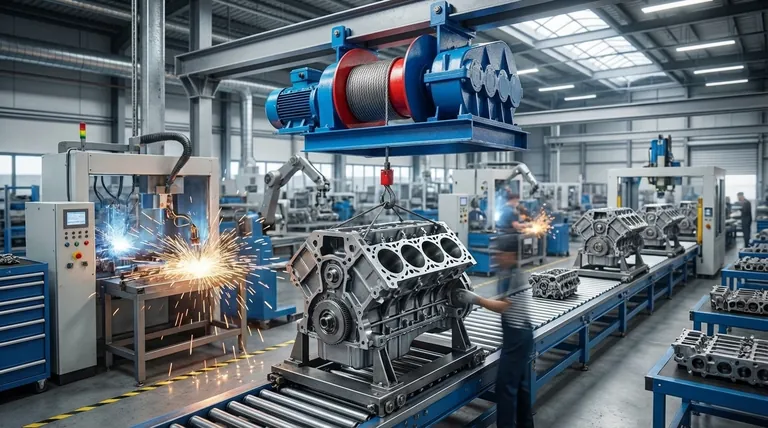
At their core, electric hoists are fundamental tools that transform manufacturing processes by enabling the precise, efficient, and safe handling of heavy materials. They are used extensively in assembly lines to accurately position components for fitting, in production areas to place heavy tooling, and during maintenance to quickly lift and move machinery.
Beyond simply lifting heavy objects, electric hoists function as precision instruments. Their real value lies in integrating seamlessly into a manufacturing workflow to minimize manual strain, accelerate operational speed, and guarantee the repeatable, accurate placement of critical components and tools.
The Core Function: How an Electric Hoist Works
To understand the impact of an electric hoist, it's essential to understand its basic mechanics. The design is elegantly simple and focused on control.
The Powertrain: Motor and Gears
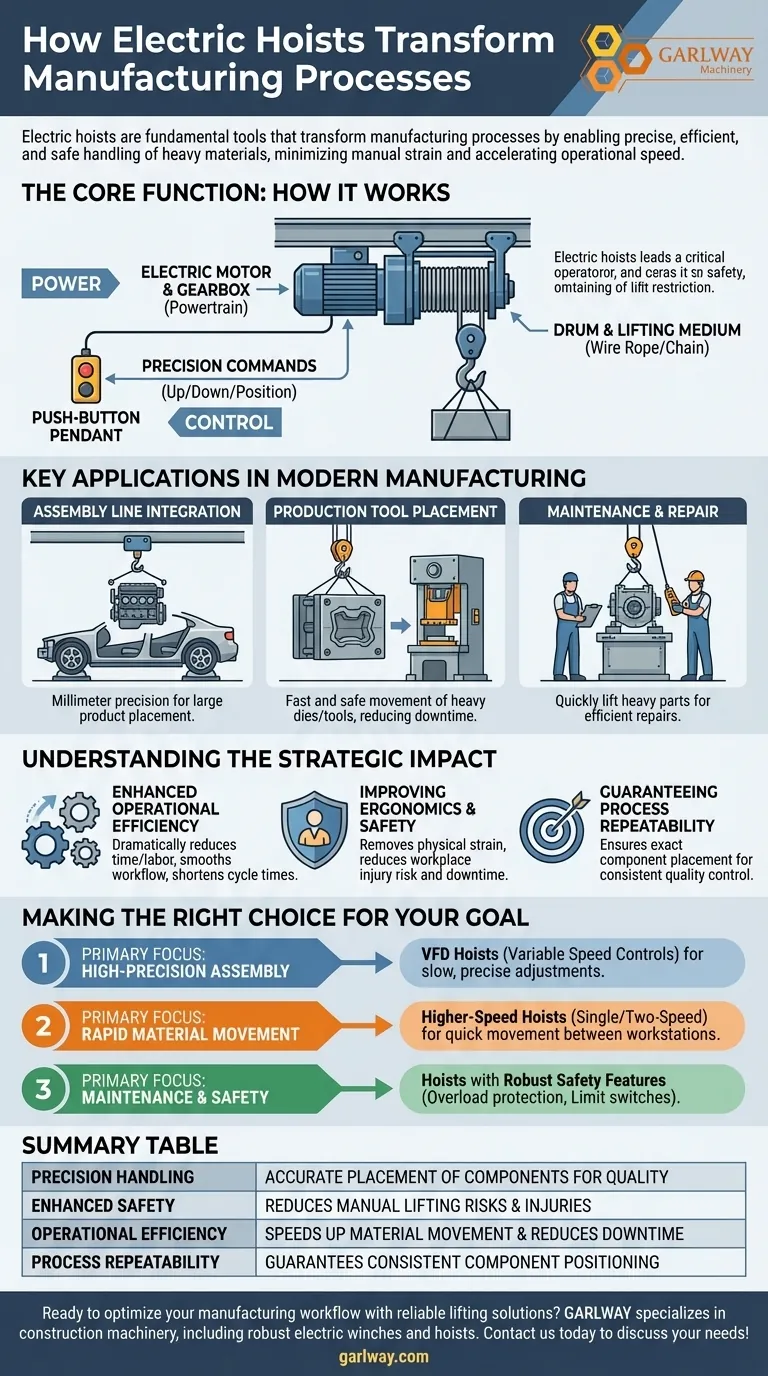
An electric motor provides the power. This motor drives a series of gears within a gearbox, which translates the motor's high-speed rotation into the high-torque, slower-speed force needed to lift heavy loads.
The Lifting Mechanism: Drum and Medium
The gearbox is connected to a drum or a lift-wheel. A lifting medium, typically a wire rope or a chain, wraps around this component. When the motor is activated, the drum rotates to either wind or unwind the medium, thereby lifting or lowering the attached load.
The Control System: Precision at Your Fingertips
Operators control the hoist using a push-button pendant or a wireless remote. This interface allows for precise commands—up, down, and sometimes horizontal movement—giving the user direct and accurate control over the load's final position.
Key Applications in Modern Manufacturing
While the concept is simple, the applications are critical to maintaining the pace and quality of modern production environments.
Assembly Line Integration
In assembly lines, especially for large products like vehicles or heavy machinery, components must be positioned with extreme accuracy. Electric hoists allow a single operator to lift a multi-ton engine block and lower it into a chassis with millimeter precision.
Production Tool Placement
Manufacturing often involves heavy dies, molds, and other tooling that must be moved into and out of production machines. An electric hoist makes this process fast and safe, significantly reducing the downtime associated with line changeovers.
Maintenance and Repair Operations
When a piece of production equipment fails, speed is critical. Electric hoists provide maintenance crews with the ability to quickly and safely lift heavy parts, access components, and perform necessary repairs, getting the line back up and running efficiently.
Understanding the Strategic Impact
The true contribution of an electric hoist goes beyond the individual lift; it influences the entire production system.
Enhancing Operational Efficiency
By automating the lifting of heavy loads, hoists dramatically reduce the time and labor required for material handling. This creates a smoother, more continuous workflow and shortens overall production cycle times.
Improving Ergonomics and Safety
Manual lifting of heavy or awkward objects is a primary cause of workplace injuries. Electric hoists remove this physical strain from workers, creating a much safer environment and reducing the risk of costly injuries and downtime.
Guaranteeing Process Repeatability
The precision control offered by electric hoists ensures that components are placed in the exact same position, every single time. This repeatability is fundamental to maintaining high standards of quality control in any assembly process.
Making the Right Choice for Your Goal
To properly leverage an electric hoist, you must align its capabilities with your specific operational needs.
- If your primary focus is high-precision assembly: Prioritize hoists with variable speed controls (VFDs) that allow for slow, precise adjustments during final placement.
- If your primary focus is rapid material movement: Look for higher-speed, single- or two-speed models designed to move loads quickly between workstations.
- If your primary focus is maintenance and safety: Ensure the selected hoist has robust safety features like overload protection and upper/lower limit switches.
By understanding their function and strategic impact, you can leverage electric hoists to build a safer, more precise, and highly efficient manufacturing environment.
Summary Table:
| Key Benefit | Impact on Manufacturing |
|---|---|
| Precision Handling | Enables accurate placement of components for assembly, ensuring quality. |
| Enhanced Safety | Reduces manual lifting risks and workplace injuries. |
| Operational Efficiency | Speeds up material movement and reduces production downtime. |
| Process Repeatability | Guarantees consistent component positioning for quality control. |
Ready to optimize your manufacturing workflow with reliable lifting solutions? As GARLWAY specializes in construction machinery, including robust electric winches and hoists, we help construction companies and contractors globally enhance efficiency and safety. Contact us today to discuss how our equipment can meet your specific needs!
Visual Guide
Related Products
- Electric Hoist Winch Boat Anchor Windlass for Marine Applications
- Electric and Hydraulic Winch for Heavy Duty Applications
- Hydraulic Winding Engine Harbor Freight Winch
- Heavy Duty Electric Boat Winch Windlass Anchor
- 12000 lb Electric Boat Trailer Winch with Windlass Anchor Warn
People Also Ask
- How does an electric anchor winch work? Power, Safety, and Reliable Operation Explained
- What are the advantages of installing an electric anchor winch on a boat? Boost Safety & Ease for Boaters
- What are the operational differences between electric hoists and winches? A Guide to Safe Lifting vs. Pulling
- What are the main benefits of a boat anchor winch? Boost Safety & Efficiency for Your Vessel
- How does a boat anchor winch work? A Guide to Reliable Anchor Handling





