In essence, large and medium-sized concrete mixing stations act as the industrial heart of a major construction site, transforming efficiency by replacing manual, error-prone processes with high-volume, automated production. They achieve this by ensuring consistent concrete quality, streamlining logistics from mixing to pouring, and enabling a level of productivity that manual methods cannot match.
The core value of a centralized mixing station is its ability to turn concrete production into a predictable, mechanized, and integrated part of the construction workflow, rather than a series of disjointed, labor-intensive tasks.
The Core Mechanisms of Efficiency
A concrete mixing station is more than just a large mixer; it is an integrated system designed to eliminate bottlenecks and guarantee material quality at scale. Its efficiency stems from three key principles.
Centralized and Automated Production
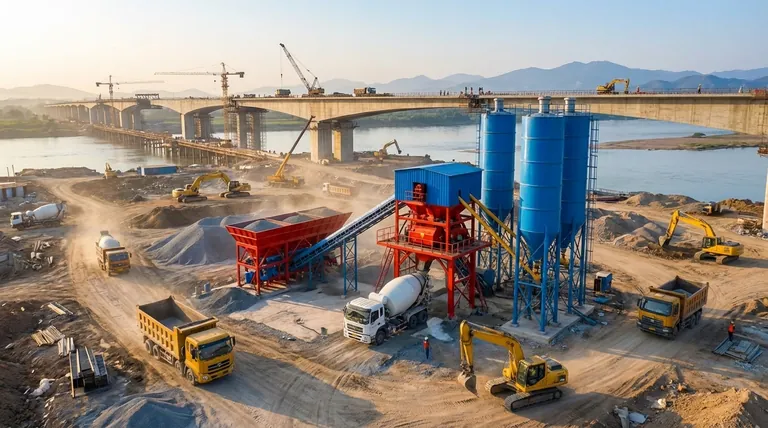
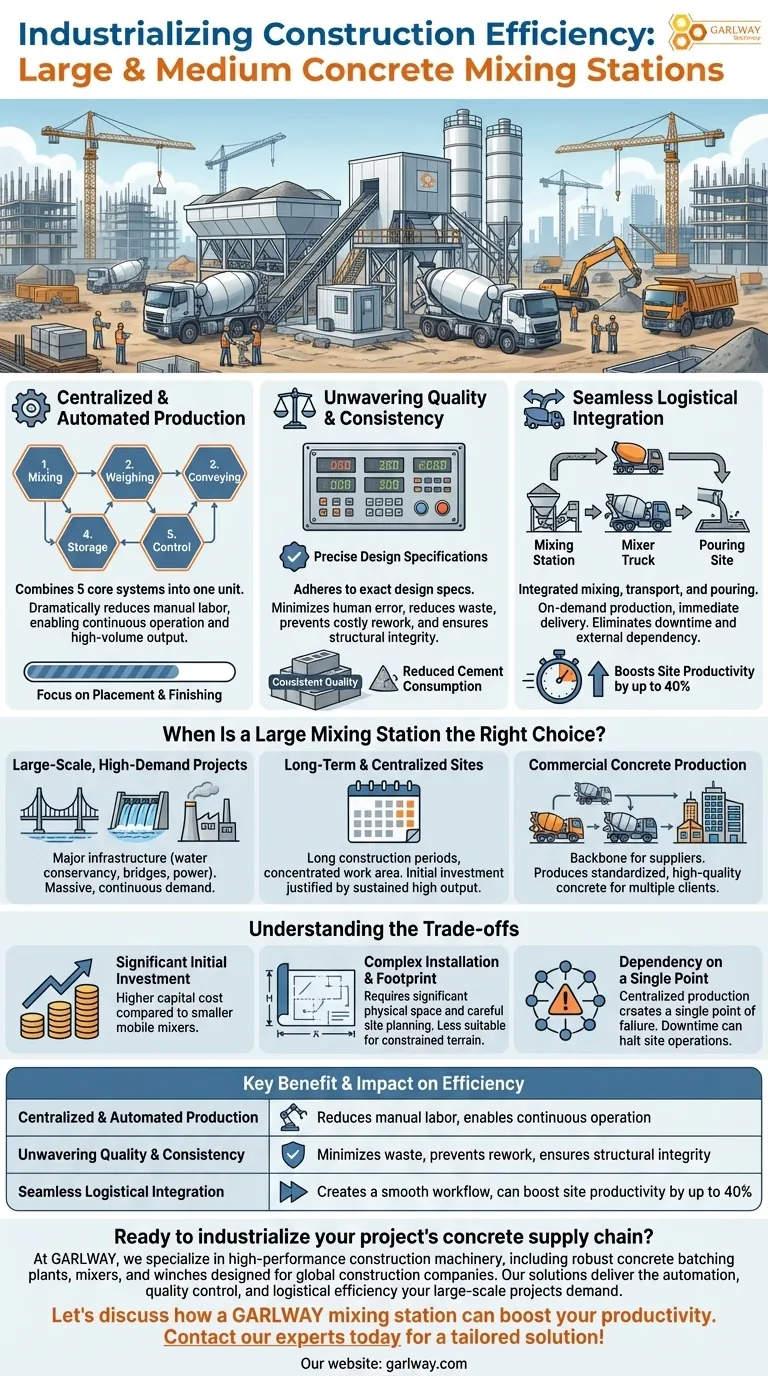
These stations combine five core systems—mixing, material weighing, conveying, storage, and control—into a single, automated unit. This mechanization dramatically reduces the need for manual labor.
By automating the process, crews can focus on placement and finishing, not on mixing. This allows for continuous operation and the production of massive quantities of concrete, which is essential for large-scale projects.
Unwavering Quality and Consistency
The integrated weighing and control systems ensure that every batch of concrete adheres to the exact design specifications. This precision minimizes human error and guarantees consistent quality.
Consistent quality reduces waste, prevents costly rework, and ensures the structural integrity of the final project. It also allows for a reduction in cement consumption, as precise measurements avoid the need for overuse to compensate for variability.
Seamless Logistical Integration
These stations facilitate a unified workflow by integrating mixing, transportation, and pouring. Concrete is produced on-demand and loaded directly into mixer trucks for immediate delivery to the point of application.
This eliminates downtime and dependency on external batching plants, creating a smooth, continuous flow of material. This integrated process can boost overall site productivity by as much as 40% compared to traditional methods.
When Is a Large Mixing Station the Right Choice?
While powerful, these stations are specialized tools. Their value is most fully realized in specific project contexts.
Large-Scale, High-Demand Projects
They are the standard for major infrastructure work, such as water conservancy, power generation, and bridge construction. These projects have a massive and continuous demand for concrete that only a centralized station can meet.
Long-Term and Centralized Sites
The setup of a large station is a significant undertaking. They are best suited for projects with a long construction period and a concentrated work area, where the initial investment is justified by sustained high output.
Commercial Concrete Production
Beyond individual project sites, these stations are the backbone of commercial concrete suppliers. They produce standardized, high-quality concrete that supports numerous smaller construction projects through pumping and mechanized delivery.
Understanding the Trade-offs
Objectivity requires acknowledging the limitations and specific requirements of this technology.
Significant Initial Investment
The primary trade-off is cost. Large and medium-sized stations represent a much higher initial capital investment compared to smaller, more mobile mixers or reliance on third-party suppliers.
Complex Installation and Footprint
While their steel structure is designed for convenient installation, they still require a significant physical footprint and careful site planning. Their size and complexity make them less suitable for projects with highly constrained or varied terrain.
Dependency on a Single Point
Centralizing production creates a single point of failure. If the main mixing station experiences a mechanical issue, it can bring a significant portion of the construction site to a halt until it is resolved.
Making the Right Choice for Your Project
Selecting the appropriate concrete production method depends entirely on the scale and demands of your work.
- If your primary focus is a large-scale infrastructure project: A dedicated large or medium-sized mixing station is almost certainly the most efficient and cost-effective solution for ensuring quality and meeting high-volume demand.
- If your primary focus is supplying commercial concrete: These stations are the essential core of your business, enabling you to produce consistent, high-grade material for a diverse client base.
- If your primary focus is a smaller, short-term, or decentralized project: The high initial investment and logistical footprint of a large station are likely not justified, and smaller mixers or third-party suppliers are a better fit.
Ultimately, leveraging a large mixing station is a strategic decision to industrialize your project's most critical material supply chain.
Summary Table:
| Key Benefit | Impact on Efficiency |
|---|---|
| Centralized & Automated Production | Reduces manual labor, enables continuous operation |
| Unwavering Quality & Consistency | Minimizes waste, prevents rework, ensures structural integrity |
| Seamless Logistical Integration | Creates a smooth workflow, can boost site productivity by up to 40% |
Ready to industrialize your project's concrete supply chain?
At GARLWAY, we specialize in high-performance construction machinery, including robust concrete batching plants, mixers, and winches designed for construction companies and contractors globally. Our solutions are engineered to deliver the automation, quality control, and logistical efficiency your large-scale projects demand.
Let's discuss how a GARLWAY mixing station can boost your productivity. Contact our experts today for a tailored solution!
Visual Guide
Related Products
- HZS90 Large Multiquip Concrete Mixers for Construction
- HZS75 Concrete Batching Plant Cement Mixer Price Concrete Mixer Bunnings Mixing Plant
- Portable Concrete Mixer Machine Equipment for Mixing Concrete
- Commercial Electric Concrete Mixer Machine HZS 50 Small Batch Plant for Sale
- HZS35 Small Cement Concrete Mixing Batch Plant
People Also Ask
- What are the types of concrete mixers used in batching plants? Choose the Right Mixer for Your Project
- What is the core component of a concrete batching plant? The Mixer Unit Defines Your Concrete Quality
- What are the different power sources for concrete mixers? Choose the Right Power for Your Project
- What are the main types of concrete mixers? A Guide to Batch, Continuous & More
- What are the main types of concrete mixers mentioned? Find the Perfect Mixer for Your Project