Ultimately, unexpected changes in the water content of concrete stem from variations in the raw materials themselves. The most common culprits are inconsistencies in cement fineness, the properties of mineral admixtures like fly ash, and the performance of chemical admixtures such as superplasticizers. Each of these can alter the amount of water required to achieve a desired consistency.
The core issue is particle surface area. The total surface area of all the powders in your concrete mix dictates its thirst for water. Any change to a material that increases this surface area will increase the water demand, and vice-versa.
The Role of Cement Properties
The cement is the primary reactive powder in concrete, and its physical characteristics have the most direct impact on water demand.
Cement Fineness
Finer cement particles have a significantly greater total surface area than coarser particles for the same weight. Think of it as the difference between wetting a bucket of gravel versus a bucket of sand.
This increased surface area demands more water to coat each particle, which is necessary for both the chemical reaction (hydration) and for providing lubrication between particles (workability).
Particle Size Distribution
An optimal mix contains a range of particle sizes that pack together efficiently, minimizing the empty spaces (voids) that need to be filled with water and paste.
If the particle distribution is poor (e.g., too many particles of the same size), the packing is inefficient, leaving larger voids. This requires more water to fill the gaps and achieve a workable mix.
The Impact of Admixtures
Admixtures are added to concrete to enhance its properties, but they can also introduce variability if not properly controlled.
Mineral Admixtures (SCMs)
Supplementary Cementitious Materials (SCMs) like fly ash, slag, or silica fume are fine powders that also affect water demand. Their impact depends on their own fineness and particle shape.
Extremely fine materials like silica fume can dramatically increase water demand due to their vast surface area. In contrast, some fly ashes contain spherical particles that act like microscopic ball bearings, reducing friction and actually decreasing the amount of water needed. This property is known as its "water demand ratio."
Chemical Admixtures (Superplasticizers)
Superplasticizers, or high-range water reducers, work by attaching to cement particles and imparting a strong negative charge. This causes the particles to repel each other.
This electrostatic repulsion breaks up clumps of cement, releasing water that was trapped inside. This makes the mix more fluid without adding more water. A change in the admixture’s chemical formulation, dosage, or efficiency (its "water reduction rate") will directly alter the workability of the mix for a given water content.
Common Pitfalls of Inconsistent Water Content
Failing to account for these material variations has significant consequences that go far beyond a change in slump.
Compromised Strength
The water-to-cement (w/c) ratio is the single most critical factor determining concrete strength. Unplanned increases in water create a more porous internal structure after curing, leading to a direct and predictable loss of compressive strength.
Reduced Durability
That same increased porosity makes the concrete more vulnerable to external threats. It allows easier penetration of water, salts, and chemicals, which accelerates freeze-thaw damage, sulfate attack, and the corrosion of steel reinforcement.
Unpredictable Workability
The most immediate effect is on workability. A mix that is unexpectedly wet can lead to segregation of aggregates and excessive bleeding. A mix that is too dry will be difficult to place, compact, and finish properly, resulting in honeycombing and poor surface quality.
How to Ensure Consistent Concrete Quality
Managing these variables is the key to producing predictable, high-performance concrete.
- If your primary focus is consistent workability (slump): Implement rigorous quality control to test incoming materials and adjust batch weights accordingly, avoiding the uncontrolled addition of water on site.
- If your primary focus is meeting strength specifications: Maintain a strict water-to-cementitious material ratio by accounting for all sources of water, including moisture in the aggregates.
- If your primary focus is project efficiency: Leverage chemical and mineral admixtures strategically, but ensure their properties and dosage rates are consistent from batch to batch.
Mastering concrete quality begins with understanding that every component matters.
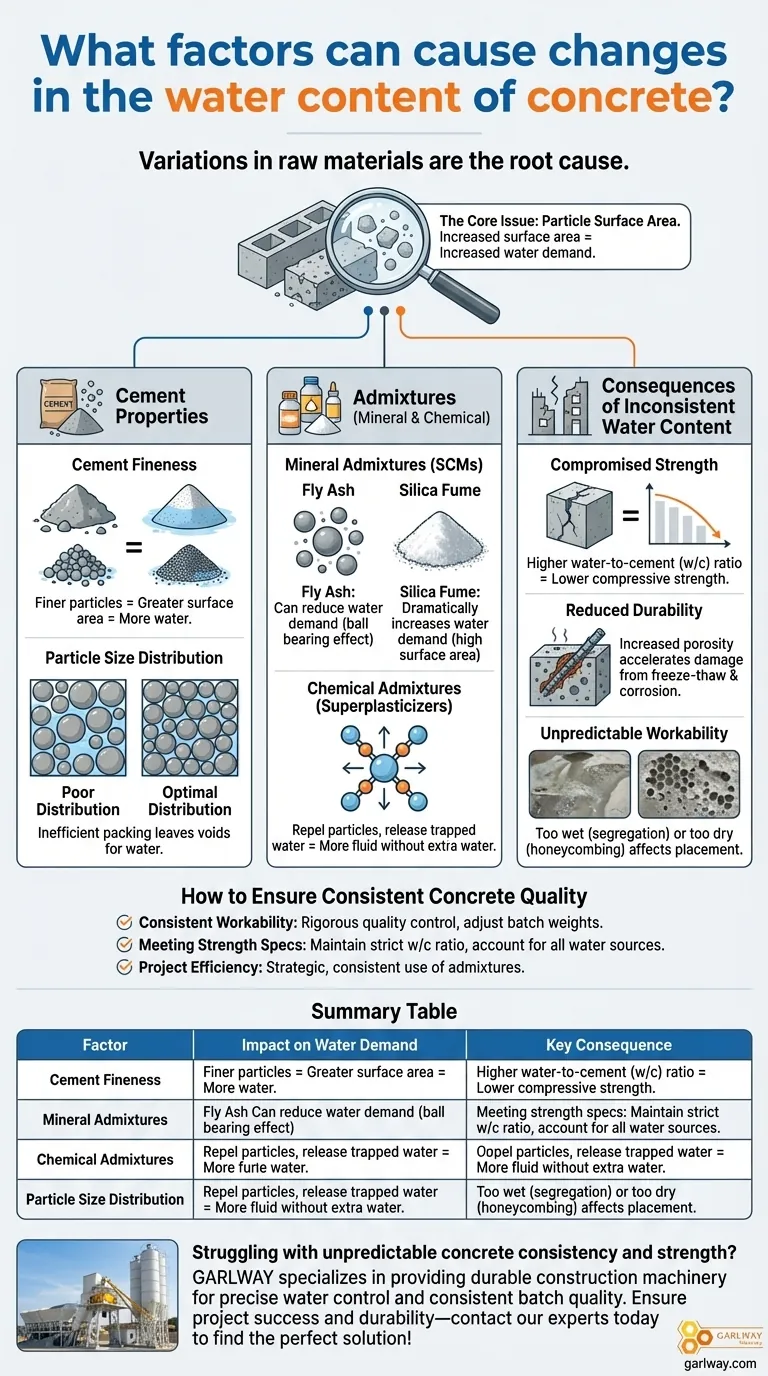
Summary Table:
| Factor | Impact on Water Demand | Key Consequence |
|---|---|---|
| Cement Fineness | Increases with finer particles | Higher water need for workability |
| Mineral Admixtures | Varies (e.g., fly ash can reduce, silica fume increases) | Alters workability and strength |
| Chemical Admixtures | Superplasticizers reduce demand | Improves fluidity without extra water |
| Particle Size Distribution | Poor distribution increases demand | Leads to higher porosity and weaker concrete |
Struggling with unpredictable concrete consistency and strength? GARLWAY specializes in providing durable construction machinery, including reliable concrete mixers and batching plants, designed to help construction companies and contractors achieve precise water control and consistent batch quality. Ensure your project's success and durability—contact our experts today to find the perfect solution for your needs!
Visual Guide
Related Products
- Portable Concrete Mixer Machine Equipment for Mixing Concrete
- Portable Cement Mixer with Lift Concrete Machine
- Portable Ready Mix Concrete Mixer Equipment
- HZS180 Ready Mix Concrete Plant for Foundations with Sand and Cement
- HZS35 Small Cement Concrete Mixing Batch Plant
People Also Ask
- Why is it necessary to use a portable concrete mixer? Gain Total Control & Efficiency
- How much concrete can you pour with a portable mixer? Find the Perfect Fit for Your Project
- What types of projects are portable concrete mixers suitable for? Ideal for DIY & Small-Scale Construction
- How much does a portable concrete mixer hold? A Guide to Choosing the Right Capacity
- What types of portable concrete mixers exist? Find the Perfect Mixer for Your Project