When considering the output of a concrete mixer, you must evaluate it not just as a standalone number, but as a critical component within your entire project workflow. The key factors are matching the mixer’s volume capacity to the project's scale, ensuring your raw material supply can sustain that output, and verifying the quality and homogeneity of the final concrete produced.
The most common mistake is focusing solely on a mixer's maximum output (m³/hour). True project efficiency comes from selecting a capacity that is perfectly balanced with your site's logistical capabilities and the specific quality demands of the concrete mix itself.

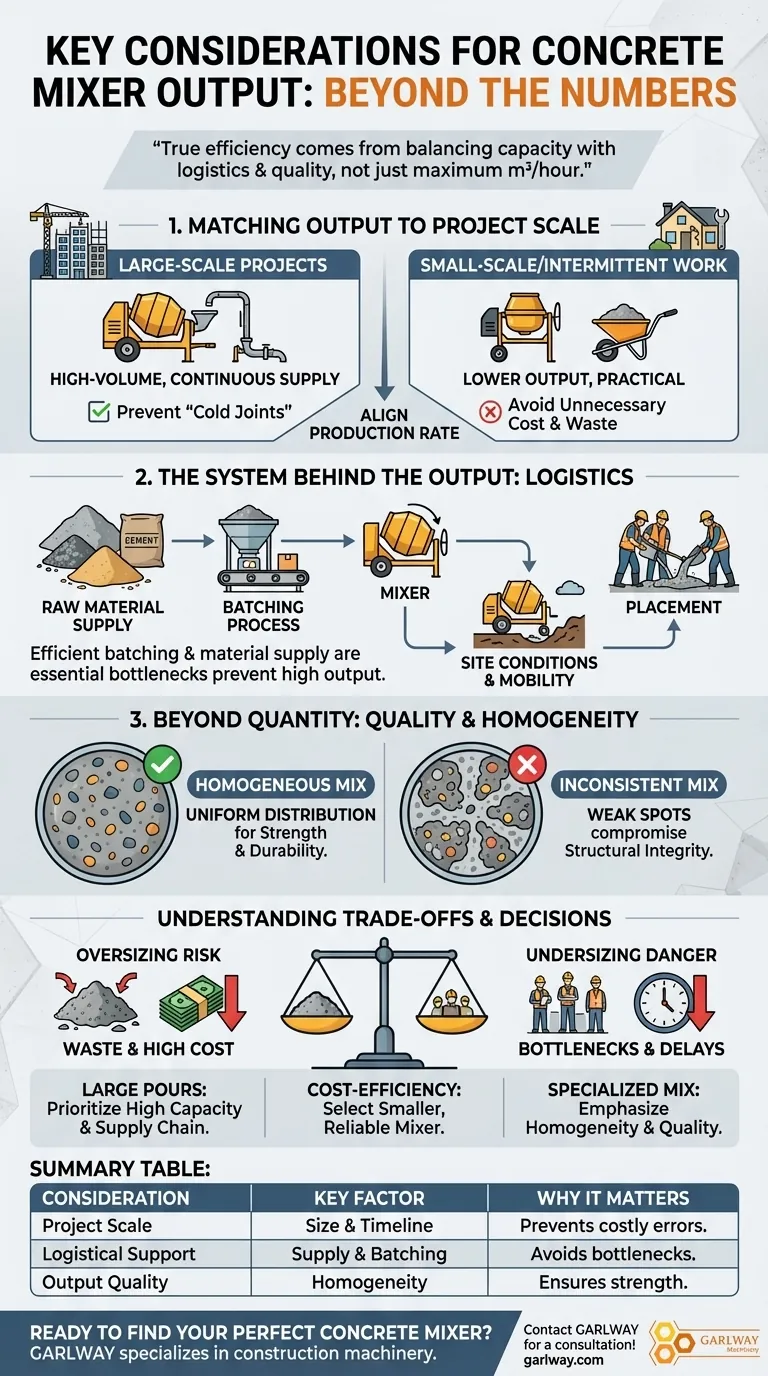
Matching Output to Project Scale
The most fundamental consideration is aligning the mixer’s production rate with the size and timeline of your construction project. This decision directly impacts cost, speed, and quality.
For Large-Scale Projects
High-volume projects, such as large foundations or multi-story structures, demand mixers with high output capacities.
This ensures a continuous supply of concrete, which is crucial for preventing "cold joints"—weak points that form when fresh concrete is poured on top of concrete that has already begun to set.
For Small-Scale or Intermittent Work
For smaller jobs like residential repairs or landscaping, a mixer with a lower output is far more practical and cost-effective.
Using an oversized mixer for small tasks leads to unnecessary capital expenditure, higher operational costs, and potential waste of materials if the entire batch isn't used promptly.
The System Behind the Output
A mixer’s stated output is theoretical until it is supported by a robust logistical system. A high-capacity mixer is ineffective if it’s constantly waiting for materials.
Raw Material Supply
Your site must have adequate storage for aggregates, sand, cement, and admixtures.
An efficient batching process—the weighing and loading of these materials—is essential to feed the mixer consistently and keep up with its production cycle. Any delay here creates a bottleneck that negates the mixer's high output.
Site Conditions and Mobility
The mixer's ability to be positioned effectively on site is also a factor.
For projects with varied terrain or multiple pour locations, a mobile mixer's maneuverability can be more critical to overall project speed than its raw output capacity.
Beyond Quantity: The Quality of the Output
The true measure of a mixer's performance is not just how much concrete it produces, but the quality of that concrete.
The Goal of Homogeneity
A highly efficient mixer produces a homogeneous mix. This means all the solid components—coarse and fine aggregates, cement, and admixtures—are uniformly distributed throughout the cement paste.
Why Homogeneity is Non-Negotiable
An inconsistent, poorly mixed batch will have weak spots, affecting the final strength, durability, and structural integrity of the concrete. The mixer’s output is irrelevant if the quality is compromised.
Understanding the Trade-offs
Choosing the wrong output capacity creates significant and costly problems. Being aware of the risks of both over- and undersizing is critical for making an informed decision.
The Risk of Oversizing
Selecting a mixer with an output far exceeding your crew's placement capacity leads to wasted concrete, high upfront investment, and increased fuel or energy consumption without any corresponding benefit to project speed.
The Danger of Undersizing
Using a mixer that is too small for the job is often the more damaging error. It creates a critical bottleneck, forcing crews to wait, delaying the entire project schedule, and increasing the risk of poor-quality pours due to interruptions.
Making the Right Choice for Your Goal
Your final decision should be guided by the unique priorities of your project.
- If your primary focus is large-scale, continuous pours: Prioritize a mixer with a high output capacity and ensure your material supply chain can consistently support it.
- If your primary focus is cost-efficiency on smaller jobs: Select a smaller, reliable mixer to minimize upfront investment, reduce waste, and lower operational costs.
- If your primary focus is high-performance or specialized concrete: Emphasize the mixer’s ability to produce a verifiably homogeneous mix, as quality is more critical than sheer volume.
Ultimately, the right mixer output creates a seamless rhythm between material supply, production, and placement on site.
Summary Table:
| Consideration | Key Factor | Why It Matters |
|---|---|---|
| Project Scale | Size and timeline of the job | Prevents costly over/undersizing; ensures continuous supply or minimizes waste. |
| Logistical Support | Raw material supply and batching process | A high-output mixer is useless if material supply is a bottleneck. |
| Output Quality | Homogeneity of the mix | Inconsistent mixing compromises concrete strength and structural integrity. |
Ready to Find Your Perfect Concrete Mixer?
Choosing the right mixer is critical to your project's budget, timeline, and quality. GARLWAY specializes in construction machinery, offering a range of concrete mixers and batching plants designed for construction companies and contractors globally.
Let our experts help you select a mixer that perfectly matches your project's scale and logistical needs.
Contact GARLWAY today for a personalized consultation and quote!
Visual Guide
Related Products
- Portable Concrete Mixer Machine Equipment for Mixing Concrete
- Construction Products Concrete Plant Machine Mixing Concrete Mixer
- Portable Electric Concrete Mixer Machine for Cement Mixing
- JZC400 Mobile Small Concrete Mixer Cement Mixer Machine
- Hydraulic Concrete Mixer Machine Cement Mixing Equipment for Mixture Concrete
People Also Ask
- Why is it necessary to use a portable concrete mixer? Gain Total Control & Efficiency
- How much concrete can you pour with a portable mixer? Find the Perfect Fit for Your Project
- What types of projects are portable concrete mixers suitable for? Ideal for DIY & Small-Scale Construction
- How much does a portable concrete mixer hold? A Guide to Choosing the Right Capacity
- What types of portable concrete mixers exist? Find the Perfect Mixer for Your Project