
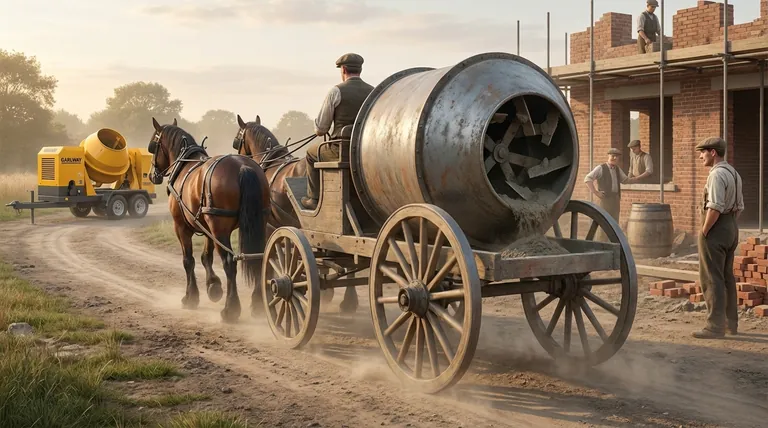
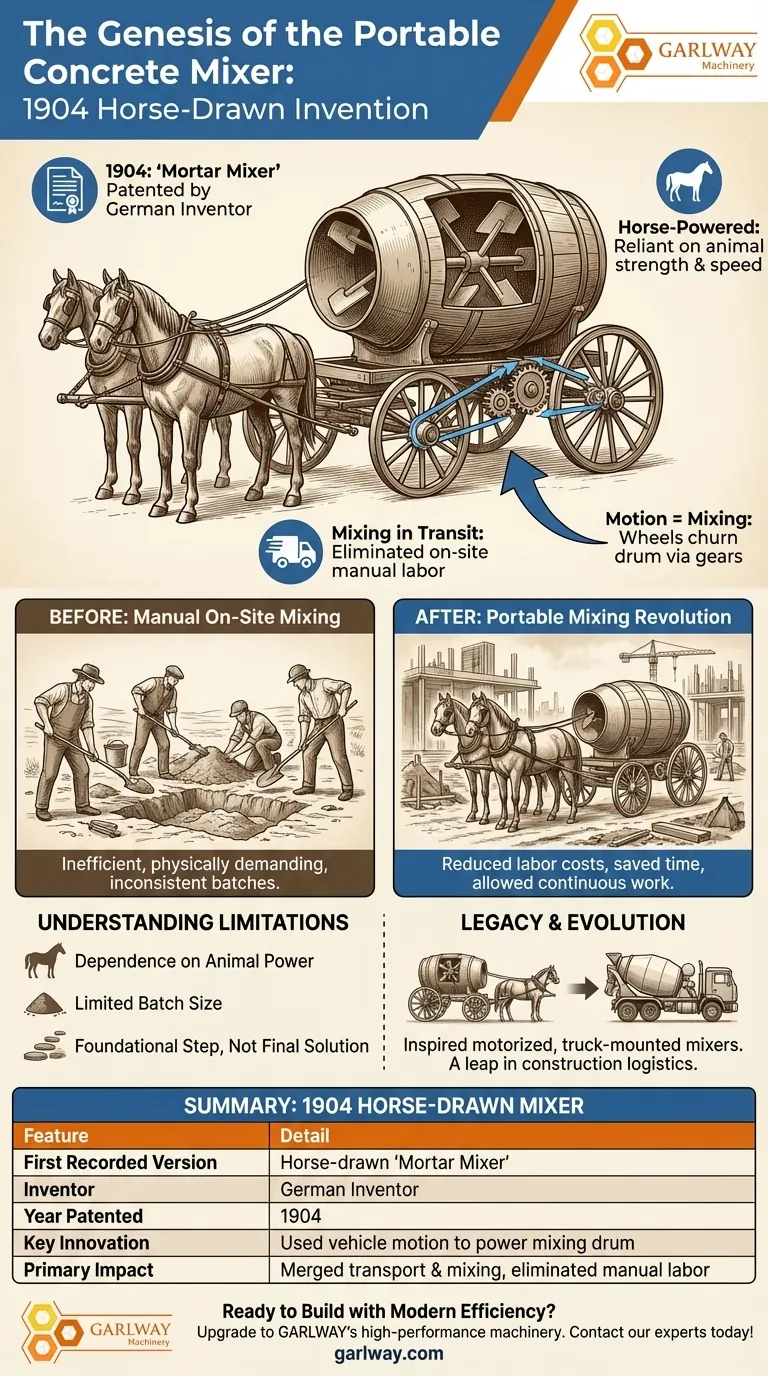
The first recorded portable concrete mixer was a horse-drawn 'Mortar Mixer' patented in 1904 by a German inventor. This machine ingeniously used the motion of the horses pulling the vehicle to churn a large drum fitted with paddles, mixing the contents while in transit.
This invention represented a fundamental shift in construction logistics. By merging the acts of transporting materials and mixing them, it eliminated the need for manual, on-site mixing and laid the groundwork for the modern transit mixer.
The Genesis of Portable Mixing
The 1904 patent was more than just a new tool; it was a new way of thinking about workflow on a job site. It introduced the concept of mechanizing and mobilizing a previously static and labor-intensive process.
The Inventor and the Patent
In 1904, a German inventor was granted a patent for a machine titled 'Mortar Mixer'. While the specific name of the inventor isn't widely cited, the patent itself is the earliest known record of a truly portable mechanical mixer.
An Ingenious Horse-Powered Design
The design was both simple and revolutionary. It consisted of a large mixing drum mounted on a wheeled chassis. This entire apparatus was designed to be pulled by horses, the standard source of motive power at the time.
The Power of Motion
The key innovation was linking the vehicle's movement to the mixing action. As the horses pulled the mixer forward, a gearing system connected to the wheels would cause the drum and its internal paddles to rotate, continuously churning the mortar or concrete inside.
The Problem This Solved: A Leap in Efficiency
Before this invention, the process of creating concrete or mortar was incredibly inefficient and physically demanding, creating significant bottlenecks in construction projects.
Before the Portable Mixer
All mixing was done manually on-site. Workers used shovels to combine cement, sand, aggregate, and water in pits or on wooden boards, a slow process that produced inconsistent batches.
Unlocking On-Site Flexibility
The horse-drawn mixer allowed a fresh batch of mortar to be prepared while being transported directly to the point of use. This drastically reduced labor costs and saved valuable time, allowing masons and builders to work more continuously.
Understanding the Limitations
While revolutionary, this first-generation technology was a foundational step, not a final solution. It carried the limitations inherent to the technology of its era.
Dependence on Animal Power
The machine's entire operation was reliant on horses. This meant its speed, range, and operational consistency were tied to the health and endurance of the animals.
Limited Batch Size
Compared to modern mixers, the capacity of these early horse-drawn drums was small. They were designed for the scale of early 20th-century construction, not for the massive pours required by later projects.
A Foundational Concept
The core weakness was also its greatest strength. While reliant on horse power, it proved the principle that mixing could be done mechanically and in transit. This concept directly inspired the development of the motorized, truck-mounted mixers that would follow with the advent of the internal combustion engine.
The Legacy of the First Portable Mixer
Understanding this invention provides critical insight into the evolution of modern construction methods. Its core principles are still relevant today.
- If your primary focus is historical context: This machine marks the critical transition from static, manual labor to dynamic, mechanized construction processes.
- If your primary focus is engineering principles: The 1904 design is a perfect example of using primary motive power (pulling the vehicle) to perform a secondary task (mixing the drum), a concept now fundamental to countless mobile industrial machines.
This simple, horse-drawn device fundamentally changed how buildings were made, setting the stage for a century of construction innovation.
Summary Table:
| Feature | Detail |
|---|---|
| First Recorded Version | Horse-drawn 'Mortar Mixer' |
| Inventor | A German inventor (patent holder) |
| Year Patented | 1904 |
| Key Innovation | Used vehicle motion to power the mixing drum |
| Primary Impact | Merged transport and mixing, eliminating manual on-site labor |
Ready to Build with Modern Efficiency?
The 1904 mixer laid the groundwork, but today's technology takes construction to the next level. GARLWAY specializes in advanced construction machinery, including high-performance concrete mixers and batching plants designed for the speed and reliability today's contractors demand.
Upgrade your project's efficiency and consistency. Contact our experts today to find the perfect concrete mixing solution for your specific needs.
Visual Guide
Related Products
- Portable Ready Mix Concrete Mixer Equipment
- Portable Concrete Mixer Machine Equipment for Mixing Concrete
- Portable Electric Concrete Mixer Machine for Cement Mixing
- Portable Cement Mixer with Lift Concrete Machine
- JW1000 Mobile Cement Mixer Concrete Mixer Truck and Batching Plant
People Also Ask
- How does a portable concrete mixer benefit construction projects? Boost Efficiency & Cut Costs On-Site
- How does the portable concrete mixer optimize time in small construction projects? Gain On-Demand Control & Efficiency
- What are the four main components of a portable concrete mixer? Build Better Concrete with the Right Mixer
- What is the use of a portable concrete mixer? Maximize On-Site Control & Efficiency
- How much concrete can you pour with a portable mixer? Find the Perfect Fit for Your Project


