
In short, a vertical concrete mixing plant is specifically designed for high-volume, continuous production environments. They are the ideal choice for large-scale commercial ready-mix supply bases and major industrial operations where consistent, high-quality concrete is needed on a massive and ongoing basis.
The decision to use a vertical concrete mixing plant hinges on the nature of your demand. It is not a solution for temporary or small-scale projects, but an industrial tool for operations centered on large-scale, sustained concrete production.
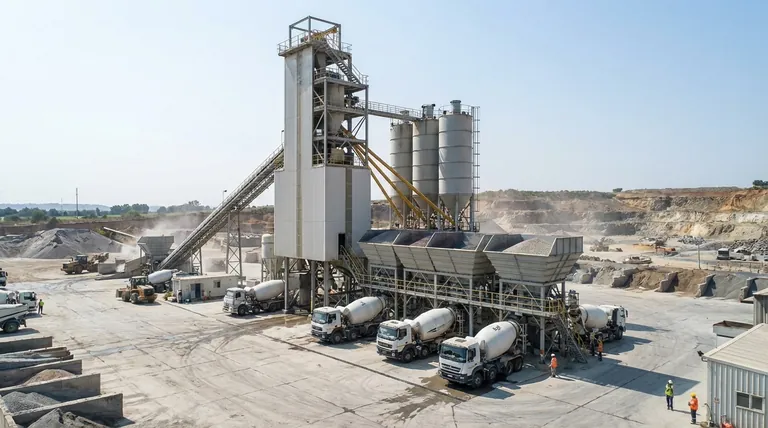
The Core Principle: Gravity-Fed Efficiency
A vertical concrete mixing plant's design is its key advantage. Understanding this principle clarifies why it excels in specific environments.
The Role of Gravity
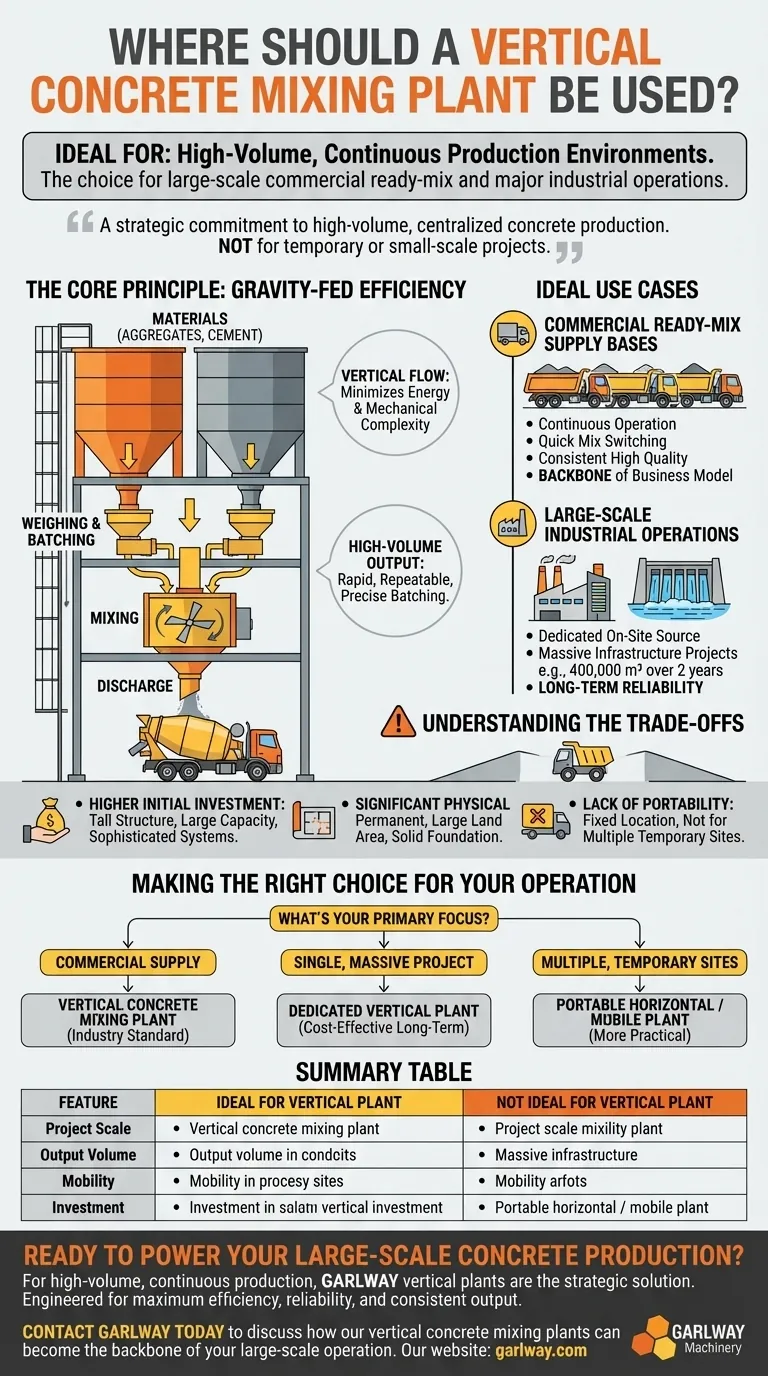
Materials are lifted to storage bins at the top of the plant. The entire production process—weighing, batching, and mixing—then uses gravity to feed materials downward.
This vertical flow is highly efficient, minimizing the energy and mechanical complexity required to move aggregates and cement through the system.
Designed for High-Volume Output
The gravity-fed design allows for rapid, repeatable, and precise batching. This makes vertical plants capable of producing a large volume of concrete per hour, consistently meeting the demanding schedules of commercial suppliers and large industrial sites.
The Ideal Use Cases Explained
The efficiency and high-output nature of vertical plants make them the standard choice for two primary applications.
Commercial Ready-Mix Supply Bases
These businesses supply concrete to a wide variety of construction projects simultaneously. They require a plant that can run continuously, switch between different mix designs quickly, and produce a consistently high-quality product for their customers.
A vertical plant is the backbone of this business model, providing the necessary throughput and reliability.
Large-Scale Industrial Operations
This includes precast concrete factories, which produce elements like beams and panels, or massive infrastructure projects like dams and airports. These projects demand a dedicated, on-site source of concrete.
For example, a project requiring 400,000 cubic meters of concrete over two years would justify a large, permanent vertical plant to ensure a steady and reliable supply.
Understanding the Trade-offs
While powerful, a vertical plant is not a universal solution. Its specialized design comes with significant considerations.
Higher Initial Investment
The tall structure, large storage capacity, and sophisticated batching systems require a substantial upfront capital investment compared to smaller, more mobile plant types.
Significant Physical Footprint
A vertical plant is a permanent or semi-permanent structure that requires significant land area and a solid foundation. Its height alone makes it a major construction project to install.
Lack of Portability
Unlike mobile or compact plants, a vertical plant cannot be easily moved from one job site to another. It is designed to operate from a fixed location for many years, making it unsuitable for contractors who manage multiple, smaller, short-term projects in different locations.
Making the Right Choice for Your Operation
Choosing the correct plant type requires matching the equipment's capabilities to your operational goals.
- If your primary focus is commercial supply: A vertical concrete mixing plant is the industry standard for establishing a ready-mix business.
- If your primary focus is a single, massive infrastructure project: A dedicated vertical plant is often the most cost-effective and reliable solution for long-term production.
- If your primary focus is serving multiple, temporary job sites: A more portable horizontal or mobile mixing plant would be a far more practical and economical choice.
Ultimately, selecting a vertical plant is a strategic commitment to high-volume, centralized concrete production.
Summary Table:
| Feature | Ideal for Vertical Plant | Not Ideal for Vertical Plant |
|---|---|---|
| Project Scale | Large-scale, continuous production | Small-scale, temporary projects |
| Output Volume | High-volume (e.g., commercial supply, dams) | Low to medium volume |
| Mobility | Fixed, permanent location | Multiple, short-term job sites |
| Investment | Substantial upfront capital | Lower initial investment |
Ready to Power Your Large-Scale Concrete Production?
If your operation involves high-volume, continuous concrete production for commercial supply or major industrial projects, a GARLWAY vertical concrete mixing plant is the strategic solution. We specialize in providing robust construction machinery—including winches, concrete mixers, and concrete batching plants—to construction companies and contractors globally.
Our vertical plants are engineered for maximum efficiency, reliability, and consistent output, helping you meet demanding project schedules and quality standards.
Contact GARLWAY today to discuss how our vertical concrete mixing plants can become the backbone of your large-scale operation.
Visual Guide
Related Products
- Construction Products Concrete Plant Machine Mixing Concrete Mixer
- HZS180 Ready Mix Concrete Plant for Foundations with Sand and Cement
- HZS35 Small Cement Concrete Mixing Batch Plant
- HZS75 Concrete Batching Plant Cement Mixer Price Concrete Mixer Bunnings Mixing Plant
- HZS120 Ready Mix Concrete Batching Plant Commercial Mud Cement Mixer
People Also Ask
- What factors should be considered when choosing between volumetric and traditional mixers? Optimize Your Concrete Project Strategy
- What is the difference between pan and planetary mixers? Choose the Right Mixer for Your Concrete Project
- When was the first concrete mixer developed and by whom? Discover the 1900 Breakthrough
- What is the average lifespan of a concrete mixer? Maximize Your Equipment's Lifespan & ROI
- What are the two broad types of concrete mixers? Choose the Right Mixer for Your Project



