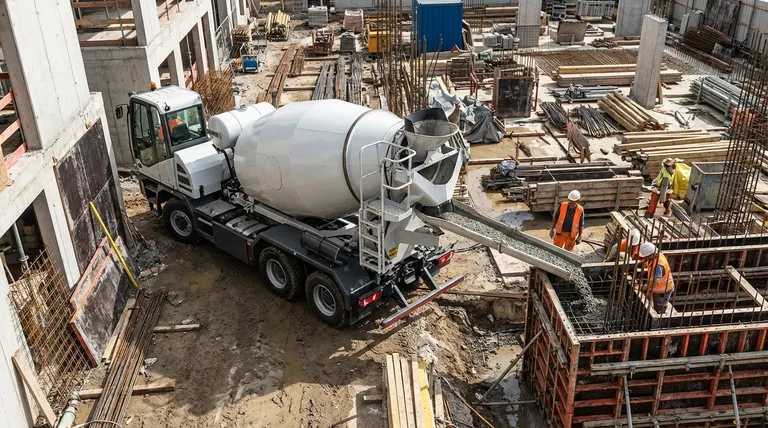
The primary advantage of a 270-degree rotating mixing tank is its ability to provide exceptional operational flexibility. This feature allows an operator to unload concrete from multiple angles and directions—to the front, sides, and rear of the vehicle—without having to constantly and precisely reposition the entire machine for each pour.
The 270-degree rotation is not merely a convenience; it is a core design element that transforms job site efficiency. It solves the critical challenges of working in constrained spaces and minimizes the time wasted on vehicle maneuvering.
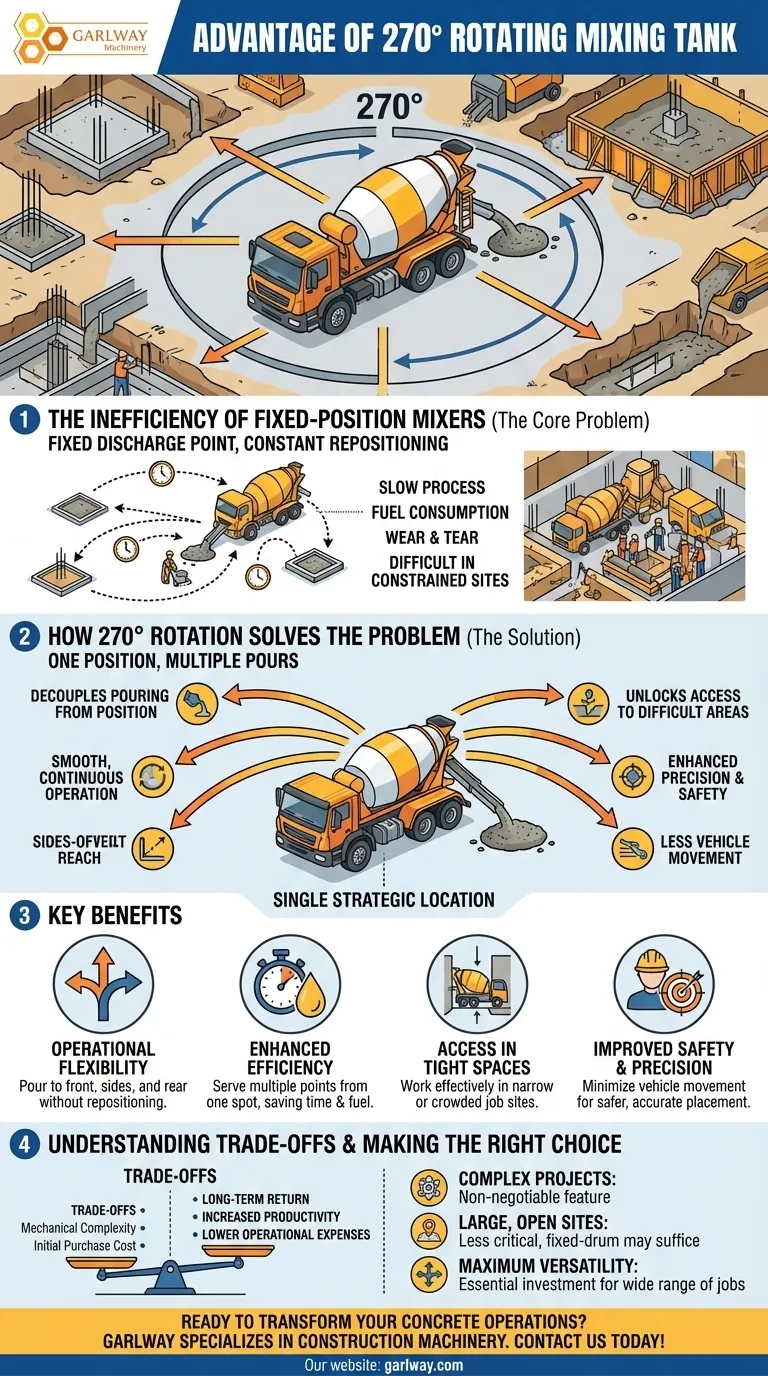
The Core Problem: The Inefficiency of Fixed-Position Mixers
To understand the value of a rotating tank, we must first recognize the limitations of traditional designs. Their fundamental constraint is a fixed discharge point.
The Constant Need to Reposition
With a standard mixer, the entire vehicle must be perfectly aligned for every pour. If concrete is needed in several spots, even a few feet apart, the operator must drive, reverse, and turn the heavy machine each time.
This constant repositioning is slow, consumes fuel, and increases wear and tear on the vehicle's drivetrain and tires.
The Challenge of Constrained Job Sites
Modern construction sites are often crowded with materials, other equipment, and personnel. Narrow access roads, tight corners, and nearby structures make it difficult, and sometimes impossible, to position a large truck mixer exactly where it needs to be.
This can lead to using wheelbarrows or pumps to move concrete, adding labor, cost, and time to the project.
How 270-Degree Rotation Solves the Problem
A rotating mixing tank fundamentally changes the workflow by decoupling the pouring action from the vehicle's position. It allows the machine to function more like a stationary tool with a long, flexible reach.
One Position, Multiple Pours
The operator can park the self-loading mixer in a single, strategic location. From that spot, they can rotate the drum and extend the chute to pour concrete into foundations, forms, or trenches across a wide arc.
This ability to serve multiple points from a fixed position is the single greatest driver of efficiency. It turns a multi-step, repetitive process into one smooth, continuous operation.
Unlocking Access to Difficult Areas
The 270-degree rotation enables work in spaces that are simply inaccessible to fixed mixers. The vehicle can be parked parallel to a trench or foundation, and the drum can be rotated 90 degrees to discharge concrete precisely over the side.
This opens up opportunities for projects in tight urban environments or complex industrial settings where maneuverability is severely limited.
Enhanced Precision and Safety
By minimizing vehicle movement, the operator can focus entirely on the pour itself. This leads to more precise placement of the concrete, reducing spillage, waste, and subsequent cleanup.
A stationary vehicle also creates a safer work environment, with less risk of accidents associated with the constant maneuvering of heavy equipment in a busy area.
Understanding the Trade-offs
While highly advantageous, this feature introduces certain considerations that are important for an objective evaluation.
Mechanical Complexity
The hydraulic system and slewing ring required for rotation add a layer of mechanical complexity compared to a simpler fixed-drum design. This means there are more components that require regular inspection and maintenance.
Initial Purchase Cost
Machines equipped with a 270-degree rotating drum typically have a higher upfront cost than their fixed-drum counterparts. The justification for this investment lies in the long-term return through increased productivity and lower operational expenses.
Making the Right Choice for Your Operation
Deciding whether this feature is essential depends entirely on your primary scope of work.
- If your primary focus is on complex or space-constrained projects: The 270-degree rotation is a non-negotiable feature that will directly translate to faster completion times and greater profitability.
- If you primarily work on large, open-access sites with simple pours: The benefits of rotation may be less critical, and a more basic, fixed-drum mixer could be a more cost-effective solution.
- If your goal is maximum versatility for a wide range of jobs: Investing in the rotational capability provides the flexibility to confidently bid on and efficiently execute almost any type of project that comes your way.
Ultimately, this feature transforms the machine from a simple concrete transporter into a comprehensive and highly efficient placement system.
Summary Table:
| Advantage | Key Benefit |
|---|---|
| Operational Flexibility | Pour concrete to the front, sides, and rear without repositioning the entire vehicle. |
| Enhanced Efficiency | Serve multiple pour points from a single parking spot, saving time and fuel. |
| Access in Tight Spaces | Work effectively in narrow or crowded job sites where maneuvering is limited. |
| Improved Safety & Precision | Minimize vehicle movement for safer, more accurate concrete placement. |
Ready to transform your concrete operations with a 270-degree rotating mixing tank? GARLWAY specializes in construction machinery, offering advanced self-loading mixers, winches, and batching plants designed for construction companies and contractors globally. Our solutions deliver the flexibility, efficiency, and reliability you need to tackle any project—big or small. Contact us today to discuss how we can boost your productivity and profitability!
Visual Guide
Related Products
- Portable Cement Mixer with Lift Concrete Machine
- HZS35 Small Cement Concrete Mixing Batch Plant
- HZS180 Ready Mix Concrete Plant for Foundations with Sand and Cement
- HZS120 Ready Mix Concrete Batching Plant Commercial Mud Cement Mixer
- Mini Cement Mortar Mixer Truck for Construction
People Also Ask
- What are the size and portability options for portable cement mixers? Find Your Perfect Match for Any Job
- Why is it necessary to use a portable concrete mixer? Gain Total Control & Efficiency
- How much concrete can you pour with a portable mixer? Find the Perfect Fit for Your Project
- What is a portable cement mixer? Achieve Consistent, On-Demand Concrete Mixing
- What are the power sources for portable cement mixers? Choose the Right Power for Your Job Site