
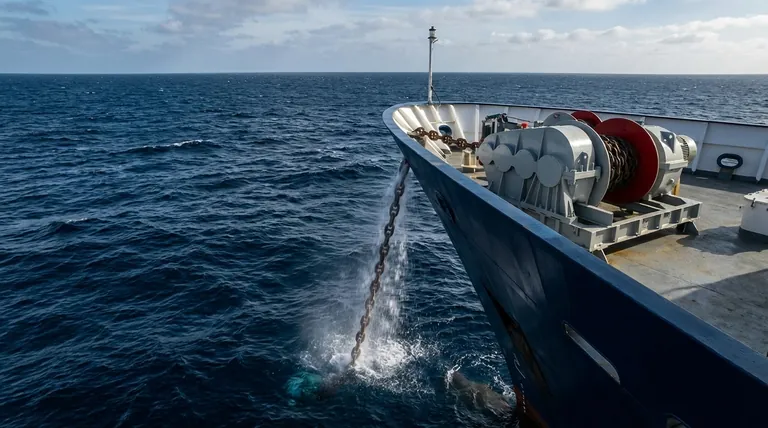
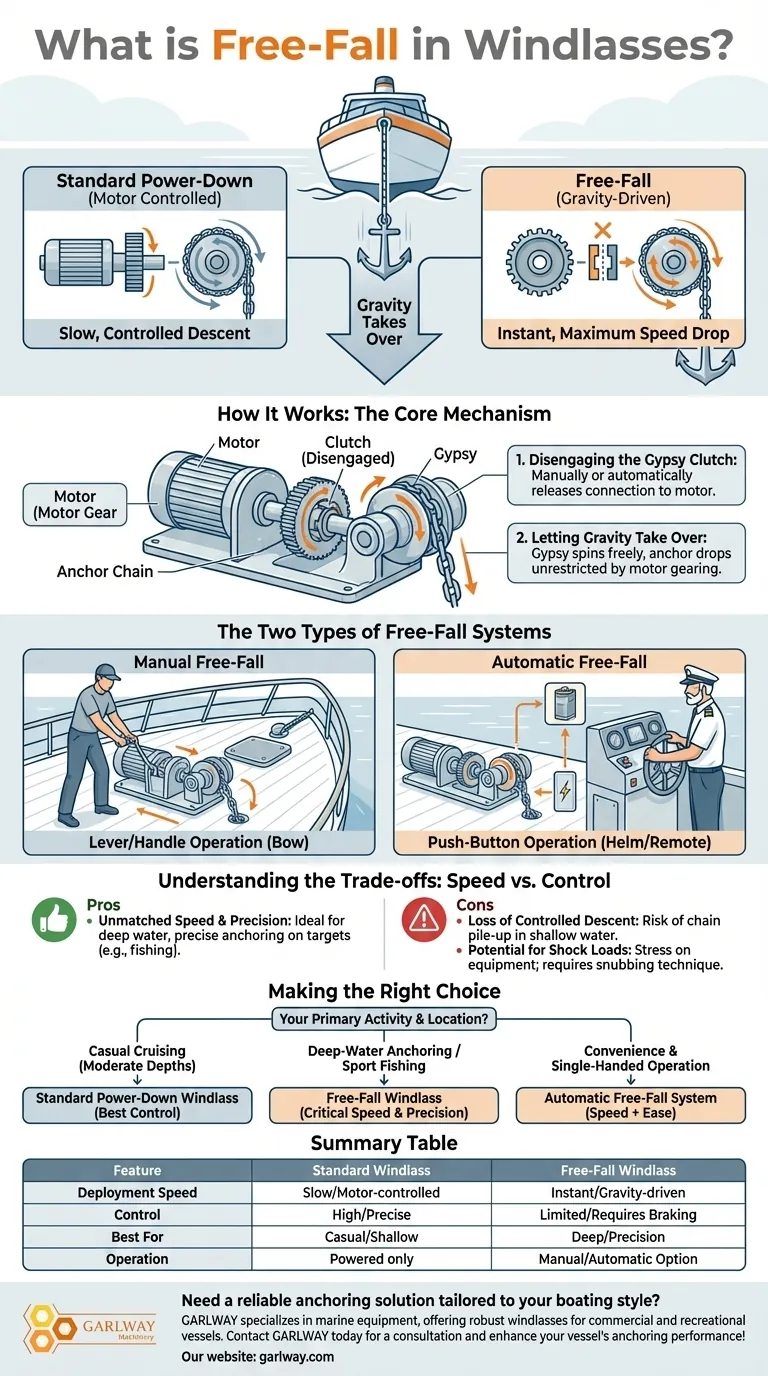
At its core, a free-fall windlass is a system that allows your anchor to drop at maximum speed, completely unrestricted by the motor. It achieves this by disengaging the clutch that connects the windlass motor to the gypsy, letting gravity do all the work for a rapid and precise deployment.
The essential difference between a standard windlass and one with free-fall is the choice it offers: you can have either a slow, controlled power-down or an instantaneous, gravity-driven drop for specific anchoring situations.
How Free-Fall Works: The Core Mechanism
A free-fall feature fundamentally changes how you deploy your anchor by introducing a way to bypass the windlass's gearing. Understanding this mechanism is key to knowing when to use it.
Disengaging the Gypsy Clutch
Every windlass has a gypsy, the notched wheel that grips the anchor chain. This gypsy is connected to the motor through a clutch. A free-fall system allows you to manually or automatically disengage this clutch on demand.
Letting Gravity Take Over
Once the clutch is released, the gypsy spins freely. The only force acting on your anchor and chain is gravity, causing them to plummet towards the seabed. This is what enables the "unlimited down speed" mentioned in technical descriptions.
The Contrast with Powered Deployment
Without free-fall, the only way to lower the anchor is with a "power-down" function. The motor actively turns the gypsy in reverse at a fixed, relatively slow speed. This method offers excellent control but is significantly slower.
The Two Types of Free-Fall Systems
Windlass manufacturers typically offer two ways to implement this feature, each with its own operational advantages.
Manual Free-Fall
This is the simplest and most direct system. It typically involves a lever or handle on the windlass unit itself. A crew member at the bow must physically operate it to release the clutch and initiate the free-fall.
Automatic Free-Fall
This system adds a layer of convenience and remote operation. An electrical command, usually from a button at the helm, activates a solenoid or other actuator that disengages the clutch. This allows the captain to drop anchor instantly without leaving the controls.
Understanding the Trade-offs: Speed vs. Control
While rapid deployment sounds like a clear benefit, free-fall is a specialized tool with distinct pros and cons. It is not inherently superior to a standard power-down system; it simply serves a different purpose.
The Pro: Unmatched Speed and Precision
The primary benefit is speed. In deep water, a powered descent can take a frustratingly long time. For fishermen trying to position themselves over a specific wreck or ledge, free-fall allows them to drop anchor the moment they are in the perfect spot, preventing the boat from drifting past the target.
The Con: Loss of Controlled Descent
The speed of free-fall means you lose the deliberate control of a powered system. In shallow water or calm conditions, the chain can drop so quickly that it piles up on top of the anchor on the seabed, increasing the risk of a fouled anchor that won't set correctly.
The Con: Potential for Shock Loads
A rapidly descending chain that comes to a sudden stop puts significant stress on the anchor rode, bow roller, and windlass itself. Proper technique requires "snubbing" or gradually braking the chain's descent as it nears the bottom to avoid damaging the equipment.
Making the Right Choice for Your Anchoring Needs
Choosing a windlass with or without a free-fall feature depends entirely on your primary boating activity and location.
- If your primary focus is casual cruising in moderate depths: A standard power-down windlass provides excellent control and is often the most reliable and straightforward choice.
- If your primary focus is deep-water anchoring or sport fishing: A free-fall system provides a critical advantage for speed and precise anchor placement over specific targets.
- If your primary focus is convenience and single-handed operation: An automatic free-fall system offers the benefits of speed with the ease of push-button control from the helm.
Ultimately, understanding free-fall empowers you to select an anchoring system that truly matches the speed and precision your boating demands.
Summary Table:
| Feature | Standard Windlass | Free-Fall Windlass |
|---|---|---|
| Deployment Speed | Slow, motor-controlled | Instant, gravity-driven |
| Control | High, precise power-down | Limited, requires braking technique |
| Best For | Casual cruising, shallow water | Deep-water fishing, precise positioning |
| Operation | Powered descent only | Manual or automatic free-fall option |
Need a reliable anchoring solution tailored to your boating style? GARLWAY specializes in marine equipment, offering robust windlasses and deck machinery for commercial and recreational vessels globally. Whether you require the rapid deployment of a free-fall system or the controlled power of a standard windlass, our experts can help you select the perfect equipment for safety and efficiency. Contact GARLWAY today for a consultation and enhance your vessel's anchoring performance!
Visual Guide
Related Products
- Quick Windlass Portable Winch for Truck and Boat Best Boat Winch
- Electric Hoist Winch Boat Anchor Windlass for Marine Applications
- Warn Winch Windlass Boat Trailer Winch
- Heavy Duty Electric Boat Winch Windlass Anchor
- 12000 lb Electric Boat Trailer Winch with Windlass Anchor Warn
People Also Ask
- What features were incorporated into the upgraded portable winch system? Boost Your Recovery Power & Safety
- What are some uses mentioned for portable winches beyond vehicle recovery? Essential Versatility for Property & Work
- How could the twisting issue with a portable winch be mitigated? Achieve Safe, Centered Pulls with Proper Rigging
- What are the primary uses of a portable winch for a truck? Boost Your Truck's Capability and Self-Reliance
- What is the single rope traction force of the quick winch without a pulley block? 0.5 to 40 Tons Explained


