
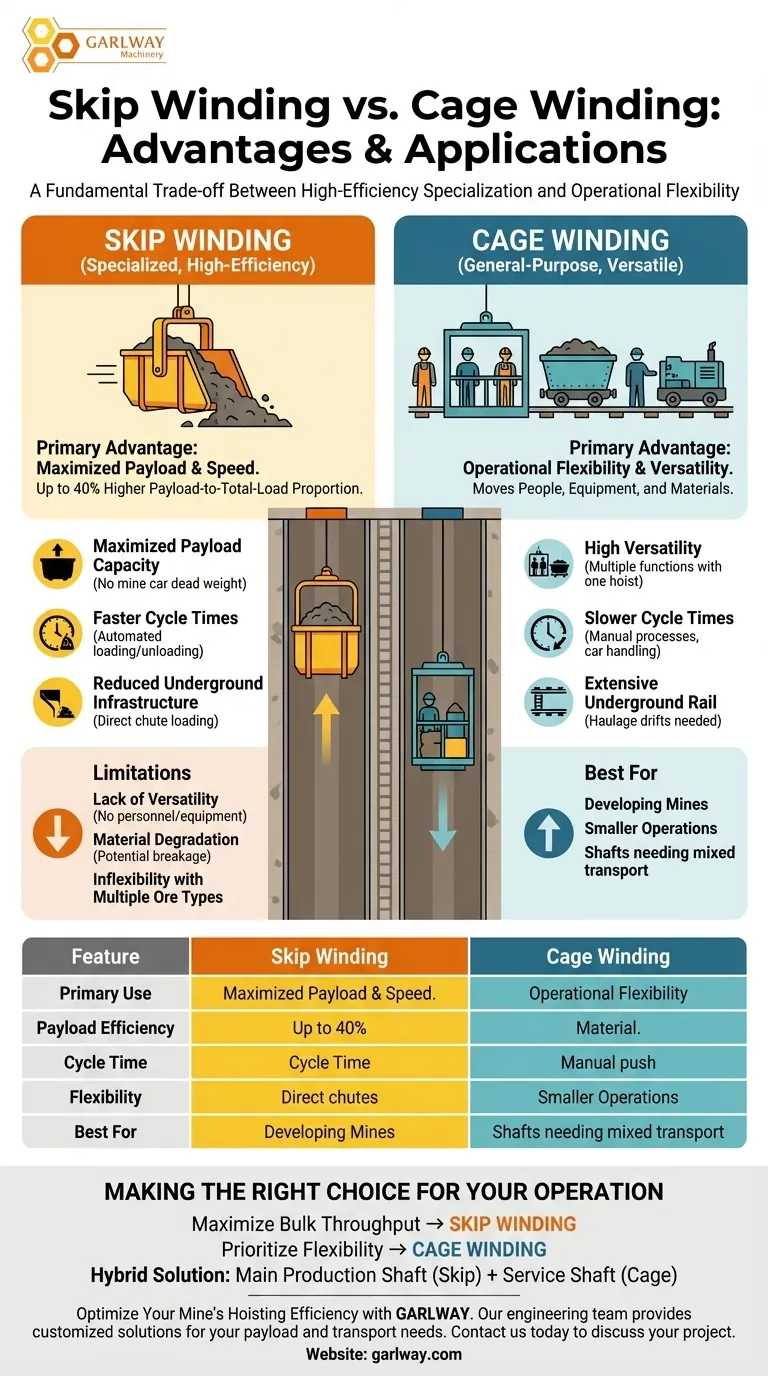
The primary advantages of skip winding are its significantly larger payload capacity and faster operational cycle times compared to cage winding. By design, a skip winder dedicates its entire function to moving bulk material, which increases the crucial payload-to-total-load proportion by as much as 40% and allows for more rapid loading and unloading.
A skip winder is a specialized tool for maximizing the vertical transport of bulk material. A cage winder is a general-purpose elevator for a mine shaft. The choice between them is a fundamental trade-off between high-efficiency specialization and operational flexibility.
The Core Difference: Specialized vs. General-Purpose
To understand the advantages, it's essential to recognize that skip and cage winders are designed for fundamentally different tasks within a mine or industrial shaft.
What is a Skip Winder?
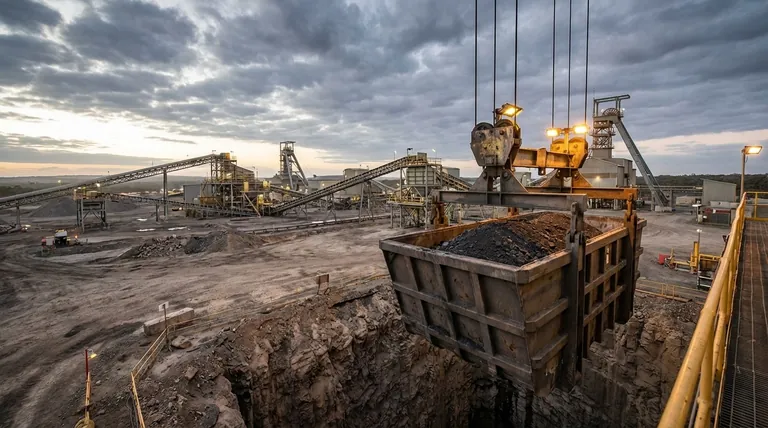
A skip is essentially a large bucket integrated directly into the hoisting system. Its sole purpose is to be filled with ore, coal, or waste rock at a lower level and hoisted to the surface to be automatically dumped into a bin or onto a conveyor.
The entire system is optimized for one thing: moving the maximum amount of loose material in the minimum amount of time.
What is a Cage Winder?
A cage is a platform, similar to an industrial elevator car. It is designed to carry personnel, equipment, and mine cars (trams or wagons) filled with material.
Its purpose is versatility. The same hoist can be used to transport workers at the start of a shift, move a piece of machinery mid-day, and haul cars of ore at other times.
Key Advantages of Skip Winding
The specialization of skip winding creates significant efficiencies in high-volume operations.
Maximized Payload Capacity
A skip's payload is the material itself. A cage's payload is a mine car plus the material inside it.
By eliminating the dead weight of the mine car, the skip can carry significantly more valuable material per trip, using the same amount of hoisting power. This is the source of the nearly 40% increase in payload efficiency.
Faster Cycle Times
Skip winding systems are built for speed. Material is typically loaded into the skip from a pre-filled measuring flask or chute, a process that takes only seconds.
At the surface, the skip automatically tips or opens a bottom door to discharge its load. This is far faster than the manual process of pushing mine cars out of a cage, taking them to a tippler, and returning the empty cars.
Reduced Underground Infrastructure
Because skips are loaded directly from chutes, they can reduce the need for extensive underground rail networks (haulage drifts) focused on moving mine cars to the shaft bottom. Material can be brought to a central crushing and storage point that feeds the skip directly.
Increased Automation Potential
The loading and discharge process for a skip is simple and repetitive, making it highly suitable for full automation. This reduces labor requirements at the busiest points of the hoisting system—the loading and unloading stations.
Understanding the Trade-offs
Despite its efficiency, skip winding is not always the superior choice. Its specialization comes with critical limitations.
Lack of Versatility
The most significant disadvantage is the inability to transport people or large equipment. A shaft dedicated to skip winding requires a separate, smaller hoist (a service or man-riding hoist) for all other transportation needs.
Material Degradation
The process of dropping ore into a loading flask and then dumping it from the skip at the surface can cause breakage. This can be a major issue for friable materials like high-grade coal, where size and integrity are critical for sale value.
Inflexibility with Multiple Ore Types
If a mine is extracting different types of ore that must be kept separate, cage winding with dedicated mine cars can be simpler to manage. A skip system would require complex chute and bin arrangements to prevent cross-contamination.
Making the Right Choice for Your Operation
Choosing the correct winding system is dependent on the primary goal of the shaft.
- If your primary focus is maximum bulk throughput: Skip winding is the definitive choice for its superior payload, speed, and automation capabilities in high-volume mines.
- If your primary focus is flexibility: Cage winding is essential for shafts that must move personnel, machinery, and materials, which is common in developing mines or smaller operations.
- If you need a hybrid solution: Many large mines use both. A main production shaft will be equipped with high-capacity skips, while a secondary service shaft uses a cage for all other duties.
Ultimately, the decision rests on whether the shaft's purpose is pure production efficiency or operational versatility.
Summary Table:
| Feature | Skip Winding | Cage Winding |
|---|---|---|
| Primary Use | Bulk material transport | Personnel, equipment, and material transport |
| Payload Efficiency | Up to 40% higher | Lower (carries mine car + material) |
| Cycle Time | Faster (automated loading/unloading) | Slower (manual processes) |
| Flexibility | Low (specialized for material) | High (versatile for various needs) |
| Best For | High-volume production shafts | Developing mines, smaller operations |
Optimize Your Mine's Hoisting Efficiency with GARLWAY
Choosing the right winding system is critical for your mine's productivity and profitability. GARLWAY specializes in robust construction machinery, including advanced hoisting solutions for demanding mining and industrial applications. Our expertise can help you determine whether a high-capacity skip winder or a versatile cage system is the right fit for your operational goals.
Let our engineering team provide a customized solution to maximize your payload capacity and streamline your vertical transport. Contact GARLWAY today to discuss your project requirements and receive a professional consultation.
Visual Guide
Related Products
People Also Ask
- How does the control system improve production efficiency in a self loading concrete mixer? Automate Mixing for Speed & Quality
- What is the purpose of keeping the drum rotating during transportation in a self loading concrete mixer? Ensure Quality & Consistency
- How does the weighing process work in a self loading concrete mixer? Achieve Precise, On-Site Concrete Batching
- What components are involved in the loading process of a self loading concrete mixer? A Guide to the Key Systems
- How should materials be loaded into a self-loading concrete mixer? Master the Step-by-Step Process
