
In simple terms, an anchor windlass is a mechanical device on a boat or ship used to raise and lower the anchor and its chain. It acts as a powerful winch, providing the mechanical advantage needed to handle the immense weight of the anchor system, which would be impossible to manage by hand. Its primary function is to give you precise control over deploying and retrieving your anchor safely and efficiently.
At its core, an anchor windlass solves a fundamental problem of scale and safety. It transforms the dangerous and difficult task of managing hundreds of pounds of anchor and chain into a controlled, manageable operation, which is essential for safely securing a vessel.
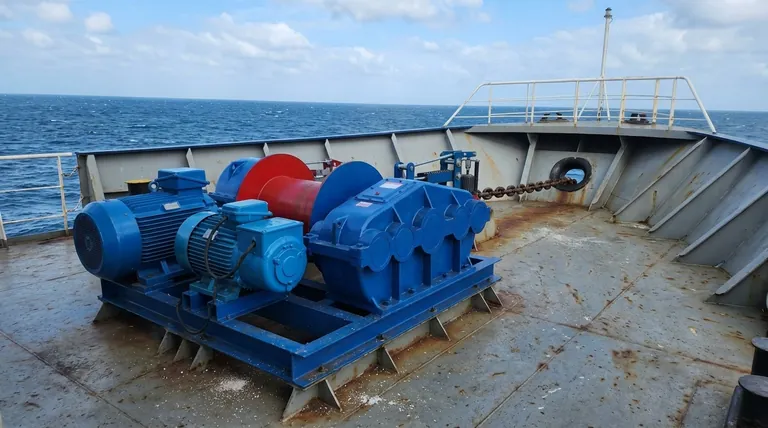
How a Windlass Provides Control and Power
A windlass isn't just about raw strength; it's a system designed for precise control during one of a vessel's most critical maneuvers. It multiplies force and ensures the anchor chain doesn't run free.
The Core Mechanism: From Motor to Chain
The system is driven by an electric motor (or in some cases, manual cranks). This motor turns a series of gears which multiply the force significantly.
These gears rotate a specialized wheel that grips the anchor chain, pulling it up from the seabed or paying it out in a controlled manner.
The Role of the Gypsy
The heart of the windlass is the gypsy (also known as a wildcat). This is a notched wheel specifically designed to interlock with the links of the anchor chain.
As the gypsy turns, its notches grab the chain, ensuring a non-slip grip to hoist the heavy anchor or prevent the chain from deploying too quickly.
The Importance of the Brake
Every windlass includes a braking system. The brake is not for stopping the boat, but for controlling the speed at which the anchor chain is lowered.
This prevents the anchor from free-falling, which could damage the vessel or the windlass itself, and allows for precise placement on the seabed.
Deconstructing the Key Components
Understanding the main parts of a windlass reveals how it achieves its purpose. Each component has a distinct and critical job.
The Power Train: Motor and Clutch
The electric motor is the source of power. It's connected to the gypsy via a clutch (often a dog clutch).
The clutch allows the operator to engage or disengage the gypsy from the motor. When disengaged, the gypsy can spin freely, which is essential for controlled anchor deployment using the brake.
Securing the Load: The Chain Stopper
Once the anchor is deployed and set, or fully retrieved, the immense load of the chain is taken off the windlass by a separate device called a chain stopper (or pawl bar / Devil's Claw).
This is a critical safety feature. It's a simple, robust mechanical lock that holds the chain, protecting the windlass's gearbox and motor from constant strain and shock loads.
Guiding the Chain: The Hawsepipe
The hawsepipe is the metal tube that runs through the boat's deck and hull. Its simple but vital job is to guide the anchor chain smoothly from the windlass down into the chain locker below deck.
Understanding the Trade-offs: Vertical vs. Horizontal Designs
Windlasses primarily come in two distinct orientations, each with its own advantages based on the vessel's size and design.
The Horizontal Windlass
In a horizontal design, the entire windlass—motor, gearbox, and gypsy—is mounted horizontally on the deck.
This configuration is robust, easy to install, and provides simple access for maintenance. It is often preferred on larger commercial or cruising vessels where deck space is less of a concern.
The Vertical Windlass
A vertical windlass has a more compact on-deck profile because only the gypsy and housing are visible. The motor and gearbox are installed below the deck.
This design is ideal for smaller boats where deck space is at a premium. The main trade-off is that maintenance and service require accessing the components from below deck.
Making the Right Choice for Your Goal
The type of windlass you need depends entirely on the design of your vessel and your priorities.
- If your primary focus is maximizing deck space on a recreational boat: A vertical windlass is the ideal choice due to its minimal and clean on-deck footprint.
- If your primary focus is durability and ease of maintenance on a larger vessel: A horizontal windlass offers robust, fully on-deck access to all its components.
Ultimately, an anchor windlass is not a luxury but a fundamental system for safe and controlled vessel management.
Summary Table:
| Component | Function | Key Benefit |
|---|---|---|
| Gypsy (Wildcat) | Grips and moves the anchor chain | Ensures a non-slip, secure hold |
| Brake System | Controls chain deployment speed | Prevents dangerous free-fall |
| Chain Stopper | Secures the chain load | Protects the windlass from strain |
| Clutch | Engages/disengages the gypsy | Allows for controlled lowering |
Ensure your vessel's safety with the right equipment.
An anchor windlass is a critical system for safe and efficient vessel management. At GARLWAY, we specialize in robust and reliable mechanical solutions. Our expertise in winches and heavy-duty equipment translates directly to the marine industry's need for powerful, dependable systems.
Whether you operate a commercial ship or a large recreational vessel, we can help you specify or source the right components for your anchor handling needs.
Contact GARLWAY today to discuss your requirements and enhance your vessel's operational safety and efficiency.
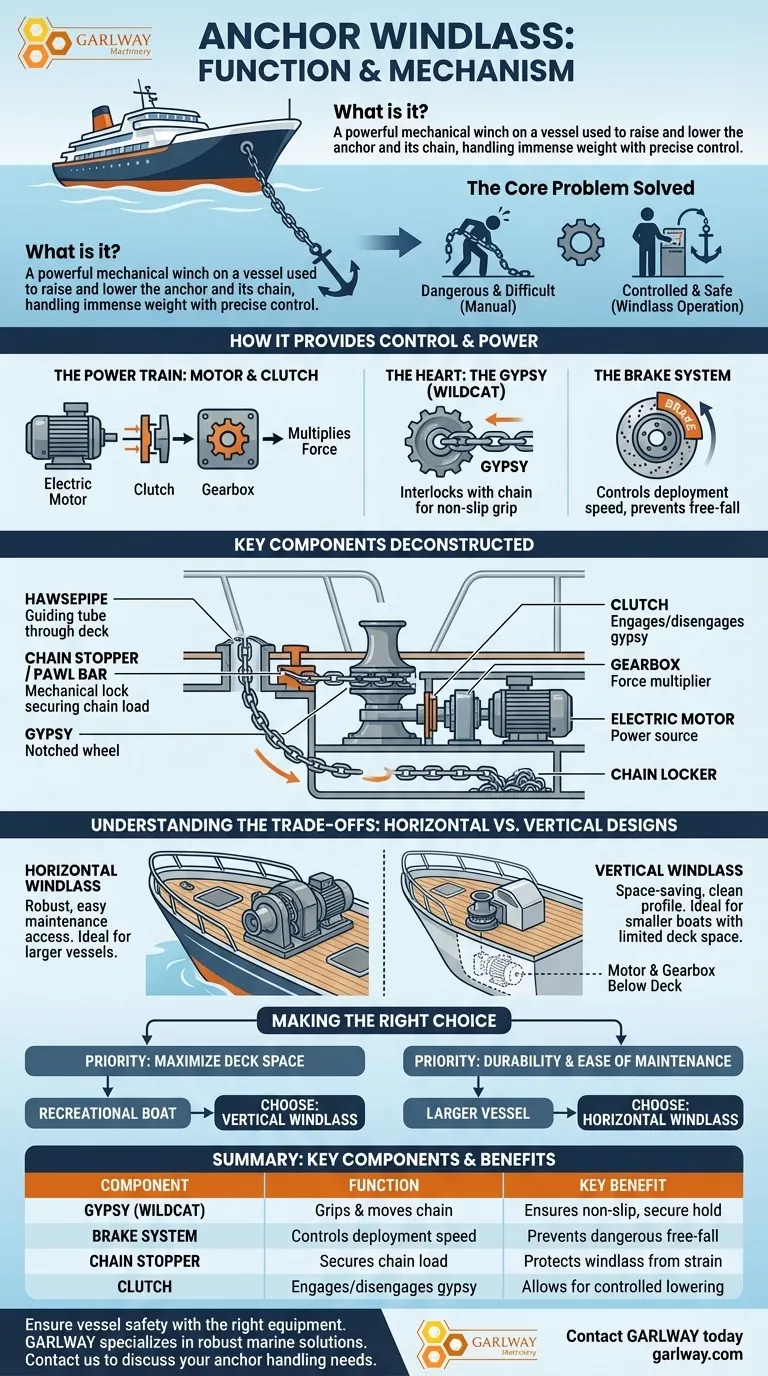
Visual Guide
Related Products
- Electric Hoist Winch Boat Anchor Windlass for Marine Applications
- Heavy Duty Electric Boat Winch Windlass Anchor
- 12000 lb Electric Boat Trailer Winch with Windlass Anchor Warn
- Quick Windlass Portable Winch for Truck and Boat Best Boat Winch
- Warn Winch Windlass Boat Trailer Winch
People Also Ask
- How does an electric anchor winch work? Power, Safety, and Reliable Operation Explained
- What are the advantages of installing an electric anchor winch on a boat? Boost Safety & Ease for Boaters
- What are the operational differences between electric hoists and winches? A Guide to Safe Lifting vs. Pulling
- What are the main benefits of a boat anchor winch? Boost Safety & Efficiency for Your Vessel
- How does a boat anchor winch work? A Guide to Reliable Anchor Handling


