
For a 5,000 lb truck, you need a winch with a minimum pulling capacity of 10,000 lbs. This recommendation is based on the industry-standard formula of multiplying your truck's Gross Vehicle Weight (GVW) by a factor of 1.5 to 2.0. Opting for the 2.0 multiplier ensures you have enough power for real-world recovery situations, which almost always involve more resistance than the vehicle's weight alone.
Choosing a winch isn't about lifting your truck's weight; it's about overcoming the combined forces of gravity, friction, and resistance when it's truly stuck. Doubling your vehicle's weight for the winch rating provides the necessary safety margin for difficult recoveries.
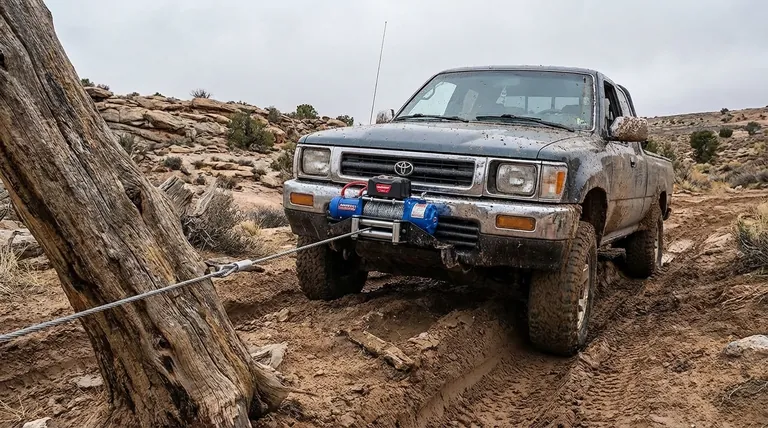
The Core Sizing Formula Explained
The process for sizing a winch is straightforward, but it's critical to understand the components of the calculation to appreciate why a significant safety margin is necessary.
H3: Start with Gross Vehicle Weight (GVW)
The number you must use is your vehicle's Gross Vehicle Weight (GVW), not its curb weight. This is the weight of the truck fully loaded with passengers, fuel, and all your gear.
A truck listed at 5,000 lbs curb weight can easily approach 6,000 lbs when loaded for a trip, which should be your new baseline for calculation.
H3: The 1.5x Multiplier: The Absolute Minimum
The absolute floor for winch capacity is 1.5 times your GVW. For a 5,000 lb truck, this would be a 7,500 lb winch.
This is considered the bare minimum and is only suitable for very light-duty, straight-line pulls on flat, hard-packed surfaces. It leaves very little room for error or complications.
H3: The 2.0x Multiplier: The Recommended Standard
The widely accepted and safer standard is to use a 2.0 multiplier. For your 5,000 lb truck, this results in a 10,000 lb winch.
This larger capacity accounts for the common variables you will inevitably face in a real recovery situation.
Why You Need So Much Extra Capacity
A vehicle recovery is never a simple lift. The winch must fight against several forces that can dramatically increase the load beyond the truck's static weight.
H3: The Force of Resistance
If your truck is stuck in deep mud, snow, or sand, a powerful suction effect is created. This resistance can easily add thousands of pounds of force that your winch must overcome.
H3: The Challenge of Inclines
Pulling a vehicle up even a moderate slope requires significantly more force than pulling it on flat ground. Gravity becomes a primary opponent, adding to the total load on the winch.
H3: How a Winch Loses Power
A winch's maximum rated pulling power is only available on the first wrap of cable around the drum.
With each additional layer of cable spooled onto the drum, the winch's effective pulling power decreases. Most recoveries happen with several layers of cable out, meaning you are rarely operating at the winch's maximum rated capacity.
Understanding the Trade-offs
Choosing the right size is a balance. Going too small is dangerous, but going excessively large has its own disadvantages.
H3: The Risk of an Undersized Winch
An undersized winch will be under constant strain during a recovery. This leads to overheating the motor, potentially damaging components, and creating a significant risk of catastrophic failure when you need it most.
H3: The Downsides of an Oversized Winch
A much larger winch (e.g., 16,500 lbs for a 5,000 lb truck) is heavier, which puts more constant stress on your front suspension. It also draws more amperage, which can tax your vehicle's alternator and battery.
Finally, oversized winches are more expensive and can present mounting challenges on smaller bumpers. Sticking to the 2.0x rule is the ideal balance.
Making the Right Choice for Your 5,000 lb Truck
Use your intended application to finalize your decision. For a 5,000 lb truck, your options center around the 10,000 lb mark.
- If your primary focus is occasional light recovery on mostly flat terrain: An 8,000 lb winch is the absolute minimum, but a 9,500 lb to 10,000 lb winch is a much safer and more reliable investment.
- If your primary focus is regular off-roading with potential for mud, snow, or hills: A 10,000 lb winch is the correct and definitive choice for reliability and safety.
- If your primary focus is serious overland travel or you anticipate recovering other, heavier vehicles: Upgrading to a 12,000 lb winch provides an extra margin of safety and reduces strain on the equipment during difficult pulls.
Ultimately, selecting a winch based on realistic challenges, not just vehicle weight, is the key to safe and successful recovery.
Summary Table:
| Vehicle Weight (GVW) | Minimum Winch Size (1.5x) | Recommended Winch Size (2.0x) | Use Case |
|---|---|---|---|
| 5,000 lbs | 7,500 lbs | 10,000 lbs | Standard off-road recovery |
| 5,000 lbs (loaded) | 9,000 lbs | 12,000 lbs | Heavy-duty or inclined terrain |
Need a reliable winch for your 5,000 lb truck? GARLWAY specializes in high-performance construction machinery, including durable winches, concrete mixers, and batching plants designed for contractors and construction companies worldwide. Our 10,000 lb winches provide the power and safety margin you need for tough recoveries. Contact GARLWAY today to get a quote and enhance your equipment's capabilities!
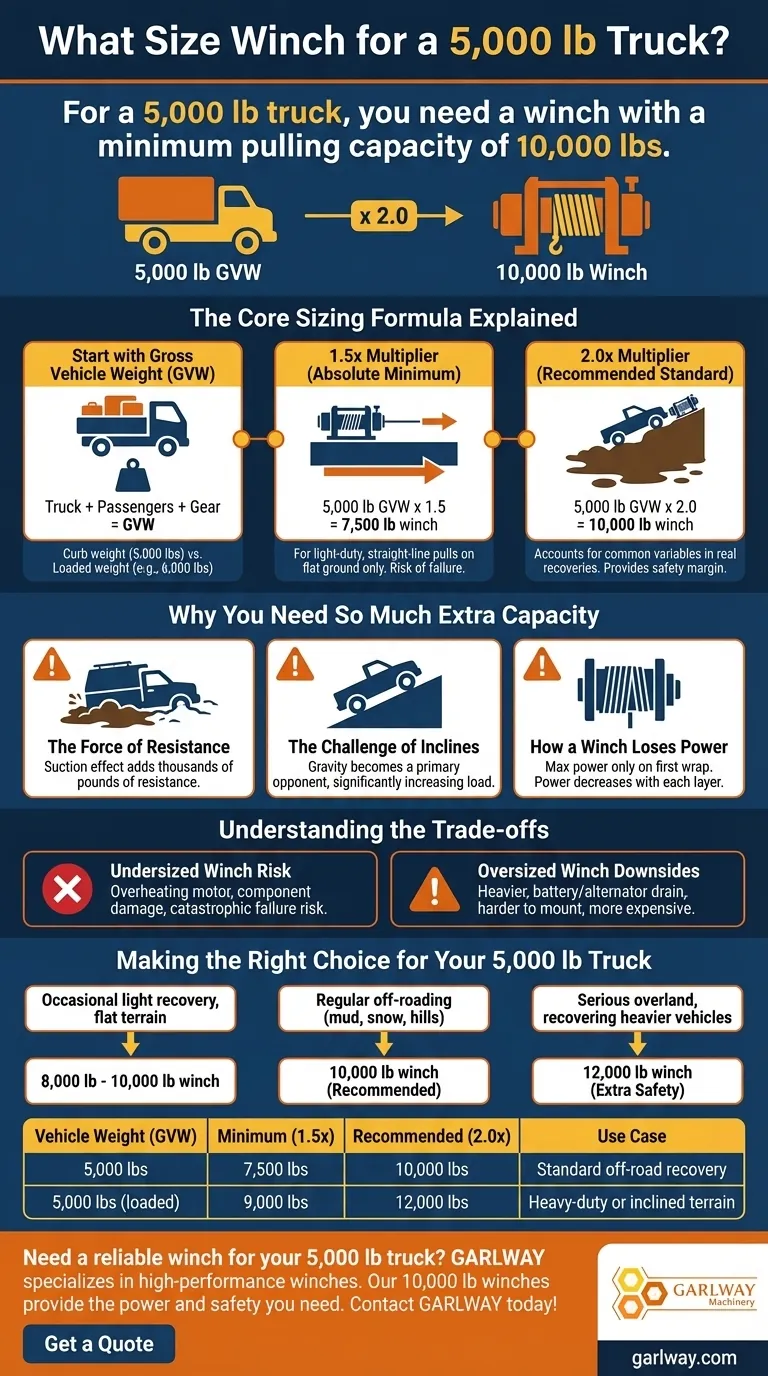
Visual Guide
Related Products
- Warn Winch Windlass Boat Trailer Winch
- Electric and Hydraulic Winch for Heavy Duty Applications
- Small Electric Winch 120V and 240V for Compact Applications
- Quick Windlass Portable Winch for Truck and Boat Best Boat Winch
- Hydraulic Winding Engine Harbor Freight Winch
People Also Ask
- What are the main components of a boat trailer winch? A Guide to Safe & Efficient Boat Loading
- What factors should be considered when choosing a boat trailer winch? Ensure Safe and Effortless Boat Loading
- What is the purpose of boat trailer winches? Safely and Efficiently Load Your Boat
- What are the two main types of boat trailer winches? Manual vs. Electric Explained
- How often should a boat trailer winch be replaced? Your Guide to Safety and Longevity





