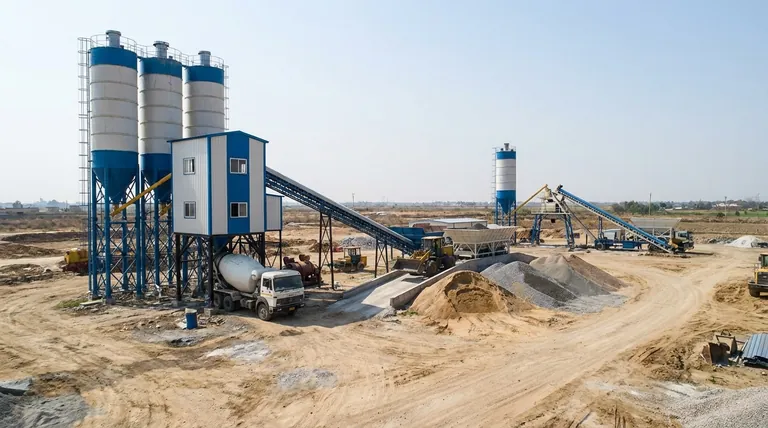
At its core, a concrete plant is an assembly of machines designed to precisely combine raw materials into concrete. The primary components are systems for storing aggregates and cement, weighing each ingredient, mixing them thoroughly, and controlling the entire automated process.
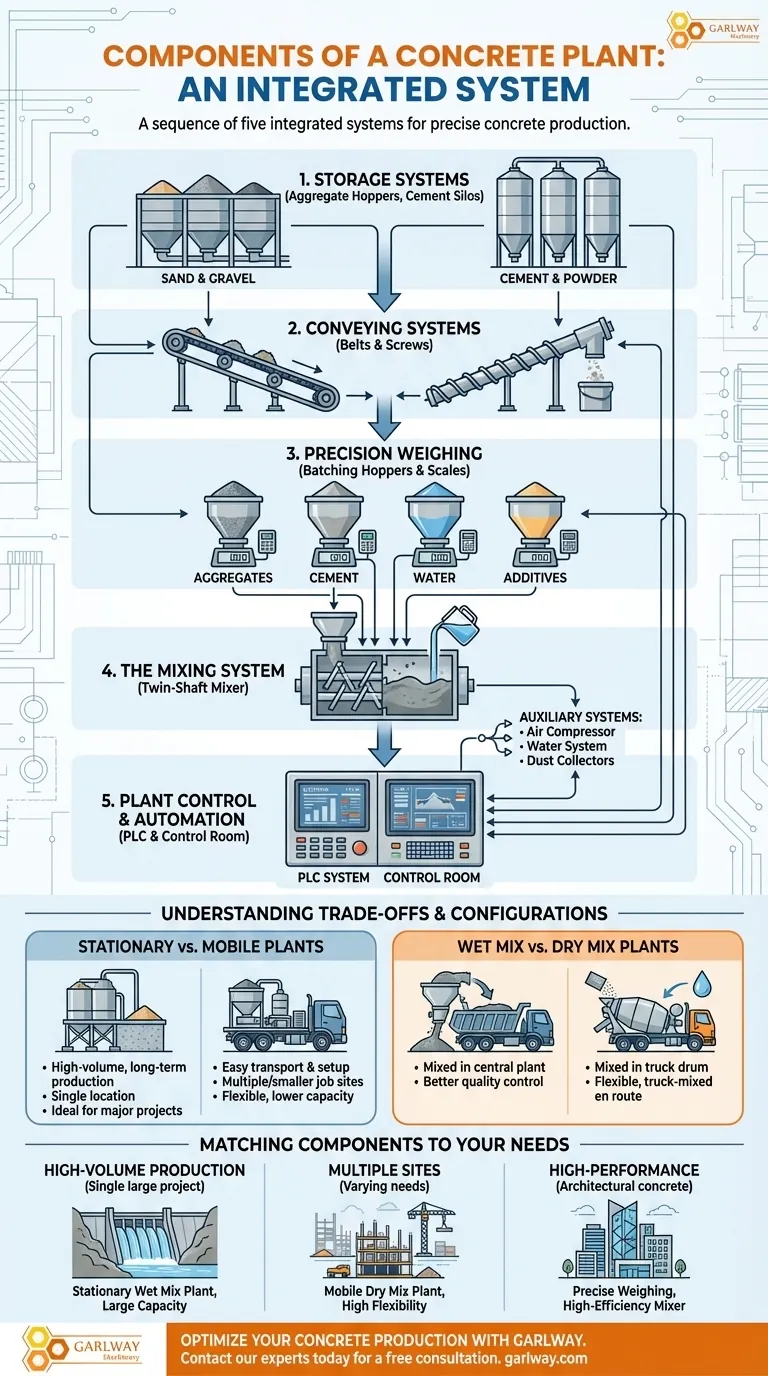
A concrete plant isn't just a collection of parts, but a sequence of five integrated systems: storage, conveying, weighing (batching), mixing, and control. Understanding how these systems interact is key to understanding the plant's function.
The Core Systems of a Concrete Plant
A concrete plant operates like a highly precise recipe kitchen. Each system performs a specific function in sequence to ensure the final product meets exact specifications.
Material Storage Systems
This is the starting point for all raw materials. Proper storage is crucial for protecting materials from the elements and ensuring a continuous supply.
The main storage components are aggregate hoppers (or bunkers) for sand and gravel, and cement silos for storing powdered cementitious materials.
Material Conveying Systems
Once stored, materials must be moved to the weighing and mixing stages. This is the role of the conveying system.
Aggregate transfer conveyors, which are typically belts, move sand and gravel from the hoppers to the weighing system. Screw conveyors are used to transport cement from the silos with high precision.
Precision Weighing (The "Batcher")
This is the most critical stage for concrete quality. The "batching" process involves accurately weighing each ingredient according to the specific mix design.
Separate weighing hoppers are used for aggregates, cement, water, and chemical additives. This separation ensures that each component is measured precisely before being introduced to the mixer.
The Mixing System
This is where the individual ingredients are combined into a homogenous mixture. The quality of the mix is directly dependent on the efficiency of the mixer.
The heart of this system is the concrete mixer, often a twin-shaft mixer, which is designed to blend all components thoroughly and consistently.
Plant Control and Automation
The entire operation is synchronized by a central control system. This is the brain of the plant, ensuring speed, accuracy, and repeatability.
A control room houses the main software and a PLC (Programmable Logic Controller) system. This system automates the control of valves, motors, and conveyors, managing the entire process from batching to mixing.
Essential Auxiliary Systems
Several other components are vital for the plant's operation and safety.
These include an air compressor to power the pneumatic systems (like opening and closing gates), a water system (tank and pump), and dust collectors to control environmental pollution.
Understanding the Trade-offs
Not all concrete plants are built the same. The specific configuration of components depends on the intended use, scale, and logistical needs of the project.
Stationary vs. Mobile Plants
A stationary plant is designed for high-volume, long-term production in a single location, like for a precast factory or a major dam project.
A mobile plant is designed for easy transport and setup, making it ideal for contractors who serve multiple, smaller job sites or temporary projects. This flexibility often comes at the cost of lower production capacity.
Wet Mix vs. Dry Mix Plants
In a wet mix plant, all ingredients, including water, are mixed in the central mixer to produce concrete before it's loaded into a truck. This offers better quality control.
A dry mix plant weighs the sand, gravel, and cement and discharges them directly into a concrete truck mixer. Water is then added and mixed in the truck's drum en route to the site.
Matching Components to Project Needs
Choosing the right plant configuration is about aligning its capabilities with your primary goal.
- If your primary focus is high-volume production for a single, large project: You need a stationary wet mix plant with large aggregate bins, multiple cement silos, and a highly efficient, automated control system.
- If your primary focus is serving multiple construction sites with varying needs: A mobile dry mix plant provides the necessary flexibility for transport and setup, allowing you to move between jobs efficiently.
- If your primary focus is producing high-performance or architectural concrete: You require a plant with extremely precise weighing systems for cement, water, and admixtures, coupled with a high-efficiency mixer for complete homogenization.
Ultimately, viewing a concrete plant as an integrated system of components empowers you to select the right tool for the job.
Summary Table:
| System | Key Components | Primary Function |
|---|---|---|
| Storage | Aggregate Hoppers, Cement Silos | Protect and hold raw materials. |
| Conveying | Belt Conveyors, Screw Conveyors | Transport materials to the batcher. |
| Weighing (Batching) | Weigh Hoppers, Scales | Precisely measure each ingredient. |
| Mixing | Twin-Shaft Mixer | Combine materials into homogenous concrete. |
| Control | PLC, Control Room | Automate and synchronize the entire process. |
Ready to optimize your concrete production?
At GARLWAY, we specialize in designing and manufacturing high-performance concrete batching plants tailored to your project's specific needs. Whether you require a high-volume stationary plant or a flexible mobile solution, our expertise ensures you get the right integrated system for maximum efficiency and quality.
Contact our experts today for a free consultation and discover how GARLWAY can build a solution for you.
Visual Guide
Related Products
- HZS180 Ready Mix Concrete Plant for Foundations with Sand and Cement
- HZS35 Small Cement Concrete Mixing Batch Plant
- HZS75 Concrete Batching Plant Cement Mixer Price Concrete Mixer Bunnings Mixing Plant
- Commercial Electric Concrete Mixer Machine HZS 50 Small Batch Plant for Sale
- HZS120 Ready Mix Concrete Batching Plant Commercial Mud Cement Mixer
People Also Ask
- What is a ready mix concrete batching plant? The Engine of Modern Construction
- What is the name of the machine used in ready mix? Unpacking the Complete Concrete System
- What systems are included in a ready-mix concrete plant? A Guide to the 6 Core Systems
- How does a ready-mix concrete plant work? A Guide to Efficient, High-Quality Production
- What are the components of a ready mix concrete plant? A Guide to Precision and Efficiency