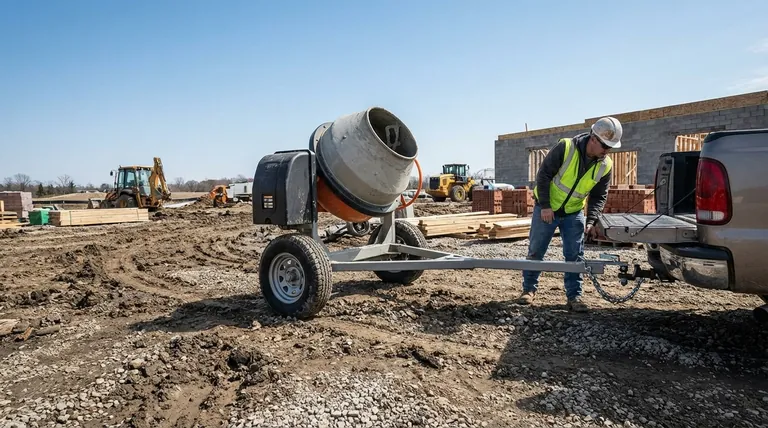
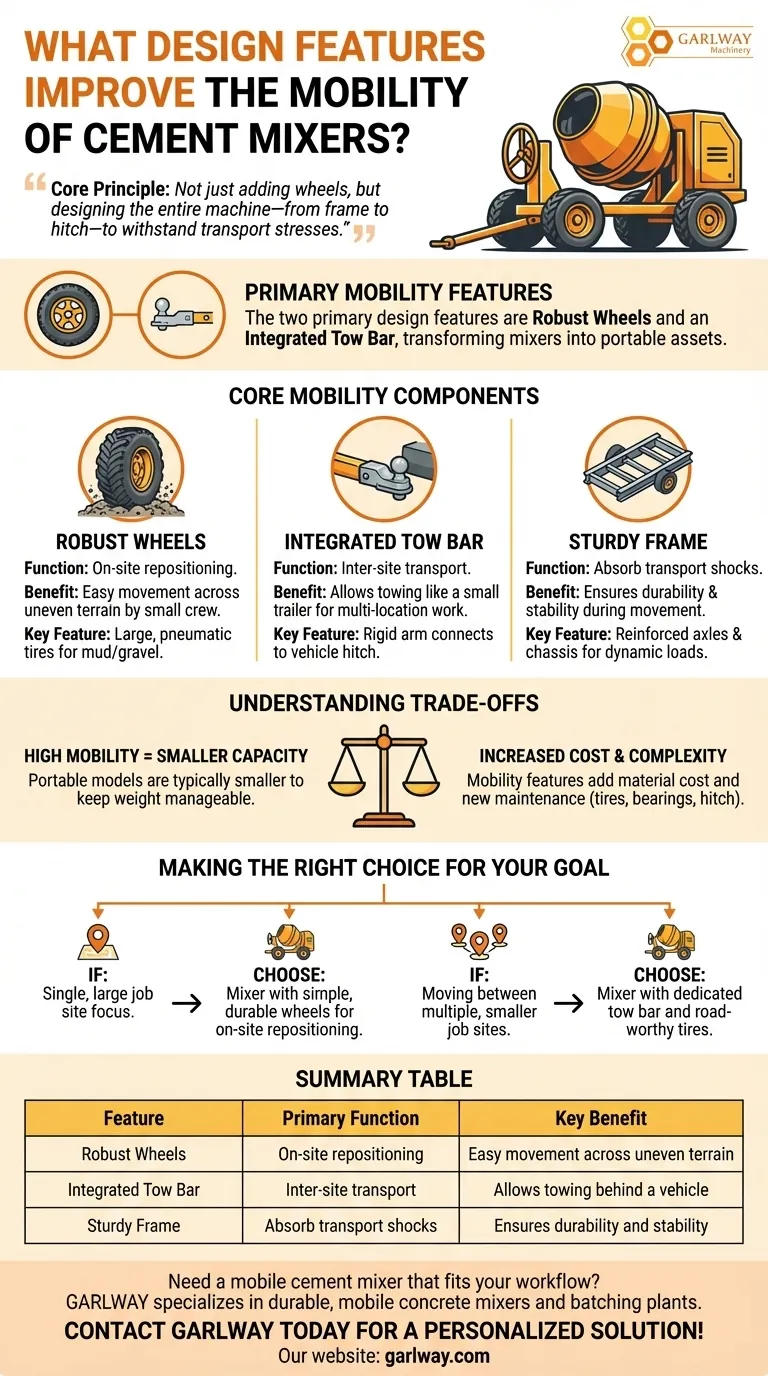
The two primary design features that improve the mobility of a cement mixer are the inclusion of robust wheels and an integrated tow bar. These components transform the mixer from a stationary piece of equipment into a portable asset, designed to be moved either around a large job site or transported between different work locations entirely.
The core principle of cement mixer mobility is not just about adding wheels, but about designing the entire machine—from the frame to the hitch—to withstand the specific stresses of transport, whether that's being rolled across uneven ground or towed on a public road.
Core Mobility Components Explained
To understand how to select the right mixer, it's essential to look at how each mobility-focused component functions. These features are part of a system designed for durability and transport.
The Role of Wheels
Wheels are the most fundamental mobility feature, intended for on-site repositioning. They allow a small crew, or even a single person, to move the mixer as the job progresses.
The type of wheel is critical. Mixers often use large, pneumatic tires that can easily handle the mud, gravel, and uneven terrain common on construction sites.
The Function of a Tow Bar
A tow bar elevates mobility from on-site movement to inter-site transport. This rigid arm connects directly to a vehicle's hitch, allowing the mixer to be towed like a small trailer.
This feature is indispensable for contractors who work on multiple projects and need to bring their equipment with them without requiring a separate flatbed trailer.
The Importance of a Sturdy Frame
Mobile mixers are intentionally built to be sturdier than their stationary counterparts. The frame must be engineered to absorb the vibrations and shocks of being moved.
This includes reinforced axles and a more robust chassis to handle the dynamic loads experienced during transport, ensuring the drum and motor remain stable and secure.
Understanding the Trade-offs
While mobility is a significant advantage, it comes with inherent compromises that are important to consider before making a selection.
Mobility vs. Capacity
There is often an inverse relationship between a mixer's mobility and its mixing capacity. Highly portable, towable models are typically smaller to keep the weight manageable for towing and on-site handling.
Large, high-volume mixers are often designed to be stationary or require heavy machinery to be moved, as their weight and size make simple wheels impractical.
Cost and Complexity
Adding wheels, suspension, a tow bar, and a reinforced frame increases the material cost and manufacturing complexity of the mixer.
Consequently, a mobile cement mixer will almost always be more expensive than a stationary model with a similar mixing capacity.
Maintenance Considerations
The components that enable mobility—tires, wheel bearings, and hitching mechanisms—also introduce new maintenance requirements.
Tires must be checked for proper inflation, and bearings may need to be greased to ensure reliable and safe transport over the life of the machine.
Making the Right Choice for Your Goal
Selecting a mixer based on its mobility features depends entirely on your operational needs. A clear understanding of your workflow will dictate the best choice.
- If your primary focus is a single, large job site: A mixer with simple, durable wheels for repositioning around the site is the most practical and cost-effective solution.
- If your primary focus is moving between multiple, smaller job sites: A mixer equipped with a dedicated tow bar and road-worthy tires is an essential investment for logistical efficiency.
Ultimately, matching the mixer’s mobility features to your project's demands ensures your equipment supports your workflow, rather than hindering it.
Summary Table:
| Feature | Primary Function | Key Benefit |
|---|---|---|
| Robust Wheels | On-site repositioning | Easy movement across uneven terrain by a small crew |
| Integrated Tow Bar | Inter-site transport | Allows towing behind a vehicle for multi-location work |
| Sturdy Frame | Absorb transport shocks | Ensures durability and stability during movement |
Need a mobile cement mixer that fits your workflow? At GARLWAY, we specialize in construction machinery designed for contractors and construction companies worldwide. Our range of durable, mobile concrete mixers and batching plants are engineered for easy transport and on-site efficiency. Let us help you choose the right equipment to streamline your projects. Contact GARLWAY today for a personalized solution!
Visual Guide
Related Products
- HZS25 Best Cement Mixer for Quick Mix Concrete at Bunnings
- JDC350 Small Cement Concrete Mortar Mixer
- JW1000 Mobile Cement Mixer Concrete Mixer Truck and Batching Plant
- JZC400 Mobile Small Concrete Mixer Cement Mixer Machine
- Concrete Cement Mixer Machine Drum Mixer for Construction
People Also Ask
- How do cement mixers enhance safety on construction sites? Reduce Strain, Hazards, and Accidents
- What are the main components of a cement mixer? A Guide to Core Parts & Functions
- What are some tips for using a cement mixer effectively? Maximize Your Mixer's Performance & Concrete Quality
- How does cleaning a cement mixer after use benefit its performance? Maximize Lifespan and Mix Quality
- Why is it important to clean the cement mixer after use? Prevent Costly Damage and Ensure Quality Concrete