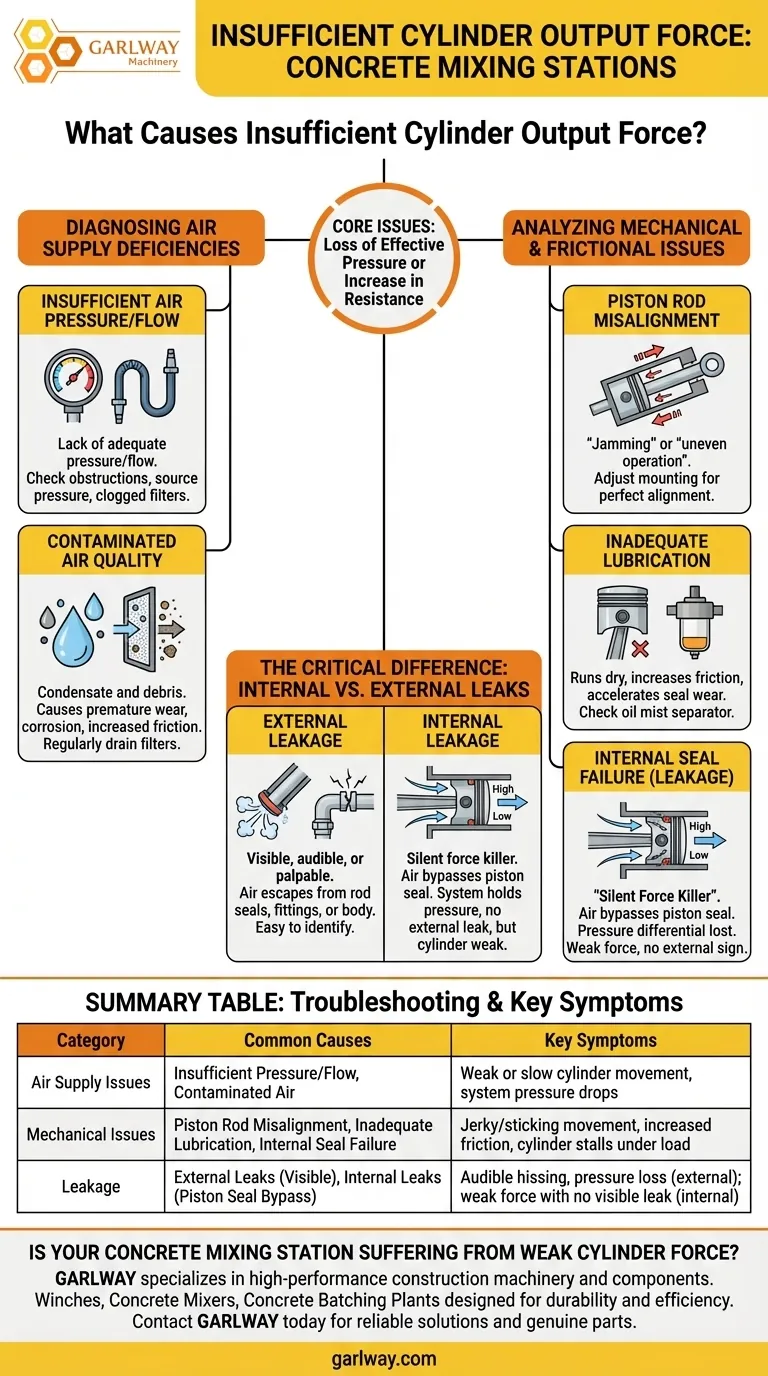
Insufficient cylinder output force in a concrete mixing station is typically caused by a handful of core issues: problems with the air supply, excessive internal friction, or mechanical misalignment. The most common culprits are insufficient air pressure, internal contamination from water or debris, poor lubrication, or a jammed or misaligned piston rod that cannot move freely.
The fundamental problem is a loss of effective pressure or an increase in resistance. To solve for low output force, you must determine if the issue originates from the air supply system delivering inadequate power, or from the mechanical system itself resisting the applied force.
Diagnosing Air Supply Deficiencies
The pneumatic system is the power source for the cylinder. Any issue that compromises the quality or pressure of the compressed air will directly reduce the force the cylinder can generate.
Insufficient Air Pressure or Flow
The most straightforward cause is a lack of adequate air pressure. The force generated is a direct product of pressure acting on the piston's surface area.
Ensure the main air supply pipeline is unobstructed and that the source pressure meets the equipment's specifications. A clogged filter or a kinked hose can severely restrict airflow.
Contaminated Air Quality
Compressed air often contains condensate (water) and other impurities. If not properly filtered, these contaminants can enter the cylinder.
This debris can cause seals to wear prematurely, increase friction, and even lead to corrosion, all of which reduce efficiency and output force. Regularly draining filters and air tanks is critical.
Analyzing Mechanical and Frictional Issues
Even with perfect air pressure, mechanical problems can prevent the cylinder from delivering its rated force. These issues increase the internal resistance the cylinder must overcome.
Piston Rod Misalignment
If the piston rod is not perfectly aligned with its load, it creates a side-load. This "jamming" or "uneven operation" causes excessive friction between the rod, its bearings, and the seals.
This friction directly opposes the cylinder's motion, effectively stealing a portion of its output force. The solution is to adjust the cylinder's mounting to ensure the piston rod's center position is perfectly aligned.
Inadequate Lubrication
Proper lubrication is essential for minimizing friction and protecting seals. Most pneumatic systems use an oil mist separator or lubricator to inject a fine mist of oil into the air supply.
If this device is malfunctioning or empty, the cylinder runs dry. This increases friction, accelerates wear on the piston seals, and is a leading cause of premature failure and reduced force.
Internal Seal Failure (Leakage)
Internal leakage occurs when the seal on the piston head is damaged, allowing compressed air to blow past it from the high-pressure side to the low-pressure side.
When this happens, the pressure differential across the piston is lost, and the cylinder cannot generate its full force. This is often a secondary symptom caused by poor lubrication or air contamination that has damaged the seal.
The Critical Difference: Internal vs. External Leaks
Understanding the type of leak is key to a fast diagnosis. Not all leaks are visible, and the most common cause of low force is often hidden.
External Leakage
This is a leak you can typically see, hear, or feel. Air escapes from rod seals, port fittings, or cracks in the cylinder body. While it represents a loss of system pressure, it's usually easy to identify.
Internal Leakage
This is the silent force killer. Air bypasses the piston seal inside the cylinder. The system holds pressure, and there are no external signs of a leak, but the cylinder itself is weak or stalls under load because the air isn't doing any work.
A Systematic Approach to Troubleshooting
To efficiently diagnose and fix insufficient cylinder force, follow a logical process from the simplest cause to the most complex.
- If you suspect an air supply issue: First, verify the pressure at the regulator and check all filters and lines for blockages or condensate.
- If you suspect a mechanical issue: Observe the piston rod's movement to check for smooth, centered operation and confirm the oil mist lubricator is working correctly.
- If the problem persists after initial checks: The cause is likely an internal piston seal failure, which will require disassembling the cylinder to inspect and replace the worn components.
Ultimately, consistent and proactive maintenance of the air supply quality and lubrication system is the most effective way to prevent insufficient cylinder force.
Summary Table:
| Category | Common Causes | Key Symptoms |
|---|---|---|
| Air Supply Issues | Insufficient air pressure/flow, contaminated air (water/debris) | Weak or slow cylinder movement, system pressure drops |
| Mechanical Issues | Piston rod misalignment, inadequate lubrication, internal seal failure | Jerky/sticking movement, increased friction, cylinder stalls under load |
| Leakage | External leaks (visible), Internal leaks (piston seal bypass) | Audible hissing, pressure loss (external); weak force with no visible leak (internal) |
Is your concrete mixing station suffering from weak cylinder force, leading to downtime and lost productivity?
GARLWAY specializes in high-performance construction machinery and components. We understand that reliable equipment is critical for your projects. Our robust winches, concrete mixers, and concrete batching plants are designed for durability and efficiency, helping construction companies and contractors worldwide minimize operational issues.
Let our experts help you get back to full power. Contact GARLWAY today for reliable solutions and genuine parts to keep your operation running smoothly.
Visual Guide
Related Products
- JDC350 Small Cement Concrete Mortar Mixer
- HZS90 Large Multiquip Concrete Mixers for Construction
- JDY350 Electric Hydraulic Mortar Mud Concrete Mixer
- Portable Concrete Mixer Machine Equipment for Mixing Concrete
- HZS25 Best Cement Mixer for Quick Mix Concrete at Bunnings
People Also Ask
- What are the primary uses of a small cement mixer? Boost Efficiency for Small to Medium Construction Jobs
- What are the physical benefits of using a small cement mixer? Reduce Strain and Prevent Injury
- What are the cost benefits of using a small cement mixer? Save on Labor, Materials & Time
- What makes small cement mixers easy and convenient to use? Boost Productivity on Any Job Site
- What factors should be considered before purchasing a small cement mixer? Find the Perfect Match for Your Project