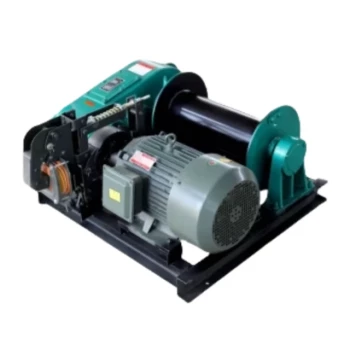
In essence, a flatbed winch is not for pulling, but for tensioning. It is a simple, robust mechanical device mounted to the side or bottom of a flatbed trailer. Its sole purpose is to work with a winch strap to tighten and secure heavy cargo, acting as a critical component of the trailer's tie-down system.
The term "winch" can be misleading. On a flatbed trailer, it almost always refers to the simple, bar-operated tensioners mounted along the side rails for securing cargo straps—not the electric or hand-crank winches used for pulling vehicles onto the deck.
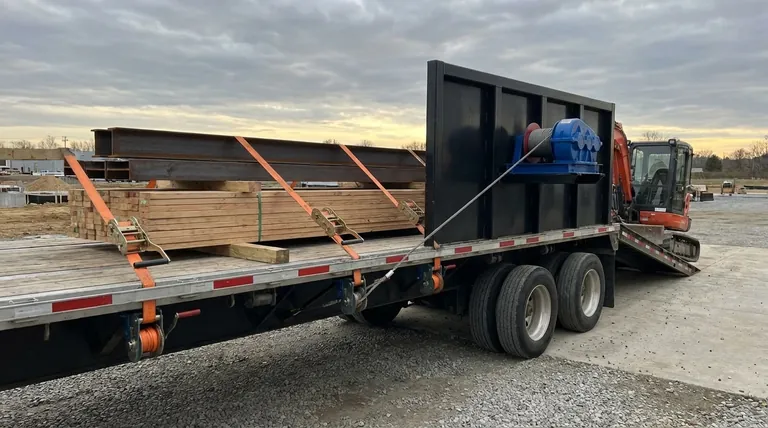
The Two Distinct Roles of a "Winch" on a Trailer
The most common point of confusion arises because two very different devices on a trailer share the same name. Understanding their purpose is key to safe and effective operation.
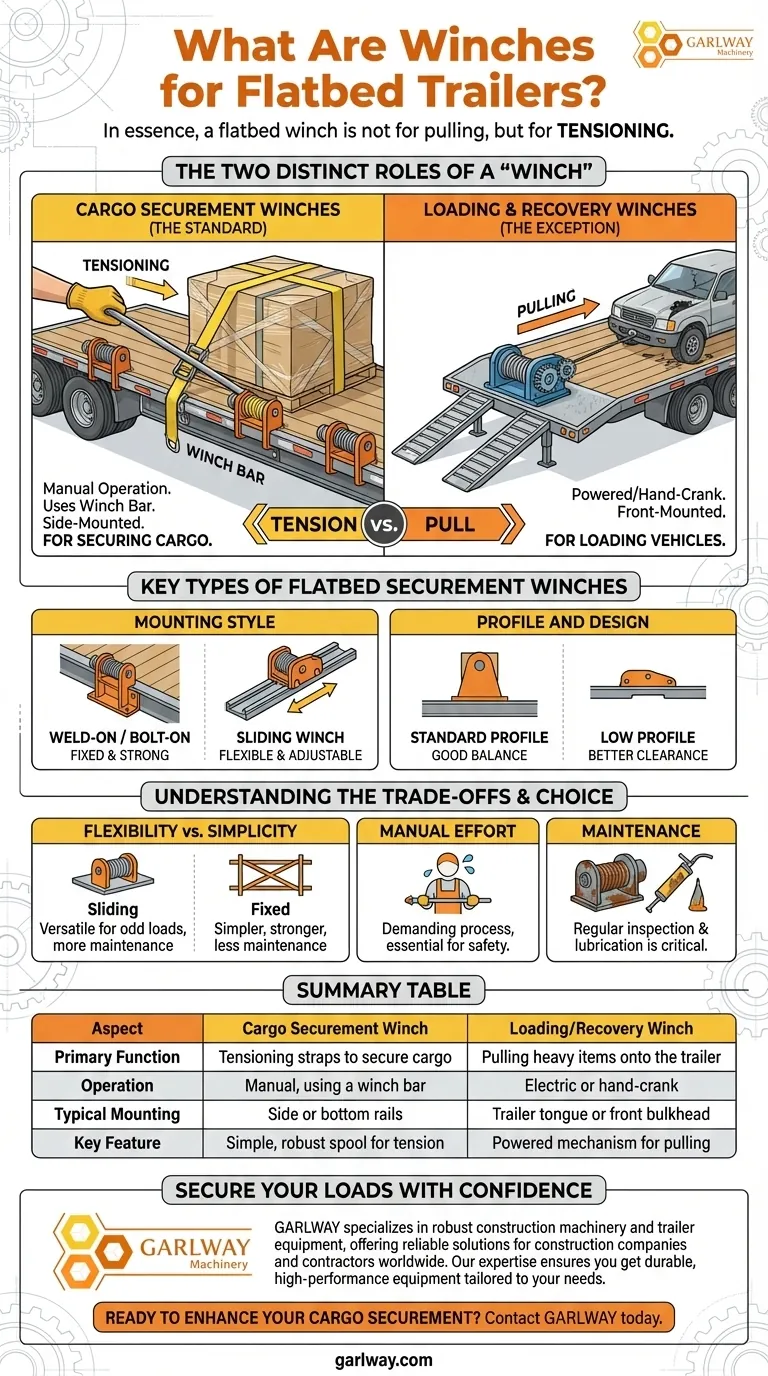
Cargo Securement Winches (The Standard)
This is the device people mean when they refer to "flatbed winches." It is a fundamental part of the cargo securement system.
These winches are simple spools that hold a winch strap. A long steel tool called a winch bar is inserted into the winch cap to gain leverage, allowing the operator to manually rotate the spool and apply immense tension to the strap holding the cargo.
They do not contain motors or gears. Their function is purely to tighten and lock a strap in place.
Loading & Recovery Winches (The Exception)
These are the more familiar powered or hand-crank winches, often mounted on the trailer's tongue or front bulkhead.
Their job is to pull heavy items onto the trailer deck, such as vehicles, construction equipment, or other rolling stock. They are typically powered by the towing vehicle's 12-volt electrical system or operated with a manual hand-crank.
These devices are for loading and unloading, not for securing the cargo during transit.
Key Types of Flatbed Securement Winches
While all cargo winches serve the same function, they differ in how they attach to the trailer and their physical design, which impacts their application.
Mounting Style
The most significant distinction is how the winch is affixed to the trailer. Weld-on and bolt-on winches are fixed in place, offering maximum strength for routine loads. Sliding winches run along a track, offering the flexibility to reposition tie-down points for loads of varying sizes.
Profile and Design
Winches come in different physical shapes to accommodate clearances. A standard profile winch is common, offering a good balance of strength and ease of use. A low profile winch is designed to sit more flush, providing better clearance for side-loading with forklifts or when tarps must fit tightly over the load.
Understanding the Trade-offs
Choosing the right winch system involves balancing flexibility, strength, and operational ease.
Flexibility vs. Simplicity
Sliding winches offer unparalleled versatility for securing odd-sized loads, but the track system adds weight, cost, and another component to maintain. Fixed weld-on winches are simpler, stronger, and more cost-effective but lack any adjustability.
Manual Operation is Demanding
Unlike a powered loading winch, a cargo winch requires significant physical effort. Using a winch bar to properly tension straps for heavy equipment is a demanding process that is essential for road safety.
Proper Maintenance is Non-Negotiable
Winches and their tracks are exposed to road salt, dirt, and weather. A winch that is difficult to slide or release due to rust or damage can waste significant time and pose a safety hazard. Regular inspection and lubrication are critical.
Making the Right Choice for Your Goal
Selecting the correct winch configuration is crucial for efficient and safe cargo hauling.
- If your primary focus is versatility for various load sizes: A sliding winch system is the best choice, allowing you to reposition tie-down points easily along the trailer rail.
- If your primary focus is maximum strength for consistent loads: Weld-on or bolt-on winches placed at strategic, permanent locations are the most robust and cost-effective solution.
- If your primary focus is loading inoperable vehicles or equipment: You need a separate, front-mounted loading winch in addition to the side-mounted cargo winches for securement.
Understanding the specific role of your winch ensures every load is not just secured, but secured with professional efficiency and safety.
Summary Table:
| Aspect | Cargo Securement Winch | Loading/Recovery Winch |
|---|---|---|
| Primary Function | Tensioning straps to secure cargo | Pulling heavy items onto the trailer |
| Operation | Manual, using a winch bar | Electric or hand-crank |
| Typical Mounting | Side or bottom rails | Trailer tongue or front bulkhead |
| Key Feature | Simple, robust spool for tension | Powered mechanism for pulling |
Secure Your Loads with Confidence
Choosing the right winch system is critical for the safety and efficiency of your operations. GARLWAY specializes in robust construction machinery and trailer equipment, offering reliable solutions for construction companies and contractors worldwide.
Our expertise in winches, concrete mixers, and batching plants ensures you get durable, high-performance equipment tailored to your needs.
Ready to enhance your cargo securement? Contact GARLWAY today for a consultation and discover how our solutions can work for you.
Visual Guide
Related Products
- Portable Small Trailer Winch
- Quick Windlass Portable Winch for Truck and Boat Best Boat Winch
- Warn Winch Windlass Boat Trailer Winch
- Electric and Hydraulic Winch for Heavy Duty Applications
- Small Electric Winch 120V and 240V for Compact Applications
People Also Ask
- What features were incorporated into the upgraded portable winch system? Boost Your Recovery Power & Safety
- What are some uses mentioned for portable winches beyond vehicle recovery? Essential Versatility for Property & Work
- How could the twisting issue with a portable winch be mitigated? Achieve Safe, Centered Pulls with Proper Rigging
- What is the significance of trailer winches in the boating industry? Ensure Safe and Efficient Boat Recovery
- What should be considered when mounting a winch on a trailer? Ensure a Safe, Aligned Installation