The evolution of ready-mix concrete is marked by a slow beginning followed by rapid, large-scale adoption. The first recorded delivery occurred in Baltimore in 1913, but the industry's significant expansion didn't begin until the 1960s, establishing it as a cornerstone of modern construction.
Ready-mix concrete's history is not just a story of a product, but of a logistical revolution that transformed construction from a variable, on-site craft into a standardized, highly efficient industrial process.
The Genesis of an Idea: The Early 20th Century
Ready-mix concrete was born from the need to solve a fundamental construction problem: consistency.
The First Delivery
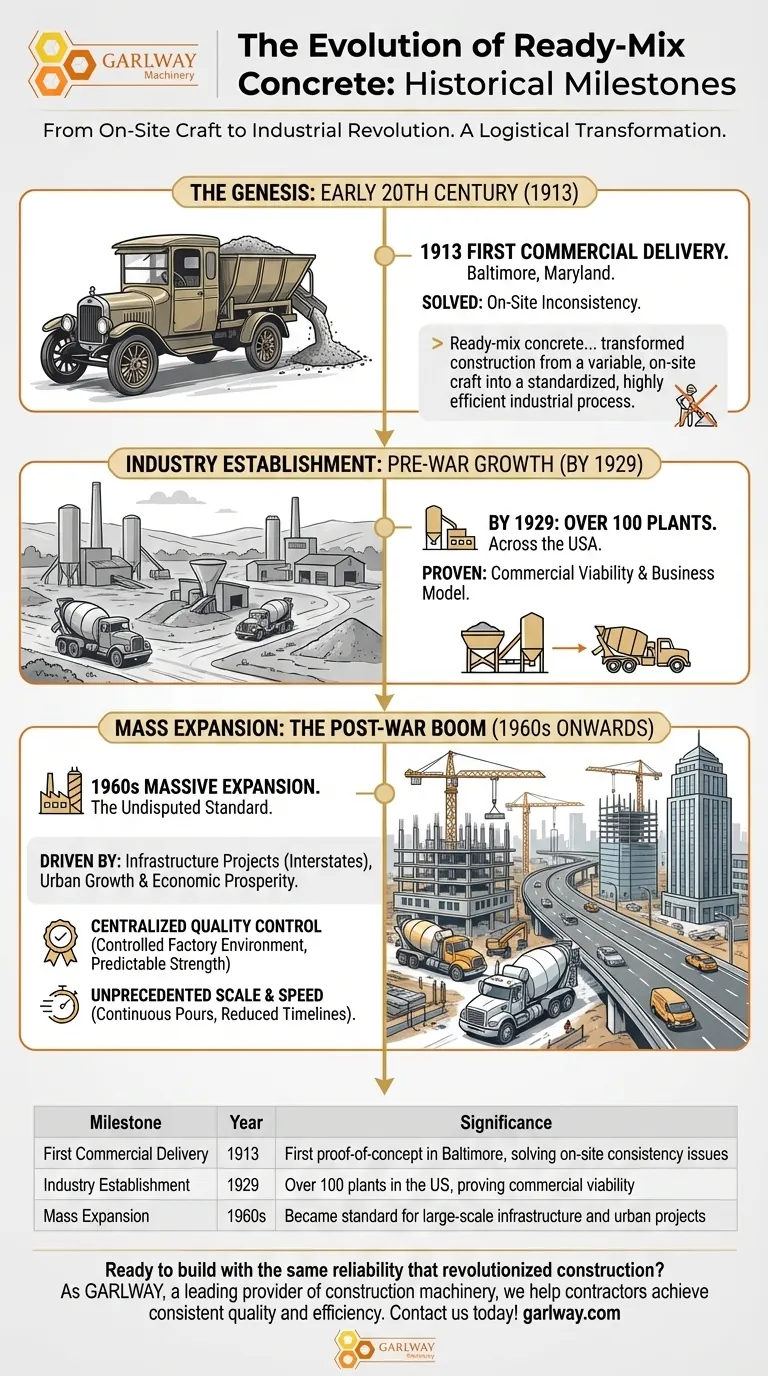
The first known commercial delivery of ready-mixed concrete took place in Baltimore, Maryland, in 1913. This event served as the initial proof-of-concept for a new way of thinking about material supply.
The Problem It Solved
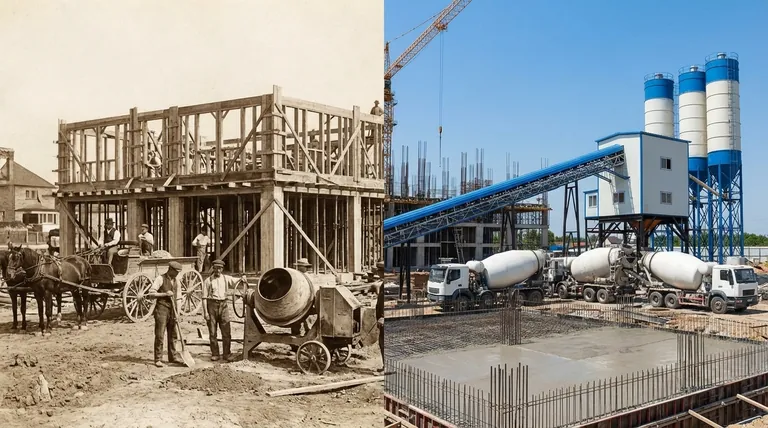
Before this, concrete was mixed on-site. This process was labor-intensive and often resulted in inconsistent quality, with strength varying from one batch to the next. Centralized batching promised a more uniform and reliable product.
From Concept to Industry: Pre-War Growth
The idea slowly gained traction over the next two decades, laying the groundwork for a viable industry.
Initial Commercialization
By 1929, there were over 100 ready-mix plants operating across the United States. This demonstrates that the business model had proven itself on a small but significant scale.
Establishing the Model
This period was crucial for developing the logistics of production and delivery. It established the core components of the industry: the centralized batching plant and the delivery truck, which were far less sophisticated than their modern counterparts.
The Modern Era: The Post-War Boom
The true inflection point for ready-mix concrete arrived in the mid-20th century, driven by unprecedented construction demands.
The 1960s Expansion
The 1960s marked the beginning of a massive expansion for the ready-mix industry. This growth has been continuous ever since.
Drivers of Growth
This boom was fueled by post-war economic prosperity, large-scale infrastructure projects like the interstate highway system, and a surge in urban and suburban construction. Ready-mix was the only practical way to supply the volume and quality of concrete needed for these massive undertakings.
The Significance of This Evolution
The shift to ready-mix was more than a convenience; it fundamentally altered construction project management and structural engineering.
Centralized Quality Control
The primary advantage was moving quality control from the chaotic job site to a controlled factory environment. This allowed for precise measurement of aggregates, cement, and water, leading to predictable strength and performance.
Unprecedented Scale and Speed
Ready-mix enabled a scale and speed of construction that was previously unimaginable. It allowed for continuous pours and ensured that a consistent supply of material was always available, dramatically reducing project timelines.
Understanding the Historical Context
Each milestone represents a distinct phase in the maturation of a critical industry.
- If your focus is on initial innovation: The 1913 delivery in Baltimore is the critical event, representing the shift from concept to reality.
- If your focus is on commercial viability: The growth to over 100 plants by 1929 shows the establishment of a functional business model and the beginning of a true industry.
- If your focus is on market dominance: The 1960s expansion is the key period when ready-mix concrete became the undisputed standard for large-scale construction.
Understanding these stages reveals how a simple idea fundamentally reshaped the way we build the modern world.
Summary Table:
| Milestone | Year | Significance |
|---|---|---|
| First Commercial Delivery | 1913 | First proof-of-concept in Baltimore, solving on-site consistency issues |
| Industry Establishment | 1929 | Over 100 plants in the US, proving commercial viability |
| Mass Expansion | 1960s | Became standard for large-scale infrastructure and urban projects |
Ready to build with the same reliability that revolutionized construction? As GARLWAY, a leading provider of construction machinery including concrete mixers and batching plants, we help construction companies and contractors worldwide achieve consistent quality and efficiency. Contact us today to learn how our solutions can support your next project!
Visual Guide
Related Products
- Ready Mixer Machine for Construction Ready Mix Machinery
- Portable Ready Mix Concrete Mixer Equipment
- HZS180 Ready Mix Concrete Plant for Foundations with Sand and Cement
- HZS120 Ready Mix Concrete Batching Plant Commercial Mud Cement Mixer
- HZS25 Best Cement Mixer for Quick Mix Concrete at Bunnings
People Also Ask
- What are the purposes of low-speed agitation in truck mixers? Preserve Concrete Quality During Transit
- How is ready-mixed concrete transported from a commercial concrete batching plant? Ensuring Quality & Timely Delivery
- What are the main ingredients mixed in a concrete mixer truck? Master the Formula for Strong Concrete
- In what ways does a mobile concrete mixer improve quality control and consistency? Achieve Superior On-Site Concrete Quality
- What types of construction projects typically use concrete mixer trucks? From Highways to Home Foundations