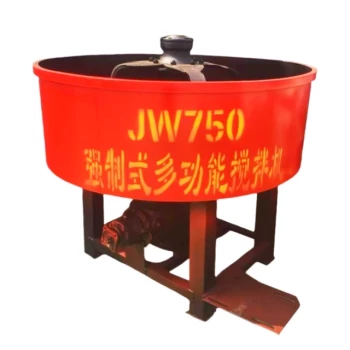
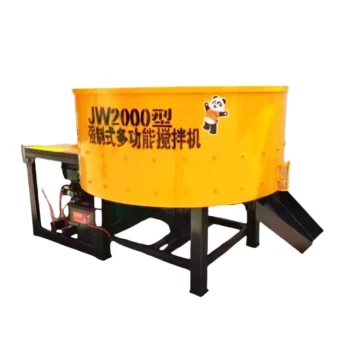
The fundamental requirements for operating a concrete mixer are a skilled operator, a precise loading and mixing sequence, and adherence to strict performance benchmarks. The process begins with adding water to the drum before the dry mix, mixing for approximately five minutes to achieve homogeneity, and discharging the final product in under 15 seconds to ensure quality and efficiency.
Efficient concrete mixer operation is not merely a mechanical task; it's a disciplined process where every step, from loading to discharging, directly impacts the structural quality of the concrete, the safety of the site, and the lifespan of the equipment.
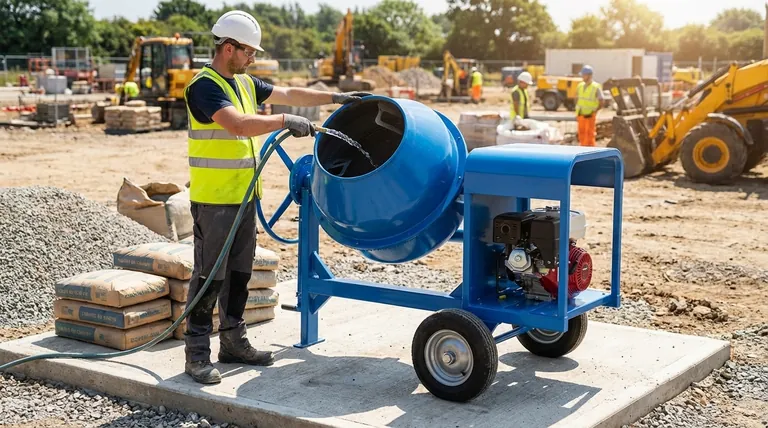
The Core Process for Maximum Efficiency
Achieving a high-quality, consistent concrete mix requires a standardized and well-understood operational workflow. Each phase has a specific purpose that contributes to the final result.
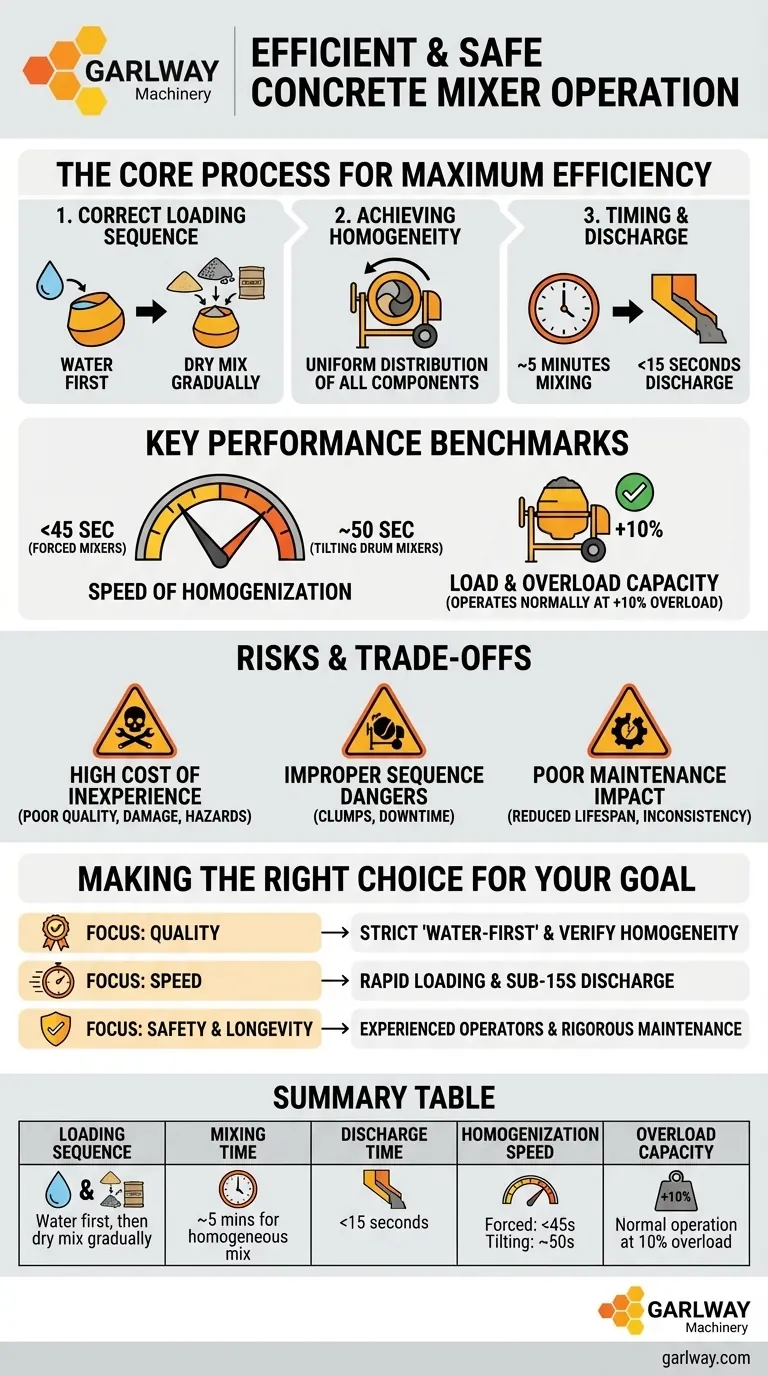
The Correct Loading Sequence
The first critical action is adding water to the mixer before the dry materials. This initial step prevents the concrete mix from clumping and sticking to the drum, ensuring a more even hydration process from the start.
Next, the dry mix of sand, gravel, and cement is added gradually while the mixer is running. This controlled loading is essential for preventing strain on the motor and achieving a uniform blend.
The Goal: Achieving Homogeneity
The primary objective of mixing is to achieve homogeneity. This means all solid components—coarse and fine aggregates, cement paste, and any admixtures—are perfectly and evenly distributed throughout the mixture.
A non-homogeneous mix will have weak spots and inconsistencies, compromising the structural integrity of the final concrete product. True efficiency is measured by how quickly the machine achieves this state.
Timing the Mix and Discharge
The typical mixing time is around five minutes, but the goal is always consistency. The mixture should be smooth and free of lumps.
Once mixing is complete, the concrete must be discharged promptly. The discharge process should be completed in less than 15 seconds to prevent the mix from beginning to set inside the drum and to maintain project momentum.
Key Performance Benchmarks to Monitor
Beyond the operational steps, a truly efficient mixer is defined by its ability to meet specific performance metrics. These standards separate well-maintained, high-performing equipment from less reliable machinery.
Speed of Homogenization
This is the most critical efficiency metric. It measures the time required to achieve a uniform mix after all materials are loaded.
- Forced mixers should reach homogeneity in under 45 seconds.
- Tilting drum mixers should achieve it in approximately 50 seconds.
Load and Overload Capacity
Reliable equipment must be able to start normally after being fully loaded and stopped for at least five minutes. This capability is crucial for handling brief on-site delays without compromising the batch.
Furthermore, the mixer should be able to operate normally under a 10% overload condition, providing a buffer for slight variations in material density or loading.
Understanding the Risks and Trade-offs
Failing to adhere to these operational standards introduces significant risks, affecting everything from project timelines to personnel safety.
The High Cost of Inexperience
Placing an inexperienced or untrained person in control of a concrete mixer is the most significant risk. This leads directly to poor-quality concrete, potential equipment damage, and serious safety hazards on the job site.
The Dangers of an Improper Sequence
Adding the dry mix before water can create hardened clumps inside the drum that are difficult to remove. This reduces the mixer's capacity, leads to inconsistent batches, and requires costly downtime for cleaning.
The Impact of Poor Maintenance
Proper operation is directly linked to maintenance. Ignoring routine checks and upkeep shortens the equipment's lifespan and, more importantly, undermines the quality and consistency of every batch of concrete produced.
Making the Right Choice for Your Goal
Your operational focus will determine which requirements you prioritize. Use these guidelines to ensure your process aligns with your project's primary objective.
- If your primary focus is concrete quality: Adhere strictly to the "water-first" loading sequence and verify mix homogeneity.
- If your primary focus is project speed: Emphasize rapid loading and ensure your equipment can meet the sub-15-second discharge benchmark.
- If your primary focus is safety and longevity: Mandate that only experienced personnel operate the machinery and implement a rigorous maintenance schedule.
Ultimately, mastering these requirements transforms the concrete mixer from a simple tool into a reliable asset for producing consistent, high-quality results.
Summary Table:
| Key Requirement | Details |
|---|---|
| Loading Sequence | Add water first, then dry mix gradually while mixer is running. |
| Mixing Time | Approximately 5 minutes to achieve a homogeneous, lump-free mix. |
| Discharge Time | Must be completed in under 15 seconds to prevent setting. |
| Homogenization Speed | Forced mixers: <45 sec. Tilting drum mixers: ~50 sec. |
| Overload Capacity | Must operate normally under a 10% overload condition. |
Ready to achieve maximum efficiency and safety with your concrete mixing operations?
GARLWAY specializes in providing robust construction machinery, including high-performance concrete mixers and batching plants, for construction companies and contractors globally. Our equipment is engineered to meet the strict performance benchmarks outlined above, ensuring consistent, high-quality concrete batch after batch.
Let us help you enhance your project's quality, speed, and on-site safety. Contact GARLWAY today to discuss your specific needs and find the perfect concrete mixing solution for your business.
Visual Guide
Related Products
- Portable Concrete Mixer Machine Equipment for Mixing Concrete
- Construction Products Concrete Plant Machine Mixing Concrete Mixer
- Portable Electric Concrete Mixer Machine for Cement Mixing
- JZC400 Mobile Small Concrete Mixer Cement Mixer Machine
- Hydraulic Concrete Mixer Machine Cement Mixing Equipment for Mixture Concrete
People Also Ask
- Why is it necessary to use a portable concrete mixer? Gain Total Control & Efficiency
- How much concrete can you pour with a portable mixer? Find the Perfect Fit for Your Project
- What types of projects are portable concrete mixers suitable for? Ideal for DIY & Small-Scale Construction
- How much does a portable concrete mixer hold? A Guide to Choosing the Right Capacity
- What types of portable concrete mixers exist? Find the Perfect Mixer for Your Project