
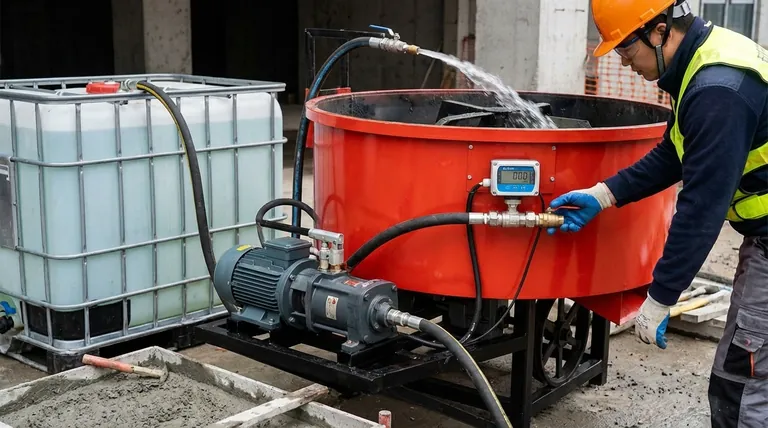
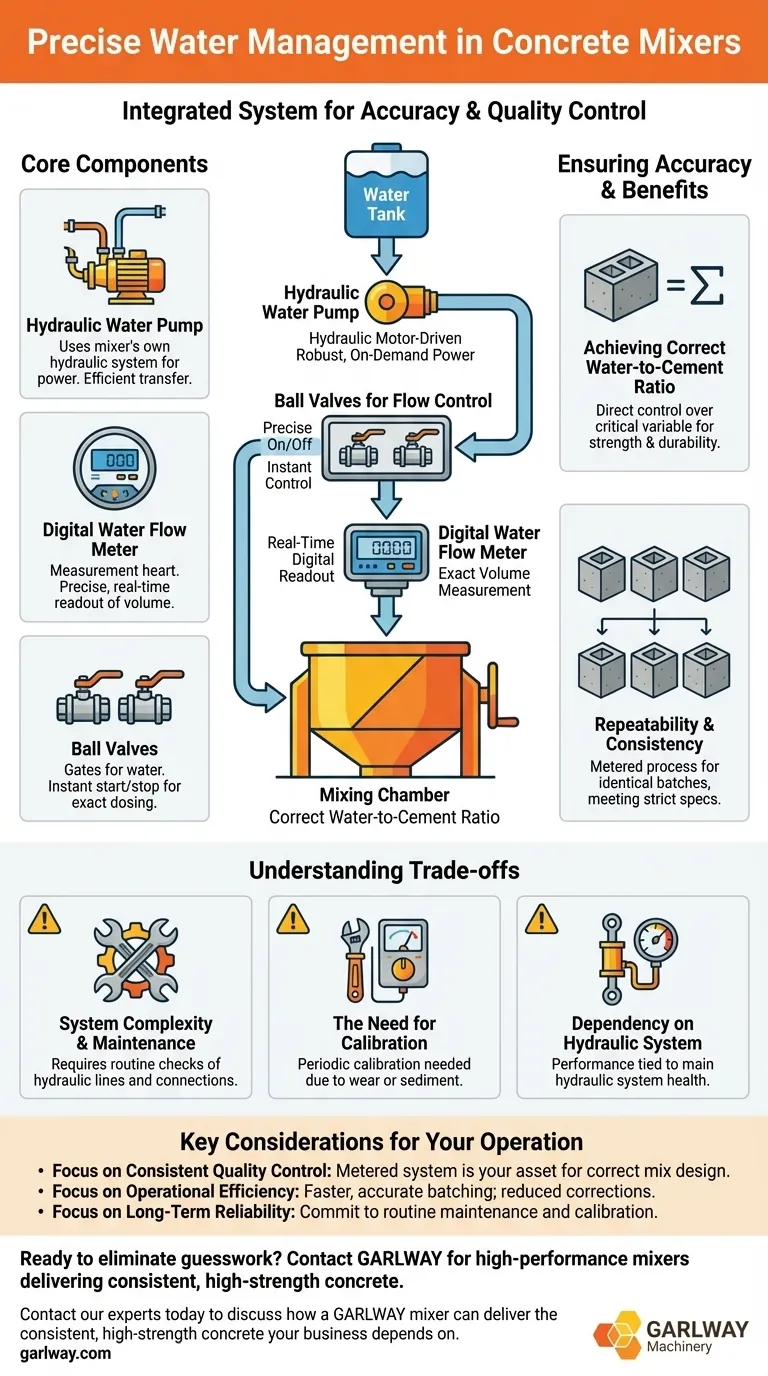
At its core, water management in these mixers is handled by a precise, integrated system designed for accuracy. This system combines a hydraulic motor-driven water pump with a digital flow meter and ball valves to give the operator exact control over the amount of water added to every batch.
The system's true purpose is to eliminate guesswork and ensure a consistently accurate water-to-cement ratio, which is the single most critical factor in determining the final strength and quality of the concrete.
The Core Components of the Water System
To understand how the system achieves its accuracy, we must look at how its key components function together. Each part plays a specific role in moving and measuring the water.
The Hydraulic Water Pump
Unlike a simple electric pump, this one is driven by the mixer's own hydraulic system. This integration provides robust, on-demand power to move water efficiently from the tank to the mixing chamber.
The Digital Water Flow Meter
This is the measurement heart of the system. As water passes through it, the meter provides a precise, real-time digital readout of the exact volume being discharged into the mix, ensuring accuracy far beyond manual or timed methods.
Ball Valves for Flow Control
These valves act as the gates for the water. They provide precise on/off control, allowing the operator to start and stop the flow instantly. This control over the suction and discharge points is crucial for adding the exact amount of water required by the flow meter.
How These Components Ensure Accuracy
The combination of a powerful pump, a precise meter, and responsive valves moves water management from an art to a science. This has a direct impact on the quality and consistency of your end product.
Achieving the Correct Water-to-Cement Ratio
The water-to-cement ratio dictates the concrete's strength, durability, and workability. By delivering a measured, exact volume of water, this system gives you direct control over this critical variable for every single batch.
Repeatability and Consistency
Because the process is metered and not based on timing or operator feel, you can produce identical batches time and time again. This level of consistency is essential for professional applications where material specifications must be strictly met.
Understanding the Trade-offs
While highly effective, a precision system like this requires a different approach than simpler, manual methods. Understanding its operational requirements is key to long-term success.
System Complexity and Maintenance
An integrated system with a hydraulic pump and digital meter is more complex than a simple hose. It requires routine maintenance, including checking hydraulic lines and connections, to ensure reliable performance.
The Need for Calibration
To maintain its accuracy, the digital flow meter must be periodically calibrated. Over time, factors like wear or sediment can affect its readings, so verification is a necessary part of a quality control program.
Dependency on the Hydraulic System
The water pump's performance is directly tied to the health of the mixer's main hydraulic system. Any issues with hydraulic pressure or flow in the main system can impact the water delivery speed and consistency.
Key Considerations for Your Operation
To make the most of this system, align its capabilities with your primary operational goals.
- If your primary focus is consistent quality control: This metered system is your greatest asset, as it removes the primary source of error in achieving the correct mix design.
- If your primary focus is operational efficiency: The integrated pump and precise controls allow for faster and more accurate batching, reducing time spent correcting mixes or waiting for manual water addition.
- If your primary focus is long-term reliability: You must commit to a routine maintenance schedule that includes regular calibration of the flow meter and inspection of the hydraulic pump.
Ultimately, this integrated system transforms water management from an approximation into a precise, controllable process.
Summary Table:
| Component | Function | Benefit |
|---|---|---|
| Hydraulic Water Pump | Uses the mixer's hydraulic system to power water delivery. | Robust, on-demand power for efficient water transfer. |
| Digital Water Flow Meter | Provides a real-time, precise readout of water volume. | Eliminates guesswork, ensuring accurate water-to-cement ratios. |
| Ball Valves | Offer precise on/off control for water flow. | Allows for instant start/stop to add the exact required amount. |
Ready to eliminate guesswork and achieve perfect concrete consistency on every project?
GARLWAY specializes in high-performance construction machinery, including concrete mixers with precision water management systems. Our equipment is engineered for construction companies and contractors who demand reliability, efficiency, and superior quality control.
Contact our experts today to discuss how a GARLWAY mixer can deliver the consistent, high-strength concrete your business depends on.
Visual Guide
Related Products
- Portable Concrete Mixer Machine Equipment for Mixing Concrete
- Construction Products Concrete Plant Machine Mixing Concrete Mixer
- Portable Electric Concrete Mixer Machine for Cement Mixing
- JZC400 Mobile Small Concrete Mixer Cement Mixer Machine
- Hydraulic Concrete Mixer Machine Cement Mixing Equipment for Mixture Concrete
People Also Ask
- Why is it necessary to use a portable concrete mixer? Gain Total Control & Efficiency
- How much concrete can you pour with a portable mixer? Find the Perfect Fit for Your Project
- What types of projects are portable concrete mixers suitable for? Ideal for DIY & Small-Scale Construction
- How much does a portable concrete mixer hold? A Guide to Choosing the Right Capacity
- What types of portable concrete mixers exist? Find the Perfect Mixer for Your Project






