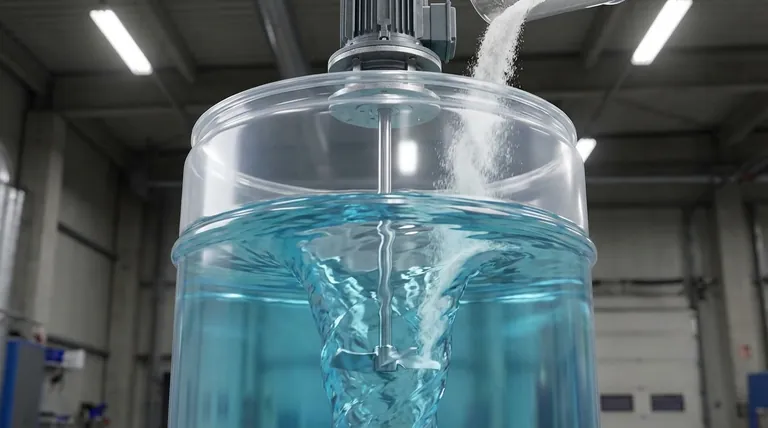
In essence, a direct drive mixer operates by connecting a motor directly to a mixing shaft and impeller. This simple design forces the impeller to spin at the same high speed as the motor, typically around 2000 RPM. This rapid rotation creates a powerful, localized vortex in the fluid, ideal for quickly blending thin liquids or dissolving solids in small batches, like a 55-gallon drum.
The core principle of a direct drive mixer is simplicity and speed. It sacrifices torque and control for high-velocity mixing, making it a specialized tool for low-viscosity applications where rapid agitation is the primary goal.
The Core Components and Their Function
A direct drive mixer's effectiveness comes from its straightforward mechanical design. Each component plays a specific role in creating the high-shear environment necessary for rapid mixing.
The Direct-Coupled Motor
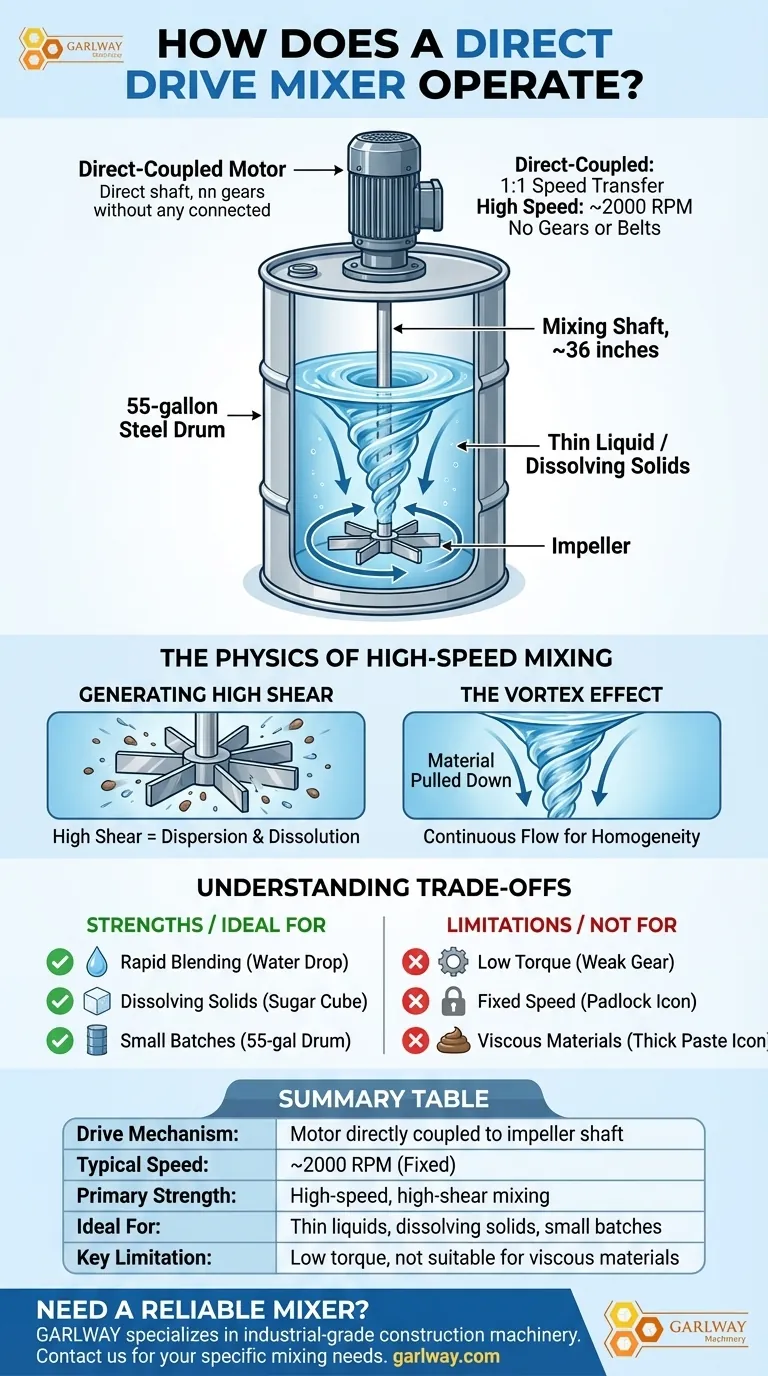
The heart of the unit is an electric motor. The term "direct drive" means the mixing shaft is connected directly to the motor's output, with no gears or belts to modify the speed.
This direct coupling is the defining feature. It ensures that every rotation of the motor is transferred one-to-one to the impeller, resulting in high rotational speeds.
The Mixing Shaft
This is a long, rigid rod, often 36 inches in length, designed to reach deep into a standard container like a 55-gallon drum.
Its primary function is to transfer the motor's rotational energy from the top of the drum down into the center of the liquid. These mixers are typically mounted directly to the container, often through a standard opening called a bunghole.
The Impeller
Attached to the end of the shaft is the impeller, which is the component that actually moves the fluid. Impellers come in various designs and are typically secured with a simple set screw.
The high-speed rotation of the impeller slices through the fluid, creating a powerful vortex and high-velocity eddies. This intense, localized turbulence is excellent for breaking apart clumps of powder or quickly combining liquids of similar viscosity.
The Physics of High-Speed Mixing
The operational principle isn't about brute force but about speed. The mixer doesn't slowly churn the entire volume of the container; it uses velocity to create a highly energetic mixing zone.
Generating High Shear
At speeds around 2000 RPM, the impeller blades move incredibly fast. This creates a high-shear environment where adjacent layers of fluid are forced to move at vastly different speeds.
This shear is highly effective for dispersion (breaking down and spreading solid particles) and dissolution (dissolving a solid into a liquid).
The Vortex Effect
The rapid spinning creates a vortex that pulls material from the top surface down toward the impeller. This creates a continuous flow pattern that ensures the contents of the drum are repeatedly passed through the high-shear zone.
This flow is critical for ensuring a homogenous mixture, preventing solids from settling at the bottom or light liquids from floating on top.
Understanding the Trade-offs
The simplicity of the direct drive design is both its greatest strength and its primary limitation. Understanding these trade-offs is crucial for selecting the right tool.
Limitation 1: Low Torque
High speed comes at the expense of torque, or rotational force. A direct drive mixer has very little power to push through thick, viscous materials.
Attempting to mix a heavy paste or sludge will overload the motor, as it simply lacks the turning force to move the impeller through the resistant material.
Limitation 2: Fixed Speed
Most direct drive mixers operate at a single, fixed speed. This lack of control can be a problem for sensitive processes.
You cannot slow the mixer down to gently fold in an ingredient or speed it up to overcome a stubborn clump. The process is either on or off.
Limitation 3: Small Batch Focus
These mixers are designed for specific, relatively small volumes. The shaft length and impeller size are optimized for containers like 55-gallon drums.
They are not suitable for large tanks or vats, as the mixing action is too localized and lacks the power to circulate the entire fluid volume effectively.
When to Choose a Direct Drive Mixer
Based on these principles, you can make a clear decision about when this tool is appropriate for your task.
- If your primary focus is rapidly blending thin liquids: The high speed is perfect for quickly achieving a uniform mixture of low-viscosity materials like water, solvents, or light oils.
- If your primary focus is dissolving powders into thin liquids: The high-shear environment excels at breaking apart agglomerates and speeding up the dissolution of salts, sugars, and other solids.
- If your primary focus is mixing high-viscosity materials: A direct drive mixer is the wrong tool; you need a gear-driven mixer that provides high torque at a lower speed.
Ultimately, the direct drive mixer is a powerful tool when used within its intended operational limits.
Summary Table:
| Feature | Characteristic |
|---|---|
| Drive Mechanism | Motor directly coupled to impeller shaft |
| Typical Speed | ~2000 RPM (Fixed) |
| Primary Strength | High-speed, high-shear mixing |
| Ideal For | Thin liquids, dissolving solids, small batches (e.g., 55-gallon drums) |
| Key Limitation | Low torque, not suitable for viscous materials |
Need a reliable mixer for your construction site or production facility? GARLWAY specializes in industrial-grade construction machinery, including concrete mixers and batching plants. Our equipment is designed for durability and performance to meet the demands of contractors and construction companies globally. Contact GARLWAY today to discuss your specific mixing needs and find the perfect solution for your project.
Visual Guide
Related Products
- Ready Mixer Machine for Construction Ready Mix Machinery
- Skid Steer Self Loading Concrete Mixers for Construction
- Harbor Freight JS1500 On Site Concrete Mixing Volumetric Cement Mixer
- Portable Concrete Mixer Machine Equipment for Mixing Concrete
- Portable Electric Concrete Mixer Machine for Cement Mixing
People Also Ask
- What are the purposes of low-speed agitation in truck mixers? Preserve Concrete Quality During Transit
- How is ready-mixed concrete transported from a commercial concrete batching plant? Ensuring Quality & Timely Delivery
- What are the main ingredients mixed in a concrete mixer truck? Master the Formula for Strong Concrete
- In what ways does a mobile concrete mixer improve quality control and consistency? Achieve Superior On-Site Concrete Quality
- What types of construction projects typically use concrete mixer trucks? From Highways to Home Foundations