
In simple terms, a slow-speed winch has a rated speed of 16 meters per minute or less, while a high-speed winch is rated for 22 meters per minute or more. These classifications define the fundamental purpose of the machine, with slow-speed models prioritizing control and high-speed models prioritizing operational efficiency.
The choice between a slow-speed and a high-speed winch is not merely about how fast the line moves; it's a critical decision that balances precision and safety against productivity and cycle time.
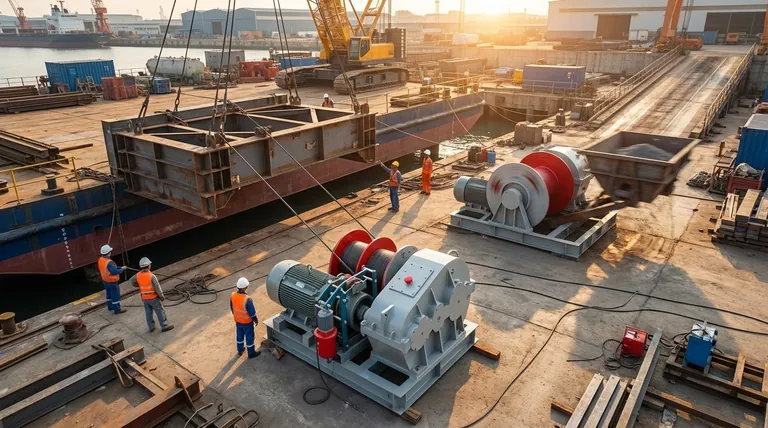
Understanding Winch Speed Classifications
The speed rating on a winch is one of its most important specifications. It dictates the applications for which the machine is best suited and is directly tied to its mechanical design and intended operational environment.
The Slow-Speed Winch (JM Series)
A slow-speed winch is formally defined by a rated rope speed of 16 meters per minute or less. In practice, most models in this category operate in the 7 to 12 m/min range.
Their model designation is typically 'jM', which stands for "winch slow-speed." The primary design goal of a JM winch is to provide maximum control for heavy lifting and precise positioning.
The High-Speed Winch (JK Series)
A high-speed winch is defined by a rated rope speed of 22 meters per minute or more. Typical operational speeds for these units fall between 18 and 25 m/min.
The model designation for this type is 'jk', for "winch high-speed." These winches are engineered for rapid material transport, making them ideal for construction sites and applications where moving loads quickly is the main objective.
Why the Gap Between 16 and 22 m/min?
The gap between these two classifications highlights their distinct design philosophies. Winches are generally engineered for either precision or speed, not a middle ground. The gearing and motor configurations required for controlled, heavy pulling are fundamentally different from those needed for rapid line retrieval.
Core Factors Beyond Line Speed
While speed is a critical differentiator, it works in concert with other key specifications to define a winch's capability.
Rated Pulling Force
The capacity, or rated pulling force, is the maximum load the winch can handle. Standard series winches often range from 1 to 32 tons. This force is a critical factor that often has an inverse relationship with speed; achieving higher pulling forces typically requires more gear reduction, which naturally results in a slower line speed.
Power Source
Winches can be powered manually, hydraulically, or electrically. The 'jM' and 'jk' speed classifications most commonly apply to electric winches, which are the predominant type used in industrial and construction settings due to their power and versatility.
Understanding the Trade-offs: Speed vs. Control
Choosing the wrong type of winch can lead to inefficiency at best and significant safety risks at worst. Understanding the inherent trade-offs is essential.
The Case for Slow-Speed Winches
The primary advantage of a slow-speed winch is precision. The slower line speed allows operators to make fine adjustments, carefully position heavy components, or gently lower sensitive loads. This control is paramount for safety during assembly, installation, and complex lifting operations. The drawback is a longer cycle time for simple transport tasks.
The Case for High-Speed Winches
The main benefit of a high-speed winch is efficiency. When the goal is simply to lift and move materials from one point to another, a faster line speed dramatically reduces project time. However, this speed comes at the cost of fine control, making these winches unsuitable for tasks that require delicate positioning.
Making the Right Choice for Your Application
Your final decision must be guided by the primary goal of the task at hand.
- If your primary focus is precision and safety: Choose a slow-speed (JM) winch for any task involving careful positioning, heavy structural assembly, or handling valuable loads.
- If your primary focus is operational efficiency: Opt for a high-speed (JK) winch when the main goal is to move materials or equipment quickly over a distance, such as on a construction site.
- If you are lifting personnel or working in high-risk environments: Always default to a slow-speed winch, as precise control is the most critical factor for ensuring safety.
Ultimately, matching the winch's design intent to your specific application is the foundation of a safe and productive operation.
Summary Table:
| Winch Type | Model Series | Rated Speed | Primary Purpose |
|---|---|---|---|
| Slow-Speed | JM Series | ≤ 16 meters/minute | Precision control & heavy lifting |
| High-Speed | JK Series | ≥ 22 meters/minute | Rapid material transport & efficiency |
Struggling to choose between precision and speed for your project?
At GARLWAY, we specialize in providing the right construction machinery for your specific needs. Whether you require the controlled power of a slow-speed JM series winch for delicate assembly or the rapid transport capabilities of a high-speed JK series winch to meet tight deadlines, our experts can help you select the perfect equipment.
We offer a full range of reliable winches, concrete mixers, and batching plants designed for construction companies and contractors worldwide.
Boost your project's safety and productivity — Contact our team today for a personalized consultation!
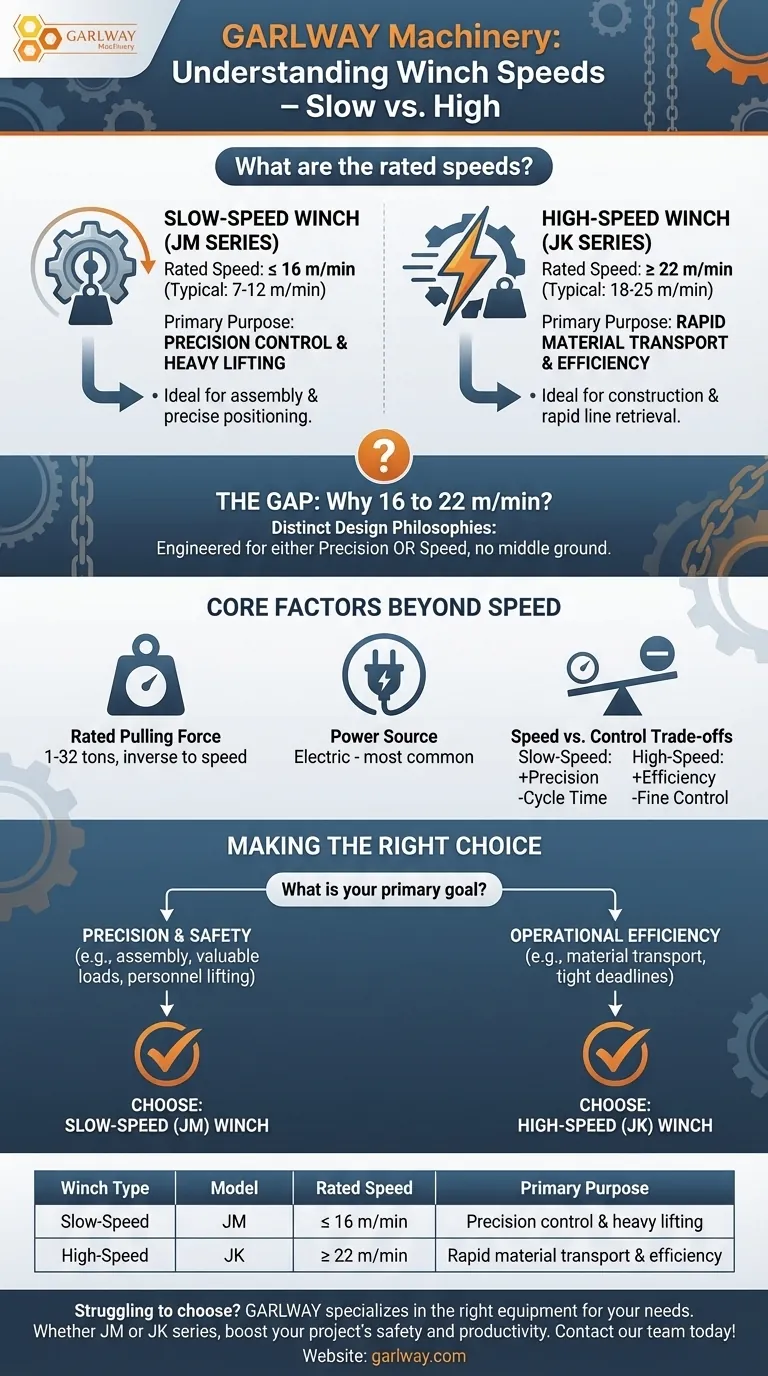
Visual Guide
Related Products
- Warn Winch Windlass Boat Trailer Winch
- Electric and Hydraulic Winch for Heavy Duty Applications
- Small Electric Winch 120V and 240V for Compact Applications
- Quick Windlass Portable Winch for Truck and Boat Best Boat Winch
- Hydraulic Winding Engine Harbor Freight Winch
People Also Ask
- What are the main components of a boat trailer winch? A Guide to Safe & Efficient Boat Loading
- What factors should be considered when choosing a boat trailer winch? Ensure Safe and Effortless Boat Loading
- What is the purpose of boat trailer winches? Safely and Efficiently Load Your Boat
- What are the two main types of boat trailer winches? Manual vs. Electric Explained
- How often should a boat trailer winch be replaced? Your Guide to Safety and Longevity





