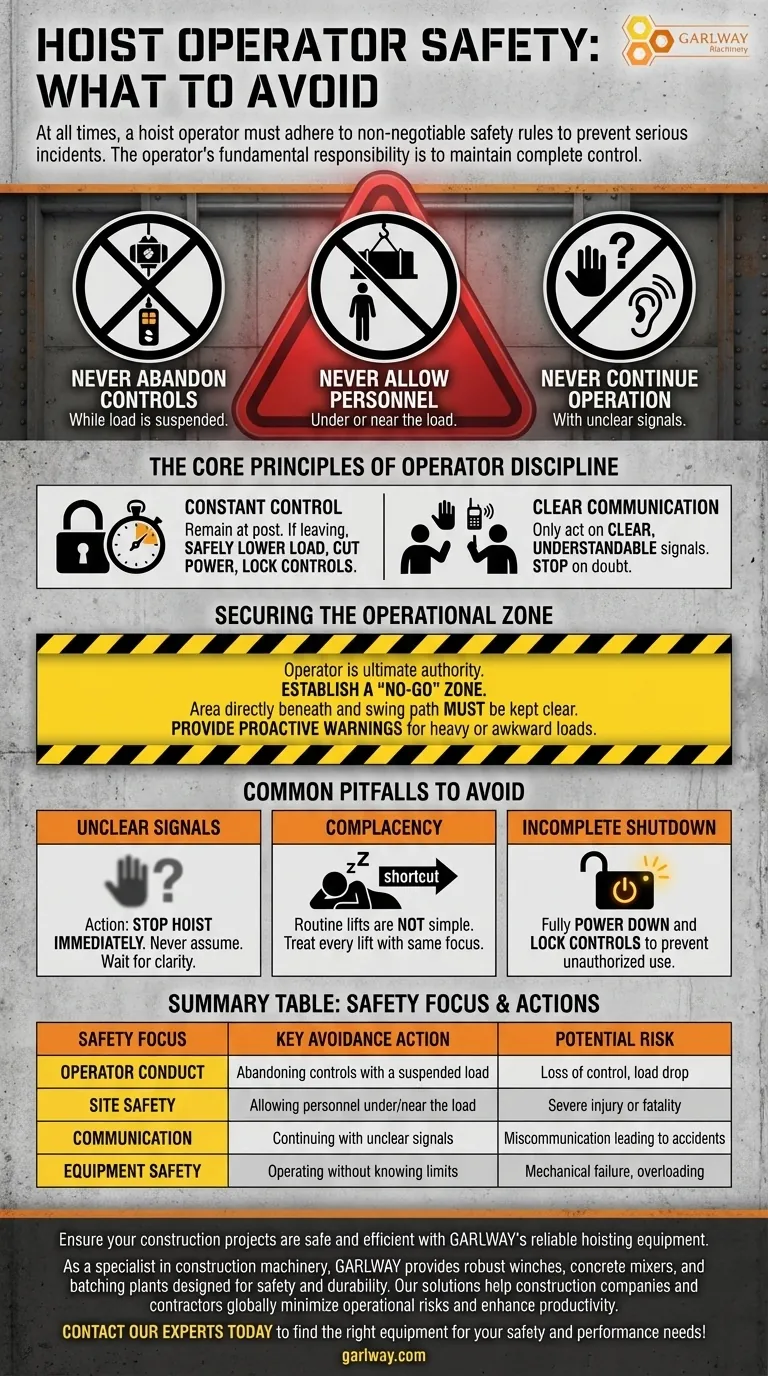
At all times, a hoist operator must avoid abandoning the controls while a load is suspended, allowing any personnel to be under or near the load, and continuing the operation with unclear signals. These core violations are the primary contributors to serious incidents and must be treated as absolute, non-negotiable rules.
The operator's fundamental responsibility is to maintain complete and uninterrupted control over the hoist, the load, and the surrounding environment. Every rule of safe operation is designed to prevent a loss of that control.
The Core Principles of Operator Discipline
Safe hoist operation is not just about following a checklist; it's about an unwavering commitment to two principles: constant control and clear communication.
Maintaining Uninterrupted Control
An operator must remain at their post for the entire duration of the lift. A suspended load is a source of immense potential energy, and leaving it unattended creates an unacceptable risk.
If an operator must leave the area for any reason, the load must first be safely lowered, the power must be cut off, and the control box should be locked to prevent unauthorized use.
Mastering Your Equipment
Operators must be thoroughly familiar with the specific hoist's structure, performance capabilities, and limitations. Operating a machine without understanding its limits is a direct path to mechanical failure or accidents.
Securing the Operational Zone
The area of the lift is a dynamic hazard zone. The operator is the ultimate authority responsible for securing it.
Establish a "No-Go" Zone
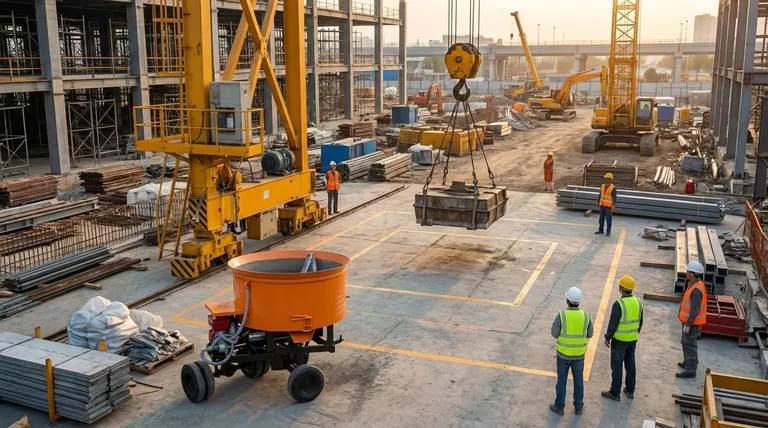
All personnel are strictly prohibited from standing, walking, or working under or around a suspended load. The area directly beneath the load and in its potential swing path must be kept completely clear.
Provide Proactive Warnings
For heavy, awkward, or large loads, visual warnings or signals may be necessary to alert other individuals in the vicinity of the overhead hazard. This ensures even those not involved in the lift are aware of the potential danger.
Common Pitfalls to Avoid
Even experienced operators can make critical errors, often stemming from complacency or pressure to work quickly. Understanding these common failure points is key to preventing them.
The Danger of Unclear Signals
If a signal from a rigger or spotter is unclear, misunderstood, or seems incorrect, the operator's only correct action is to stop the hoist immediately.
Continuing an operation based on an assumption is a severe gamble. The operator must wait for a clear, understandable signal before resuming any movement.
The Risk of Complacency
Routine lifts can create a false sense of security, leading to shortcuts. Never assume a lift is "simple." Every operation must be treated with the same level of focus and adherence to safety protocols.
The Failure of an Incomplete Shutdown
Simply walking away from the hoist after a lift is not enough. Failing to completely power down the system and lock the controls leaves the equipment vulnerable to accidental activation or unauthorized use by untrained personnel.
Making the Right Choice for Your Goal
Adhering to safety protocols is non-negotiable. Use these points to reinforce the most critical aspects of your safety program.
- If your primary focus is operator conduct: The rule is absolute—never leave the controls while the hoist is active or a load is suspended.
- If your primary focus is site safety: Enforce a zero-tolerance policy for any personnel entering the established "no-go" zone under a load.
- If your primary focus is preventing miscommunication: Implement a "stop work authority" culture where any operator is empowered and expected to halt the lift on any unclear signal without consequence.
Disciplined adherence to these foundational safety principles is the only way to ensure a safe and successful hoisting operation.
Summary Table:
| Safety Focus | Key Avoidance Action | Potential Risk |
|---|---|---|
| Operator Conduct | Abandoning controls with a suspended load | Loss of control, load drop |
| Site Safety | Allowing personnel under/near the load | Severe injury or fatality |
| Communication | Continuing with unclear signals | Miscommunication leading to accidents |
| Equipment Safety | Operating without knowing limits | Mechanical failure, overloading |
Ensure your construction projects are safe and efficient with GARLWAY's reliable hoisting equipment. As a specialist in construction machinery, GARLWAY provides robust winches, concrete mixers, and batching plants designed for safety and durability. Our solutions help construction companies and contractors globally minimize operational risks and enhance productivity. Contact our experts today to find the right equipment for your safety and performance needs!
Visual Guide
Related Products
- Electric Hoist Winch Boat Anchor Windlass for Marine Applications
- Electric and Hydraulic Winch for Heavy Duty Applications
- Hydraulic Winding Engine Harbor Freight Winch
- Portable Cement Mixer with Lift Concrete Machine
- 12000 lb Electric Boat Trailer Winch with Windlass Anchor Warn
People Also Ask
- How does an electric anchor winch work? Power, Safety, and Reliable Operation Explained
- What are the advantages of installing an electric anchor winch on a boat? Boost Safety & Ease for Boaters
- What are the operational differences between electric hoists and winches? A Guide to Safe Lifting vs. Pulling
- What are the main benefits of a boat anchor winch? Boost Safety & Efficiency for Your Vessel
- How does a boat anchor winch work? A Guide to Reliable Anchor Handling