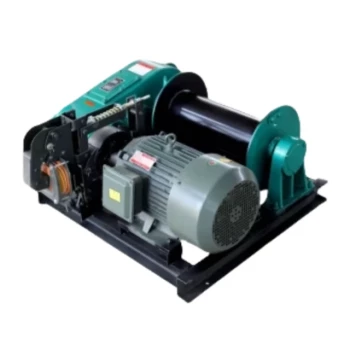
At its core, a winch is a powerful pulling tool designed for vehicle recovery. It allows a 4WD to pull itself, or another vehicle, out of a situation where it's immobilized due to a lack of traction—such as being stuck in deep mud, soft sand, or heavy snow.
A winch is more than just a recovery device; it's the ultimate tool for self-reliance in the backcountry. It transforms a potentially trip-ending disaster into a solvable, controlled problem, especially when no other vehicle is around to help.
The Core Function: Vehicle Recovery
A winch's primary purpose is to move a vehicle when its own wheels cannot. This function is critical in two key scenarios.
Self-Recovery: Your Primary Insurance Policy
This is the most common and vital use of a winch. It's for when you are traveling alone or have gotten into a spot where another vehicle cannot safely reach you to help.
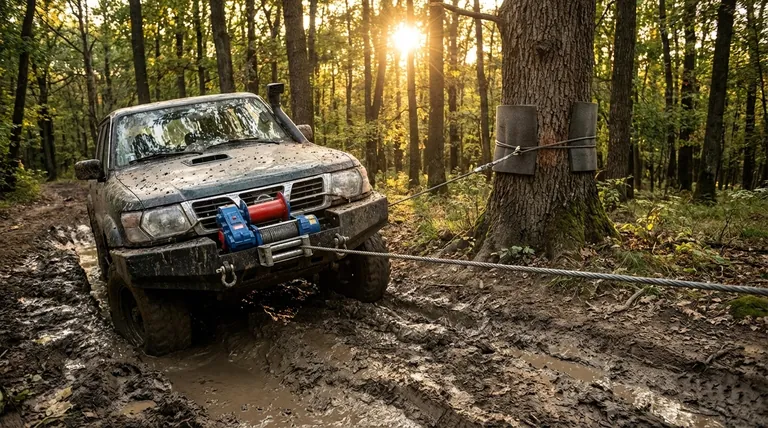
A winch allows you to find a solid anchor point—like a large tree or a rock—and pull your own vehicle out of the obstacle. It provides a constant, powerful force that is independent of wheel spin.
Assisting Others: The Good Samaritan Tool
Off-roading often involves a community aspect. A winch equips you to safely recover another vehicle that is stuck.
This is often safer and more controlled than using a kinetic recovery (or "snatch") strap, especially if the stuck vehicle is in a precarious position or bogged down severely.
Beyond Basic Recovery: Versatile Problem-Solving
While getting unstuck is its main job, a winch is a versatile tool that can solve a range of other off-road problems.
Clearing Trail Obstacles
A trail can easily be blocked by a fallen tree or a large rockslide. A winch provides the power needed to drag these obstacles out of the way, clearing the path for you and others.
Stabilizing a Vehicle
In a tricky off-camber situation where a vehicle is at risk of sliding or rolling over, a winch line can be used as a safety line. By anchoring to a high point, you can provide tension to stabilize the vehicle as it navigates the dangerous section.
Field-Expedient Mechanical Repairs
A winch can serve as a powerful come-along for trailside fixes. For example, it can be used to carefully straighten a bent steering component like a tie rod enough to limp back to civilization.
Understanding the Pitfalls and Proper Use
A winch is a powerful tool, but misuse can lead to equipment damage or serious injury. Understanding its limitations is critical.
A Winch is Not for Shock Loading
Never attempt a "running start" with a winch line like you would with a kinetic snatch strap. Winches are designed for slow, steady pulls. Shock loading the system can cause catastrophic failure of the line, gears, or mounting points.
Lifting is a High-Risk Operation
While references mention lifting, this is not the designed purpose of a 4WD recovery winch. They lack the braking systems and safety ratings of a dedicated hoist or crane. Lifting with a vehicle winch should only be considered in a dire emergency and with extreme caution.
It Requires a System of Gear
A winch is useless and dangerous on its own. To operate it safely and effectively, you need a full recovery kit, including a tree trunk protector, rated shackles, a snatch block (pulley), and heavy-duty gloves.
How to Apply This to Your Adventures
Choosing to invest in a winch depends entirely on the type of travel you do.
- If your primary focus is exploring graded dirt roads and mild trails: A winch is likely unnecessary. A quality set of recovery boards and a snatch strap will handle most potential issues.
- If your primary focus is remote solo travel or tackling challenging terrain: A winch becomes a non-negotiable piece of safety equipment for self-sufficiency.
- If your primary focus is group expeditions and tackling known obstacles: A winch is a critical tool that ensures the entire group can overcome difficult sections safely and efficiently.
Ultimately, a winch is the definitive tool for turning helplessness into capability when you are far from home.
Summary Table:
| Use Case | Key Benefit | Ideal For |
|---|---|---|
| Self-Recovery | Pulls your vehicle out of mud, sand, or snow | Solo travelers and remote explorers |
| Assisting Others | Safely recovers other stuck vehicles | Group off-roading and expeditions |
| Clearing Trail Obstacles | Moves fallen trees or rocks from the path | Trail maintenance and access |
| Vehicle Stabilization | Prevents sliding or rolling on tricky terrain | Off-camber and hazardous sections |
Ready to enhance your 4WD adventures with reliable, powerful equipment? GARLWAY specializes in heavy-duty winches and construction machinery, trusted by contractors and adventurers globally for durability and performance. Whether you're tackling remote trails or demanding job sites, our winches provide the self-reliance you need. Contact us today to find the perfect winch for your vehicle and explore our full range of concrete mixers and batching plants!
Visual Guide
Related Products
- Warn Winch Windlass Boat Trailer Winch
- Electric and Hydraulic Winch for Heavy Duty Applications
- Small Electric Winch 120V and 240V for Compact Applications
- Quick Windlass Portable Winch for Truck and Boat Best Boat Winch
- Hydraulic Winding Engine Harbor Freight Winch
People Also Ask
- What are the main components of a boat trailer winch? A Guide to Safe & Efficient Boat Loading
- What factors should be considered when choosing a boat trailer winch? Ensure Safe and Effortless Boat Loading
- What is the purpose of boat trailer winches? Safely and Efficiently Load Your Boat
- What are the two main types of boat trailer winches? Manual vs. Electric Explained
- How often should a boat trailer winch be replaced? Your Guide to Safety and Longevity