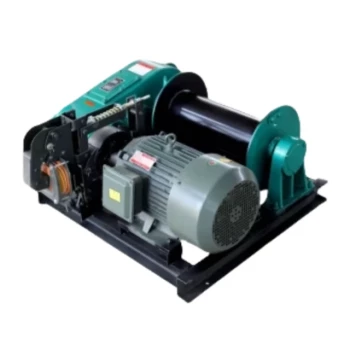
Ultimately, user experience highlights a distinct split in function: Drum winches are consistently favored for their rapid, free-spool deployment in deep water, while traditional windlasses are regarded as reliable and compact solutions for general-purpose anchoring. A common point of agreement across users is that anchor swivels are an unnecessary and frequent point of failure.
The choice between a drum winch and a windlass is not a matter of which is superior overall, but a strategic decision based on your specific anchoring depth, available deck space, and the operational speed your activities demand.
The Core Operational Difference
The fundamental distinction between these two systems comes down to how they handle the anchor rode (the line or chain connecting the anchor to the boat) and the speed at which they can deploy the anchor.
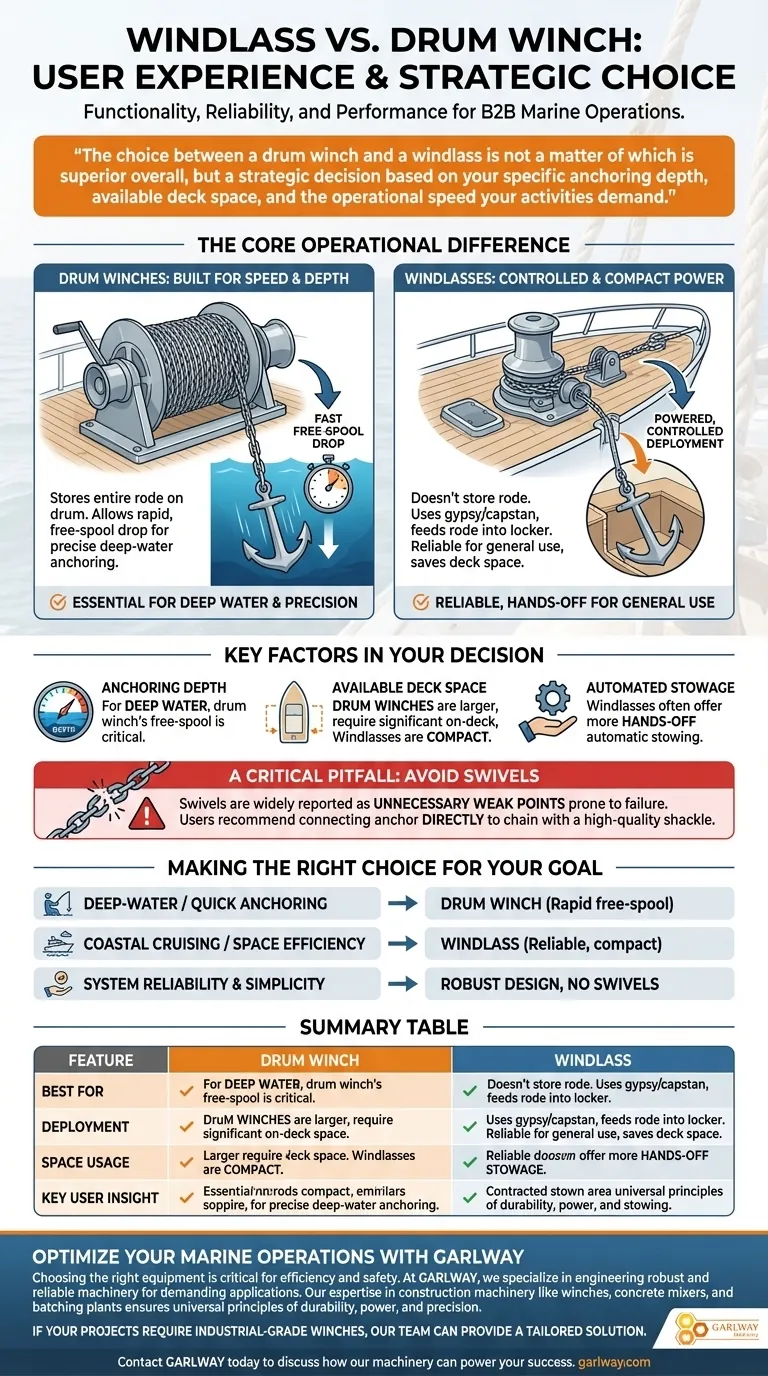
Drum Winches: Built for Speed and Depth
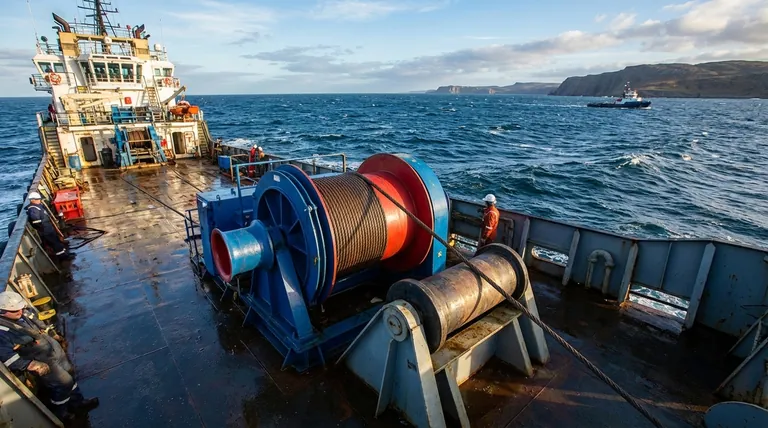
Drum winches store the entire anchor rode wrapped neatly around a large, single drum.
Their most celebrated feature, according to users, is the fast free-spool drop. This allows the anchor to plummet directly to the bottom with minimal resistance, which is a significant advantage when trying to anchor precisely over a spot in deep water.
Windlasses: Controlled and Compact Power
A traditional windlass does not store the rode. Instead, it uses a gypsy (for chain) or capstan (for rope) to pull the rode in and feeds it down into a dedicated anchor locker below deck.
Users find them highly reliable for general use. The deployment is powered and more controlled than a free-spool drop, and the system generally takes up less valuable space on the bow.
Key Factors in Your Decision
User experiences point to several critical factors that should guide your choice. Each system presents a different set of compromises.
Anchoring Depth
The depth of the water you typically anchor in is the most significant factor.
For deep-water applications, the speed and efficiency of a drum winch's free-spool drop are often considered essential.
Available Deck Space
The physical footprint of the anchoring system is a major practical consideration.
Drum winches are significantly larger and heavier than windlasses because they must house the entire rode on deck. This can be a major issue on smaller boats or those with limited bow space.
Automated Stowage
Consider whether the anchor can be deployed and retrieved without needing manual assistance at the bow.
A well-configured windlass and bow roller can often provide a more "hands-off" experience, automatically stowing the anchor in its final position.
A Critical Pitfall to Avoid
Regardless of the system you choose, user feedback offers a clear warning about a common accessory.
The Problem with Swivels
Anchor swivels, designed to prevent the chain from twisting, are widely reported as unnecessary weak points in the ground tackle system.
Experienced boaters often find they are prone to failure under load and recommend connecting the anchor directly to the chain with a high-quality shackle for maximum reliability.
Making the Right Choice for Your Goal
Base your decision on the most common anchoring scenario you will face.
- If your primary focus is deep-water fishing or anchoring quickly: The drum winch is the superior choice due to its rapid free-spool capability.
- If your primary focus is coastal cruising and managing deck space: A quality windlass provides a reliable, compact, and proven solution for most situations.
- If your primary focus is system reliability and simplicity: Prioritize a robust design and avoid adding potential failure points like anchor swivels.
Choosing the right system is about accurately matching the equipment's core strengths to your specific needs on the water.
Summary Table:
| Feature | Drum Winch | Windlass |
|---|---|---|
| Best For | Deep-water anchoring, rapid deployment | Coastal cruising, space efficiency |
| Deployment | Fast free-spool drop | Powered, controlled retrieval |
| Space Usage | Larger on-deck footprint | Compact, uses below-deck locker |
| Key User Insight | Essential for precision in deep water | Reliable and hands-off for general use |
Optimize Your Marine Operations with GARLWAY
Choosing the right equipment is critical for efficiency and safety on the water. At GARLWAY, we specialize in engineering robust and reliable machinery for demanding applications. While our expertise lies in construction machinery like winches, concrete mixers, and batching plants, the principles of durability, power, and precision are universal.
If your projects require industrial-grade winches built for heavy-duty performance, our team can provide a solution tailored to your specific operational demands.
Contact GARLWAY today to discuss how our machinery can power your success.
Visual Guide
Related Products
- Best 18000 Pound Drum Anchor Trailer Winch
- Warn Winch Windlass Boat Trailer Winch
- Portable Small Trailer Winch
- Electric and Hydraulic Winch for Heavy Duty Applications
- Heavy Duty Electric Boat Winch Windlass Anchor
People Also Ask
- In what scenarios is a winch particularly useful for trailers? Load Heavy Items Safely & Efficiently
- How do you install a trailer winch? A Step-by-Step Guide for a Safe & Secure Setup
- What should be considered when mounting a winch on a trailer? Ensure a Safe, Aligned Installation
- What are the considerations for equipping a trailer with a winch for hauling a car? A Guide to Safe and Efficient Vehicle Loading
- What are the main types of trailer winches? Choose the Right Power Source for Your Load