
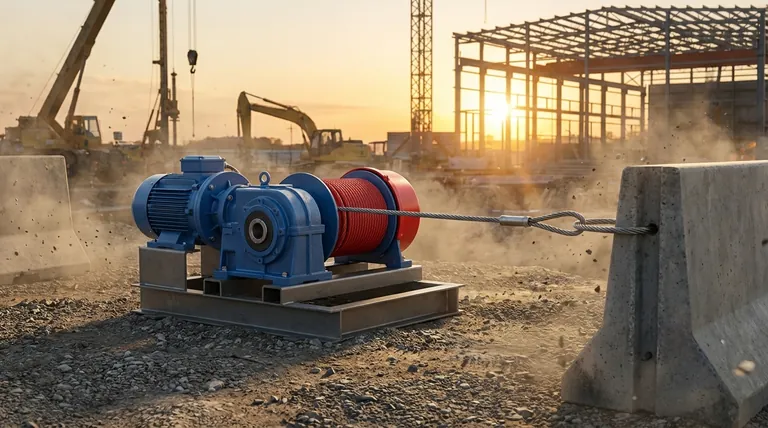
At its core, a winch is a mechanical device that multiplies force to pull, lift, or tension a heavy object. It achieves this by using a power source—either manual or electric—to wind a cable or rope around a central drum. The key components that work together to make this happen are the motor, gear train, drum, and cable.
A winch is fundamentally a force multiplier. It converts the high-speed, low-torque rotational energy from a motor into the low-speed, high-torque linear pulling power needed to move heavy loads.
How a Winch Creates Pulling Power
A winch's ability to move objects far heavier than its motor could handle alone comes from a coordinated system of components. Each part has a distinct role in converting energy into powerful, controlled force.
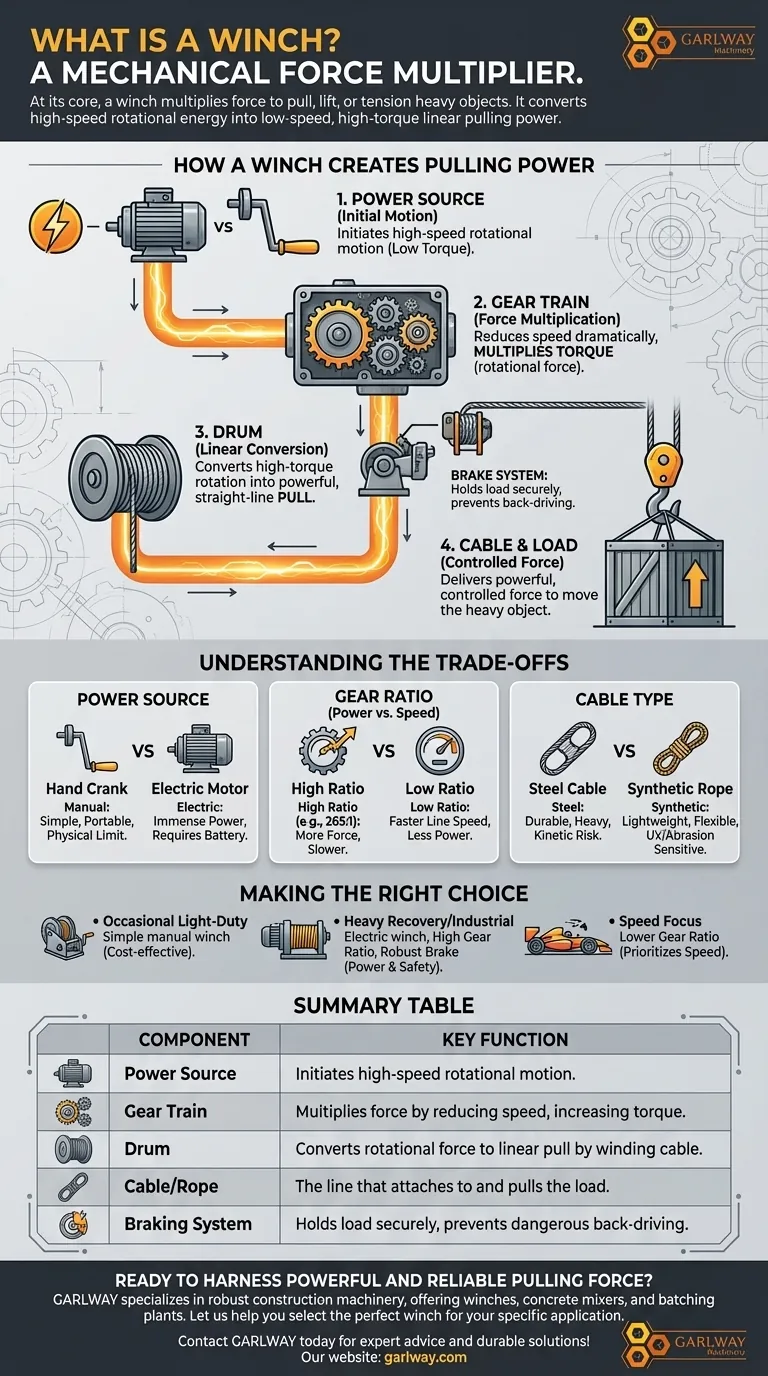
The Power Source: Creating Initial Motion
The process begins with the power source. This is either a manual hand crank or, more commonly, an electric motor. The motor's job is not to pull the load directly but to initiate high-speed rotational motion.
The Gear Train: The Heart of Force Multiplication
The energy from the motor flows into the gear train, or gearbox. This is the most critical component for generating pulling power.
A series of reduction gears slows the rotation from the motor dramatically. This reduction in speed results in a proportional increase in torque, which is rotational force. Think of it like the low gears on a bicycle: pedaling is easier (more torque), but your speed is slower.
The Drum: Converting Rotation to Linear Pull
The high-torque, low-speed rotation from the gear train is then transferred to the drum (or spool).
As the drum turns, it winds the cable (or rope) around itself. This action converts the rotational force into a powerful, straight-line pull on the object attached to the end of the cable.
The Braking System: Ensuring Safety and Control
A crucial, often internal, component is the brake. When the motor stops, the brake automatically engages.
This prevents the weight of the load from pulling the cable back out, a dangerous condition known as "back-driving." It holds the load securely in place.
Understanding the Trade-offs
The specific design of each component dictates a winch's performance. Understanding these trade-offs is key to selecting the right tool for a job.
Power Source: Manual vs. Electric
A manual winch is simple, portable, and doesn't require a power supply, but its pulling capacity is limited by your physical strength. An electric winch offers immense power and ease of use but requires a robust electrical source, typically a vehicle battery.
Gear Ratio: Power vs. Speed
The gear ratio inside the gearbox determines the winch's core characteristics. A high gear ratio (e.g., 265:1) means more force multiplication, resulting in a very powerful but slow pull. A lower ratio provides a faster line speed with less pulling power.
Cable Type: Steel vs. Synthetic
The choice of line is also critical. Steel cable is highly durable and resistant to abrasion but is heavy and can store dangerous kinetic energy if it snaps. Synthetic rope is lightweight, flexible, and safer, but it is more susceptible to UV degradation and abrasion damage.
Making the Right Choice for Your Goal
Understanding how these components function together allows you to choose the right winch for your specific application.
- If your primary focus is occasional light-duty pulling: A simple manual winch offers a cost-effective and reliable solution.
- If your primary focus is heavy vehicle recovery or industrial lifting: An electric winch with a high gear ratio and a robust braking system is essential for power and safety.
- If your primary focus is speed over maximum power: Look for a winch with a lower gear ratio that prioritizes faster line speed.
By recognizing that a winch is a system of interconnected parts, you can better evaluate its capabilities and ensure it meets the demands of your task.
Summary Table:
| Component | Key Function |
|---|---|
| Power Source (Motor/Hand Crank) | Initiates high-speed rotational motion. |
| Gear Train (Gearbox) | Multiplies force by reducing speed and increasing torque. |
| Drum | Converts rotational force into a linear pull by winding the cable. |
| Cable/Rope | The line that attaches to and pulls the load. |
| Braking System | Holds the load securely in place and prevents dangerous back-driving. |
Ready to harness powerful and reliable pulling force for your projects?
Understanding the mechanics is the first step. The next is choosing the right equipment. GARLWAY specializes in robust construction machinery, offering a range of winches, concrete mixers, and batching plants designed for the demanding needs of construction companies and contractors globally.
Let us help you select the perfect winch for your specific application, ensuring safety, efficiency, and maximum performance on your job site.
Contact GARLWAY today for expert advice and to explore our durable solutions!
Visual Guide
Related Products
- Warn Winch Windlass Boat Trailer Winch
- Electric and Hydraulic Winch for Heavy Duty Applications
- Small Electric Winch 120V and 240V for Compact Applications
- 12000 lb Electric Boat Trailer Winch with Windlass Anchor Warn
- Quick Windlass Portable Winch for Truck and Boat Best Boat Winch
People Also Ask
- What are the main components of a boat trailer winch? A Guide to Safe & Efficient Boat Loading
- What factors should be considered when choosing a boat trailer winch? Ensure Safe and Effortless Boat Loading
- What is the purpose of boat trailer winches? Safely and Efficiently Load Your Boat
- What are the two main types of boat trailer winches? Manual vs. Electric Explained
- How often should a boat trailer winch be replaced? Your Guide to Safety and Longevity





