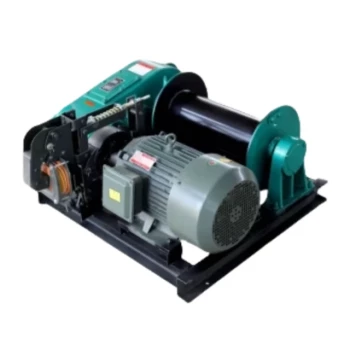
When setting up a winch, the most critical rule is to exclusively use certified, manufacturer-approved accessories. Beyond this core principle, key components for an effective system include a self-launching bow sprit for anchor management, a remote control for ease of use, and proper hardware like a swivel to connect your anchor and rode correctly.
The success of your winch setup depends less on a single "best" accessory and more on creating a complete, integrated system. Every component—from the mounting bolts to the anchor swivel—must be specifically designed to work together safely and efficiently as specified by the winch manufacturer.
Foundational Components: The Base of Your System
Before considering operational add-ons, you must ensure the core installation is sound. The winch's power is useless without a secure and correctly configured foundation.
Ensuring a Level and Firm Foundation
The installation site for the winch must be completely level. More importantly, the connection to the foundation or under-frame has to be absolutely firm, meeting the precise torque and support requirements laid out in the instruction manual.
Matching the Drum and Fairlead
The winch is a system, not just a motor. The drum size must be appropriate for the length and diameter of your rope and chain (the rode). Likewise, the roller or fairlead configuration must be correctly positioned to guide the rode smoothly onto the drum, preventing chafing and jams.
Essential Operational Accessories
Once the foundation is secure, certain accessories can dramatically improve the functionality and convenience of your winching operations, particularly in marine applications.
The Bow Sprit for Anchor Management
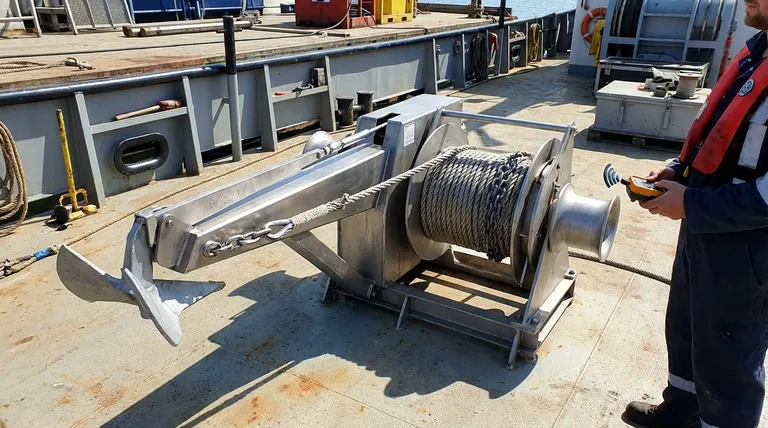
A hinged or self-launching bow sprit is a highly recommended accessory for any anchor winch. It holds the anchor clear of the bow, preventing it from damaging the hull. Critically, it allows you to deploy the anchor without manually pushing it over the side each time.
The Remote Control for Convenience and Safety
A remote control allows you to operate the winch from the helm or another location with a better vantage point. This not only adds significant convenience but also improves safety, as you can manage the process without being right next to the high-tension rode and anchor.
Connecting the System: Rode and Anchor Hardware
The final pieces of the puzzle are the components that connect your winch to its load, such as an anchor. Using the right hardware here is non-negotiable for system integrity.
Splicing Rope to Chain
Most anchor rodes consist of a rope section for shock absorption and a chain section for weight and abrasion resistance. These two materials must be joined with a professional rope-to-chain splice that is strong and streamlined enough to pass through the fairlead and wind onto the drum without catching.
The Critical Role of the Swivel
A high-quality swivel should be installed between the anchor and the chain. This small but vital component allows the anchor to orient itself correctly on the seabed and prevents the chain from twisting as the boat moves, which could weaken the rode or cause retrieval problems.
The Overarching Principle: Adhering to Manufacturer Specifications
It can be tempting to mix and match components to save money or for perceived performance gains. This is almost always a mistake that introduces significant risk.
Why "Certified" Matters
Manufacturer-approved accessories have been tested to handle the specific loads and stresses generated by your winch model. Using certified components is your primary guarantee of safety and performance. Uncertified parts may have unknown load ratings or material weaknesses.
The Danger of Mismatched Components
Using a component that is not designed for your system can lead to a cascade of failures. An improperly sized fairlead can shred your rope, a weak shackle can break under load, and an insecure foundation can rip the winch right off its mount. Following the manual is your most important safety procedure.
Making the Right Choice for Your Goal
Select your accessories based on a clear understanding of the entire system's requirements.
- If your primary focus is safety and reliability: Adhere strictly to the manufacturer's manual, using only certified accessories and ensuring the foundation is professionally installed.
- If your primary focus is ease of use: Invest in a self-launching bow sprit and a reliable remote control to simplify and streamline the anchoring process.
- If you are building a complete system from scratch: Start by confirming the foundational requirements—drum size, fairlead, and mounting—before selecting your rode, anchor, and connecting hardware.
Ultimately, a reliable winch is a cohesive system where every part is chosen to support the others.
Summary Table:
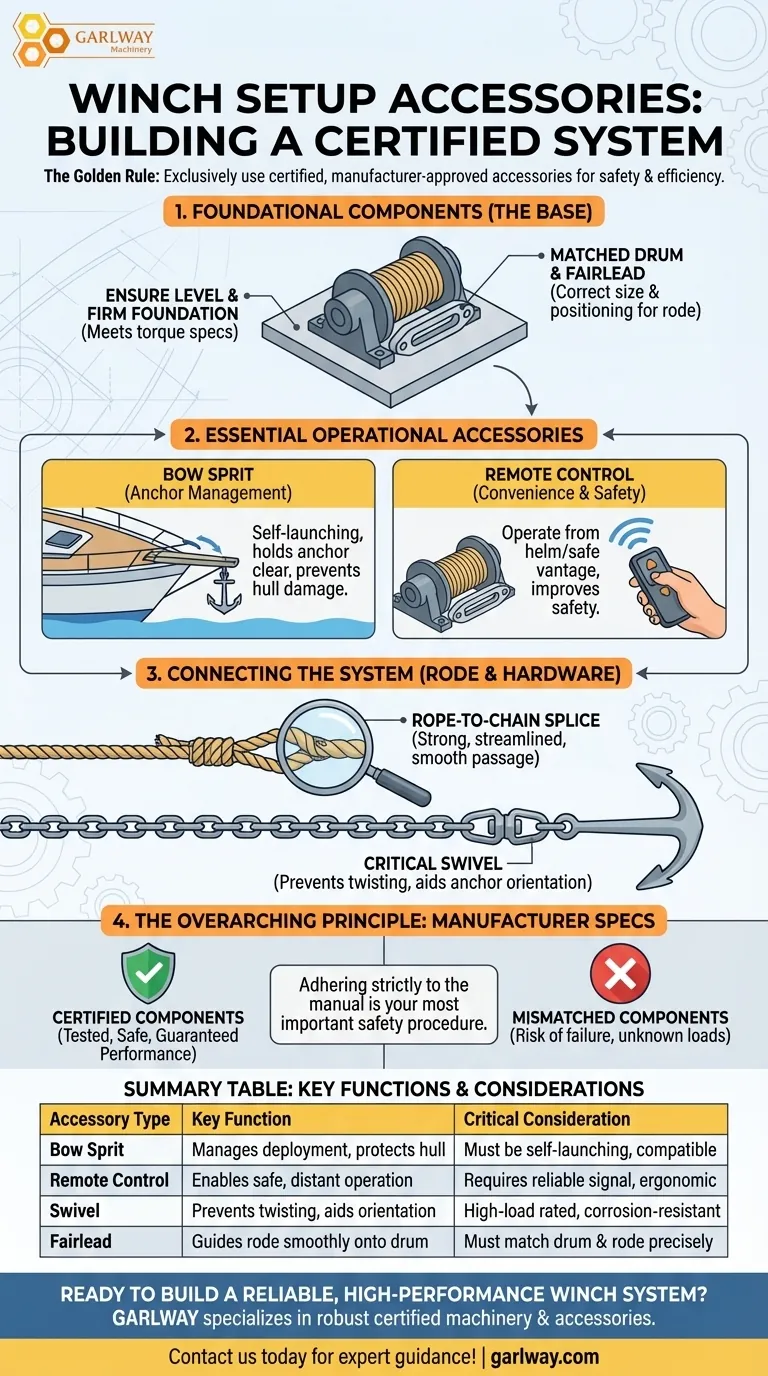
| Accessory Type | Key Function | Critical Consideration |
|---|---|---|
| Bow Sprit | Manages anchor deployment and protects hull | Must be self-launching and compatible with winch model |
| Remote Control | Enables safe operation from a distance | Requires reliable signal and ergonomic design |
| Swivel | Prevents rode twisting and aids anchor orientation | Must be high-load rated and corrosion-resistant |
| Fairlead | Guides rope/chain smoothly onto drum | Must match drum size and rode diameter precisely |
Ready to build a reliable, high-performance winch system?
At GARLWAY, we specialize in construction machinery and offer robust winches, concrete mixers, and batching plants tailored for construction companies and contractors worldwide. Our certified, manufacturer-approved accessories ensure your setup is safe, efficient, and built to last.
Contact us today for expert guidance and a solution that meets your project’s demands!
Visual Guide
Related Products
- Small Electric Winch 120V and 240V for Compact Applications
- Quick Windlass Portable Winch for Truck and Boat Best Boat Winch
- Heavy Duty Electric Boat Winch Windlass Anchor
- Portable Small Trailer Winch
- Warn Winch Windlass Boat Trailer Winch
People Also Ask
- What makes electric winches suitable for off-road use? Key Features for Reliable Vehicle Recovery
- What are the common applications of electric winches? Power Your Lifting & Pulling Tasks
- What are the common uses of an electric winch? A Guide to Safe and Efficient Heavy Lifting
- What are the uses of electric winches in mining and tunneling? Enhance Safety and Efficiency Underground
- How do electric winches contribute to energy savings? Maximize Efficiency and Lower Costs