
In essence, wire rope electric hoists are the foundational workhorses for lifting, moving, and positioning heavy materials across major industrial and construction environments. Their primary applications span from manufacturing assembly lines and warehousing to large-scale infrastructure projects like bridge building, shipbuilding, and mining. They are engineered to handle substantial loads, such as large concrete structures, steel beams, and heavy mechanical equipment, with both speed and precision.
A wire rope electric hoist is selected not just for what it lifts, but for how it performs. Its design prioritizes high-speed, high-capacity, and long-lift applications, making it the default choice for heavy-duty operations where efficiency and power are paramount.
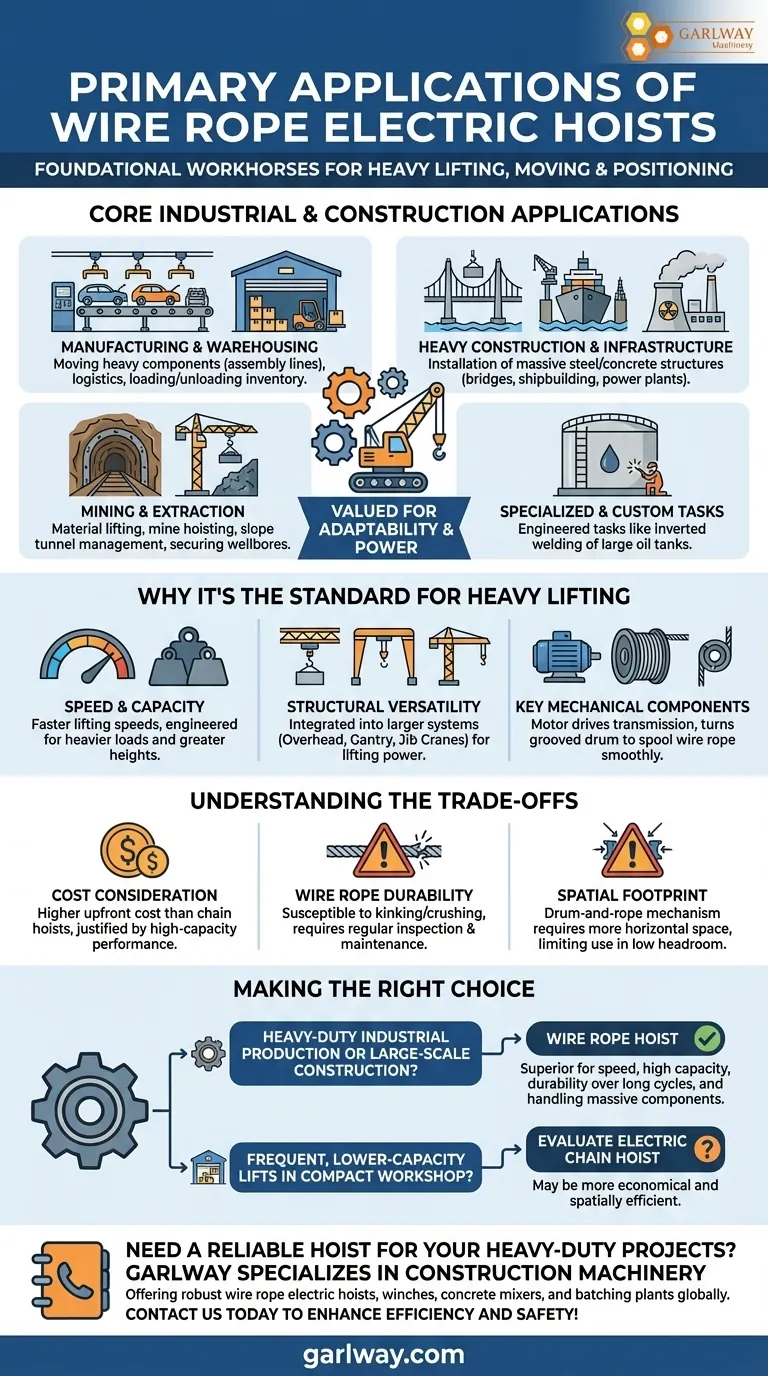
Core Industrial and Construction Applications
Wire rope hoists are valued for their adaptability, appearing in a wide range of demanding sectors where moving significant weight is a daily requirement.
Manufacturing and Warehousing
In a factory setting, these hoists are critical for moving heavy components along an assembly line, such as in automobile manufacturing. They are also used in logistics and warehouses for loading, unloading, and positioning heavy inventory.
Heavy Construction and Infrastructure
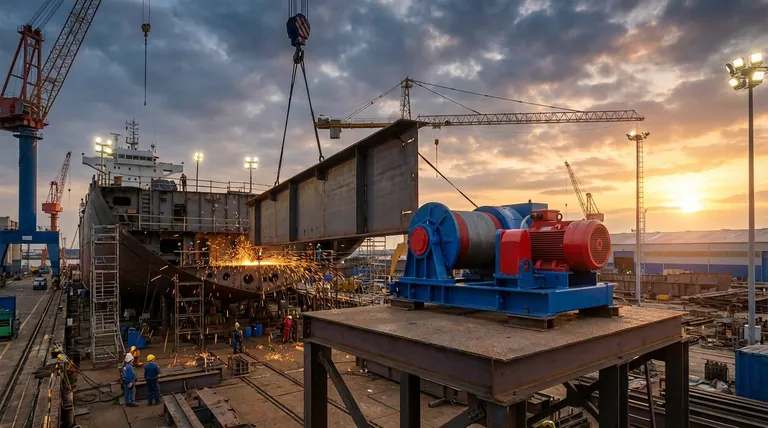
This is where wire rope hoists truly excel. They are indispensable for the installation and movement of massive steel and concrete structures in projects like bridge construction, power plant development, and shipbuilding.
Mining and Extraction
The robust nature of wire rope hoists makes them suitable for the harsh conditions of mining. They are used for material lifting, mine hoisting, slope tunnel management, and securing wellbores.
Specialized and Custom Tasks
Beyond general lifting, these hoists are used for highly specific, engineered tasks. A key example is the inverted welding of large oil tanks, where the hoist provides the necessary power and control for precise positioning.
Why Wire Rope Hoists are the Standard for Heavy Lifting
The widespread adoption of wire rope hoists is a direct result of their core design principles, which are optimized for power, speed, and integration.
The Need for Speed and Capacity
Wire rope hoists are specifically engineered for heavier loads and greater lifting heights compared to many alternatives. Their design allows for faster lifting speeds, which is critical for maintaining productivity in demanding, high-cycle industrial environments.
Structural Versatility
These hoists can operate as standalone units but are most often integrated into larger lifting systems. They form the heart of equipment like overhead cranes, gantry cranes, and jib cranes, providing the actual lifting power for a structured frame.
Key Mechanical Components
Their power comes from a simple, effective system: a motor drives a transmission, which turns a grooved drum. The steel wire rope wraps around this drum, with a rope guide ensuring it spools correctly to prevent tangling and ensure a smooth, stable lift.
Understanding the Trade-offs
While powerful and effective, wire rope hoists are not the solution for every lifting scenario. Understanding their limitations is key to making an informed decision.
Cost Consideration
Generally, electric wire rope hoists are more expensive upfront than their electric chain hoist counterparts. The investment is justified by their superior performance in high-capacity and high-speed applications.
Wire Rope Durability
While strong, the wire rope itself can be more susceptible to damage from kinking, crushing, and certain harsh environments compared to a hardened steel chain. Regular inspection and proper maintenance are critical.
Spatial Footprint
The drum-and-rope mechanism typically requires more horizontal space than the compact gearbox of a chain hoist. This can be a limiting factor in facilities with low headroom or tight spaces.
Making the Right Choice for Your Goal
Selecting the correct hoist means matching the equipment's strengths to your operational demands.
- If your primary focus is heavy-duty industrial production: A wire rope hoist is the superior choice for its combination of speed, high capacity, and durability over long-duty cycles.
- If you are managing a large-scale construction project: The hoist's raw power and ability to handle massive components like steel beams and pre-cast concrete make it essential.
- If your needs involve frequent, lower-capacity lifts in a compact workshop: You should evaluate if a more economical and spatially efficient electric chain hoist would better suit your application.
Ultimately, selecting a wire rope electric hoist is a decision for power, speed, and reliability in the most demanding lifting operations.
Summary Table:
| Application | Key Use Cases |
|---|---|
| Manufacturing & Warehousing | Assembly lines, loading/unloading heavy inventory |
| Heavy Construction | Bridge building, steel/beam installation, shipbuilding |
| Mining & Extraction | Material lifting, mine hoisting, tunnel management |
| Specialized Tasks | Inverted welding, custom engineered lifting operations |
Need a reliable hoist for your heavy-duty projects? GARLWAY specializes in construction machinery, offering robust wire rope electric hoists, winches, concrete mixers, and batching plants for construction companies and contractors globally. Let us help you enhance efficiency and safety—contact us today to discuss your lifting needs!
Visual Guide
Related Products
- Electric Hoist Winch Boat Anchor Windlass for Marine Applications
- Electric and Hydraulic Winch for Heavy Duty Applications
People Also Ask
- How does an electric anchor winch work? Power, Safety, and Reliable Operation Explained
- What are the advantages of installing an electric anchor winch on a boat? Boost Safety & Ease for Boaters
- What are the operational differences between electric hoists and winches? A Guide to Safe Lifting vs. Pulling
- What are the main benefits of a boat anchor winch? Boost Safety & Efficiency for Your Vessel
- How does a boat anchor winch work? A Guide to Reliable Anchor Handling

