
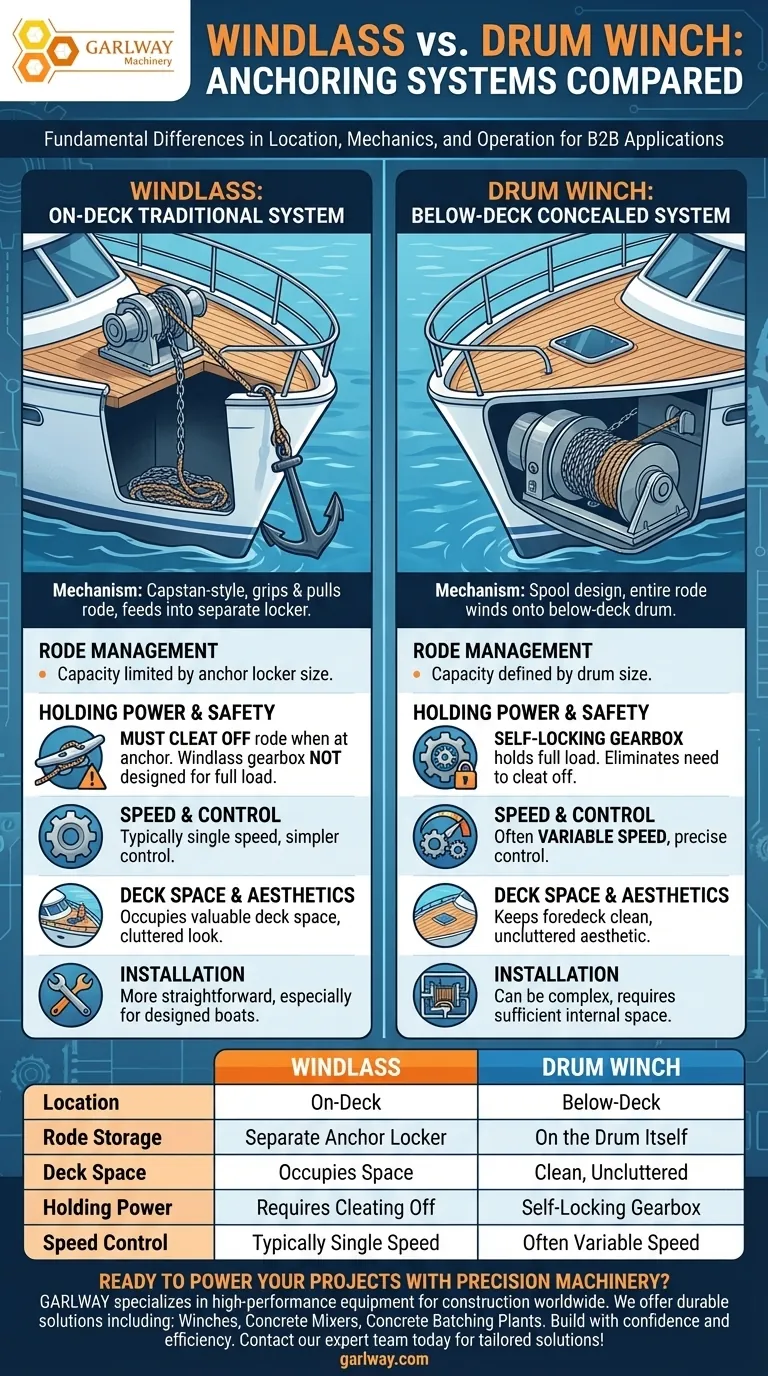
At its core, the difference between a windlass and a drum winch is about location and mechanics. A windlass is a capstan-style device mounted on the deck that feeds the anchor rode into a locker below, while a drum winch is a large spool installed below deck that winds the entire rode onto itself.
The choice isn't just about lifting an anchor; it's a decision between a traditional on-deck system (windlass) and a concealed, self-contained system (drum winch), each with significant implications for your boat's deck space, safety, and operation.
The Fundamental Design Difference
To understand the practical outcomes, you must first grasp how each system is fundamentally built and where it lives on your vessel.
Windlass: The On-Deck Workhorse
A windlass is the more traditional and common powered anchoring system. It's mounted directly on the deck of the boat.
The mechanism works by gripping the anchor chain or rope, pulling it up, and then feeding it down through a hole into the anchor locker below. The windlass itself does not store the rode.
Drum Winch: The Below-Deck Solution
A drum winch is designed to be installed out of sight, typically within the anchor well or locker.
Its entire mechanism, including a large drum, is housed below the deck. The anchor rode (chain and rope) winds directly and neatly onto this drum, keeping the entire system contained and hidden.
Key Operational Distinctions
The design differences lead to very different experiences when you are actually anchoring.
Rode Management
A windlass's capacity is only limited by the size of your anchor locker. It simply feeds the rope and chain into the available space.
A drum winch's capacity is strictly defined by the physical size of its drum. You can only fit as much rode as the drum is designed to hold.
Holding Power and Safety
With a windlass, you must cleat off the anchor rode once the anchor is set. The windlass itself is not designed to bear the full load of the boat at anchor; doing so will damage its gearbox.
Drum winches are built with oversized, self-locking gearboxes. This allows them to hold the boat's full load directly, eliminating the need to cleat off the rode for safety.
Speed and Control
Drum winches often feature variable speed operation, giving you more precise control when deploying and retrieving the anchor.
A traditional windlass typically operates at a single speed, offering simpler but less nuanced control.
Understanding the Trade-offs
Neither system is universally superior. The right choice depends on understanding their inherent compromises.
Deck Space and Aesthetics
The most obvious trade-off is visual. A drum winch keeps the foredeck clean and uncluttered, as the entire bulky mechanism is hidden.
A windlass occupies valuable deck space. While a necessary piece of hardware, it contributes to a more cluttered and traditional look.
Installation and Retrofitting
Installing a windlass is often more straightforward, especially on boats designed for one, as it primarily involves mounting it to the deck.
Fitting a drum winch can be more complex. It requires sufficient space inside the anchor locker to house the entire unit, which may not be possible on all boat designs without modification.
Making the Right Choice for Your Goal
Your specific priorities will determine the best system for your vessel.
- If your primary focus is a clean, uncluttered deck and operational simplicity: The drum winch is the superior choice, hiding the mechanism and removing the need to cleat off.
- If your primary focus is fitting a system to a boat with a very deep anchor locker but limited internal space: A traditional windlass may be the only practical and cost-effective solution.
- If your primary focus is holding power without extra steps: The self-locking gearbox of a drum winch provides a significant safety and convenience advantage.
By understanding these core differences in design and function, you can confidently select the anchoring system that truly aligns with your boat and your needs.
Summary Table:
| Feature | Windlass | Drum Winch |
|---|---|---|
| Location | On-Deck | Below-Deck |
| Rode Storage | Separate Anchor Locker | On the Drum Itself |
| Deck Space | Occupies Space | Clean, Uncluttered |
| Holding Power | Requires Cleating Off | Self-Locking Gearbox |
| Speed Control | Typically Single Speed | Often Variable Speed |
Ready to Power Your Projects with Precision Machinery?
Just as choosing the right winch is critical for safe anchoring, selecting the right construction machinery is vital for your project's success. GARLWAY specializes in high-performance equipment for construction companies and contractors worldwide.
We offer durable and reliable solutions, including:
- Winches for heavy lifting and pulling
- Concrete Mixers for consistent batching
- Concrete Batching Plants for efficient large-scale production
Let us help you build with confidence and efficiency. Contact our expert team today to discuss your specific needs and get a tailored solution!
Visual Guide
Related Products
- Best 18000 Pound Drum Anchor Trailer Winch
- Warn Winch Windlass Boat Trailer Winch
- Portable Small Trailer Winch
- Electric 120V Boat Winch by Badlands
- Heavy Duty Electric Boat Winch Windlass Anchor
People Also Ask
- In what scenarios is a winch particularly useful for trailers? Load Heavy Items Safely & Efficiently
- How do you install a trailer winch? A Step-by-Step Guide for a Safe & Secure Setup
- What should be considered when mounting a winch on a trailer? Ensure a Safe, Aligned Installation
- What are the considerations for equipping a trailer with a winch for hauling a car? A Guide to Safe and Efficient Vehicle Loading
- What are the main types of trailer winches? Choose the Right Power Source for Your Load



