
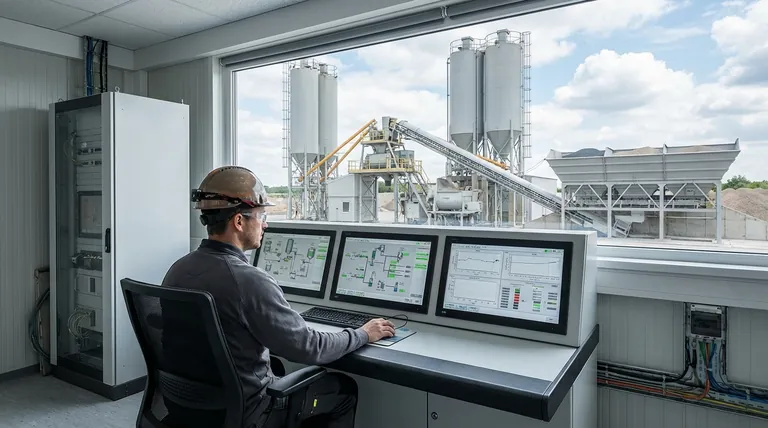
At their core, modern concrete batch plants are managed by sophisticated control systems built around a Programmable Logic Controller (PLC). These industrial computers serve as the brain of the operation, executing pre-programmed instructions to automate the entire concrete production process, often managed by an operator through a touch screen interface.
The control system is the central nervous system of a batch plant. It moves beyond simple on/off functionality to provide precise automation, critical safety interlocks, and real-time data, directly impacting the quality, consistency, and efficiency of the concrete produced.
The Architecture of a Batch Plant Control System
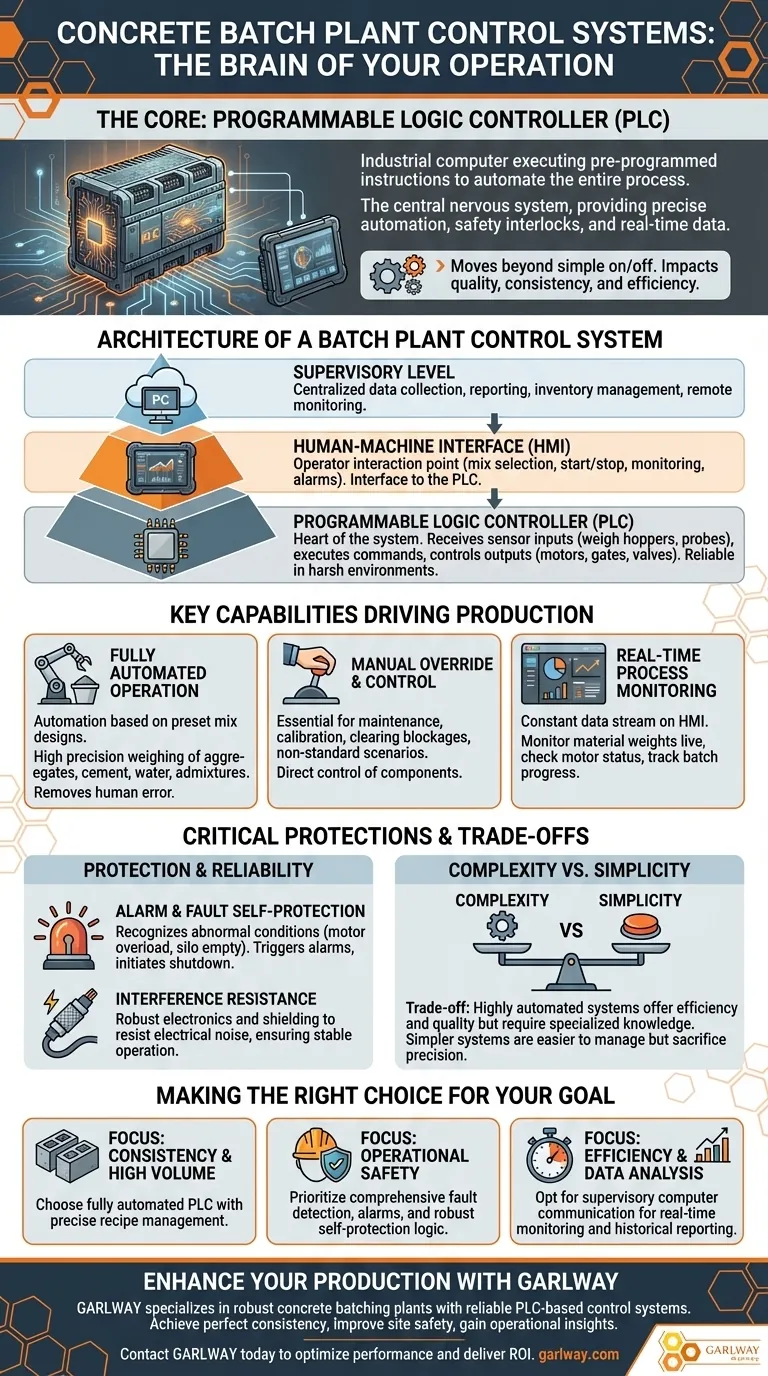
A plant's control system isn't a single component but a combination of hardware and software working in unison. Understanding these layers clarifies how a raw command becomes a finished batch of concrete.
The Programmable Logic Controller (PLC)
The PLC is the industrial-grade computer at the heart of the system. It receives inputs from sensors (like weigh hoppers and moisture probes) and executes a programmed sequence of commands to control outputs (like motors, gates, and valves).
PLCs are chosen for their extreme reliability and ability to withstand the harsh environment of a concrete plant.
The Human-Machine Interface (HMI)
The HMI is how the operator interacts with the PLC. This is typically a ruggedized touch screen or a computer running specialized software.
From the HMI, an operator can select mix designs, start and stop batches, monitor the process in real-time, and view alarm statuses.
The Supervisory Level
In many modern plants, the PLC and HMI communicate with a higher-level computer system. This allows for centralized data collection, report generation, inventory management, and remote monitoring.
Key Capabilities That Drive Production
The value of a modern control system lies in its core functions, which are designed to maximize consistency, safety, and efficiency.
Fully Automated Operation
The primary function is automation based on preset mix designs or recipes. The system automatically weighs aggregates, cement, water, and admixtures with high precision, ensuring every batch meets the required specifications.
This removes the potential for human error in measurement, which is critical for producing consistent, high-quality concrete.
Manual Override and Control
Even in a fully automated system, manual control is essential. Operators must have the ability to take direct control of individual components like gates and conveyors.
This is necessary for maintenance, calibration, clearing blockages, or handling non-standard operational scenarios.
Real-Time Process Monitoring
The control system provides a constant stream of data, displayed visually on the HMI. Operators can monitor the weight of each material in real-time, see the status of all motors, and track the overall progress of the batch.
Critical Protections and Inherent Trade-offs
A robust control system does more than just run the plant; it protects it. However, this sophistication comes with its own set of considerations.
Alarm and Fault Self-Protection
The system is programmed to recognize abnormal conditions. If a motor overloads, a silo runs empty, or a scale fails to reach its target weight, the system will trigger an alarm.
In critical situations, it can initiate an automatic shutdown sequence to prevent damage to equipment or the production of a bad batch.
Interference Resistance
Concrete plants are electrically noisy environments. Control systems are designed with shielding and robust electronics to resist electrical interference, ensuring stable and reliable operation without unexplained shutdowns or errors.
Complexity vs. Simplicity
The main trade-off is between capability and complexity. A highly automated system with detailed reporting offers immense efficiency and quality control but requires more specialized knowledge to operate and maintain. A simpler system may be easier to manage but sacrifices precision and data insight.
Making the Right Choice for Your Goal
The emphasis you place on different control system features should align directly with your operational priorities.
- If your primary focus is consistency and high volume: A fully automated PLC system with precise recipe management is the only way to guarantee every batch meets specifications.
- If your primary focus is operational safety: Prioritize a system with comprehensive fault detection, clear alarm notifications, and robust self-protection logic to prevent equipment damage.
- If your primary focus is efficiency and data analysis: A system that communicates with a supervisory computer for real-time monitoring and historical reporting is critical for optimizing performance.
Ultimately, the control system dictates the plant's potential for quality, safety, and efficiency.
Summary Table:
| System Component | Primary Function |
|---|---|
| Programmable Logic Controller (PLC) | Executes automated sequences; the plant's brain. |
| Human-Machine Interface (HMI) | Allows operator interaction via a touch screen. |
| Supervisory Level | Enables data collection, reporting, and remote monitoring. |
| Key Capabilities | Value Delivered |
| Automated Operation | Ensures precise batching for consistent quality. |
| Manual Override | Provides flexibility for maintenance and troubleshooting. |
| Real-Time Monitoring | Tracks weights and machine statuses live. |
| Alarm & Fault Protection | Prevents equipment damage and bad batches. |
Ready to enhance your concrete production with a state-of-the-art control system?
GARLWAY specializes in providing robust construction machinery, including advanced concrete batching plants with reliable PLC-based control systems. Our solutions are designed for construction companies and contractors who demand precision, efficiency, and operational safety.
We can help you:
- Achieve perfect batch consistency with automated recipe management.
- Improve site safety with integrated fault detection and alarms.
- Gain valuable operational insights through real-time monitoring and reporting.
Contact GARLWAY today to discuss how our control systems can optimize your plant's performance and deliver a rapid return on investment.
Visual Guide
Related Products
- HZS120 Ready Mix Concrete Batching Plant Commercial Mud Cement Mixer
- HZS35 Small Cement Concrete Mixing Batch Plant
- HZS75 Concrete Batching Plant Cement Mixer Price Concrete Mixer Bunnings Mixing Plant
- Commercial Electric Concrete Mixer Machine HZS 50 Small Batch Plant for Sale
- HZS180 Ready Mix Concrete Plant for Foundations with Sand and Cement
People Also Ask
- What is a ready mix concrete batching plant? The Engine of Modern Construction
- What is the name of the machine used in ready mix? Unpacking the Complete Concrete System
- What is the core component of a concrete batching plant? The Mixer Unit Defines Your Concrete Quality
- What are the types of concrete mixers used in batching plants? Choose the Right Mixer for Your Project
- What are the advantages and disadvantages of concrete batching plants? Maximize Quality & Efficiency





