
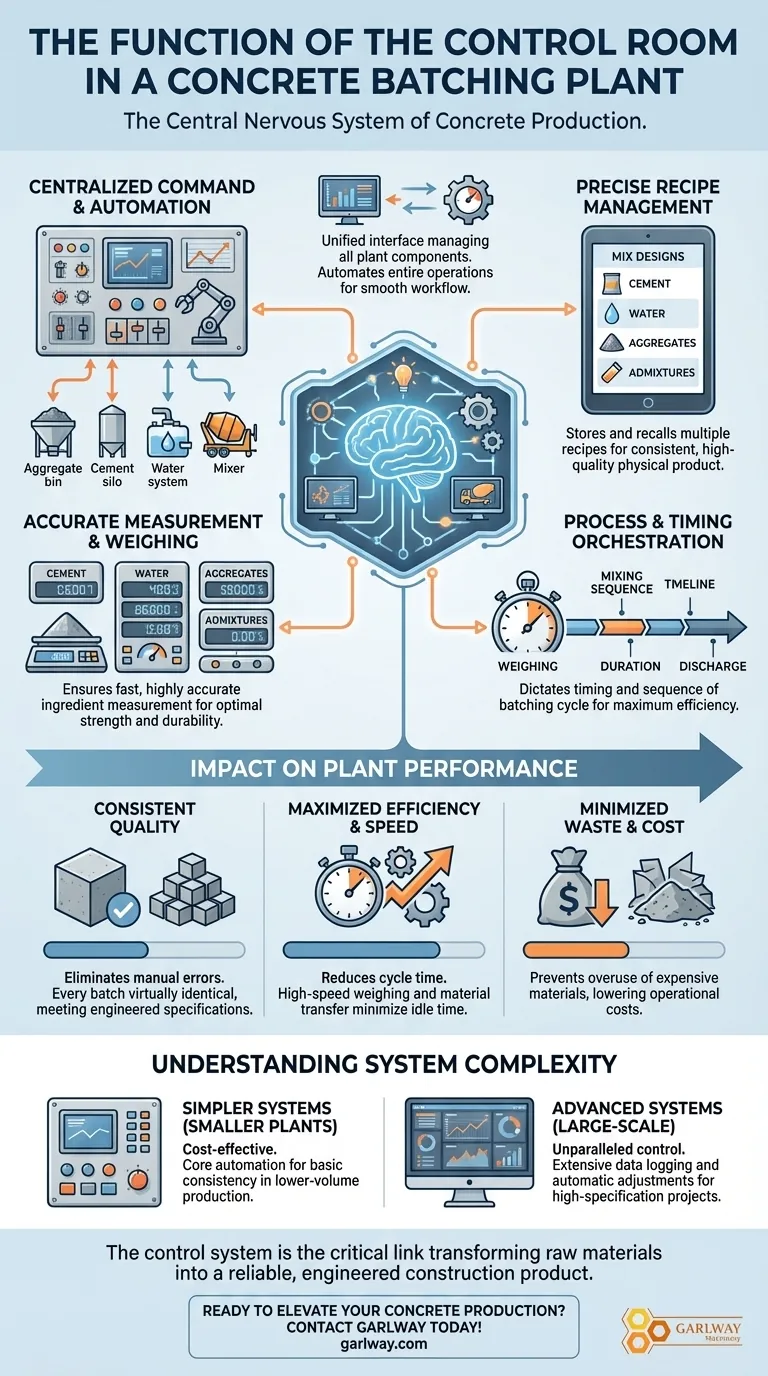
In a concrete batching plant, the control room functions as the central nervous system. It is the single point from which an operator manages, automates, and monitors the entire concrete production process, from weighing raw materials to orchestrating the final mix.
The control room's fundamental purpose is to translate a precise concrete recipe into a consistent, high-quality physical product. It achieves this by removing manual error and ensuring every batch is produced with exacting accuracy and repeatability.

The Core Functions of the Control System
A modern control system is responsible for the precise execution of every step in the batching cycle. Its functions are critical for maintaining the integrity of the final concrete product.
Centralized Command and Automation
The control room provides a unified interface to manage all plant components. This includes aggregate bins, cement silos, water and admixture systems, conveyors, and the mixer itself.
It automates the entire sequence of operations based on predetermined parameters, ensuring a smooth and efficient workflow without direct manual intervention for each step.
Precise Recipe Management
The system is where mix designs are entered, stored, and recalled. Operators can save numerous recipes, each with specific proportions of cement, water, aggregates, and admixtures.
This allows for the rapid selection of the correct mix design for a specific job, guaranteeing that the engineered specifications are met precisely every time.
Accurate Measurement and Weighing
The control panel is directly linked to the plant's scales and meters. It ensures fast and highly accurate measurement of every ingredient for the batch.
This precision is fundamental to concrete quality, as even small deviations in the water-to-cement ratio or aggregate amounts can significantly impact strength and durability.
Process and Timing Orchestration
The system dictates the timing of the entire process. It controls how long materials are weighed, the sequence in which they are added to the mixer, and the exact mixing duration.
Once mixing is complete, the control system also manages the discharge of the concrete into a transport truck.
The Impact on Plant Performance
The effectiveness of the control room directly correlates to the plant's overall performance, influencing quality, efficiency, and profitability.
Guaranteeing Consistent Quality
By automating the batching process, the control system eliminates the inconsistencies and potential errors of manual operation.
This ensures that every batch of a specific recipe is virtually identical, providing the consistent quality required for modern construction projects.
Maximizing Efficiency and Speed
Automation drastically reduces the time required for each batch cycle. Accurate, high-speed weighing and coordinated material transfer minimize idle time and maximize plant throughput.
The ability to quickly switch between stored recipes also saves valuable time when changing production from one type of concrete to another.
Minimizing Waste and Cost
Precision is the key to profitability. By ensuring exact measurements, the control system prevents the overuse of expensive materials like cement and admixtures.
This reduction in waste directly translates to lower operational costs and a more sustainable, profitable operation.
Understanding the Trade-off: System Complexity
Control systems are not one-size-fits-all. The complexity of the system is a critical decision based on the scale and requirements of the operation.
Simpler Systems for Smaller Plants
For smaller or mobile batching plants, a simpler control panel may be sufficient. These systems provide core automation for weighing and mixing but may have limited recipe storage or reporting capabilities.
They offer a cost-effective solution for straightforward, lower-volume production where basic consistency is the primary goal.
Advanced Systems for Large-Scale Operations
Large commercial or project-specific plants require more sophisticated, computer-based control systems. These offer extensive recipe management, real-time monitoring, detailed data logging, and automatic adjustments.
While requiring a larger initial investment, these advanced systems provide unparalleled control, quality assurance, and operational data essential for high-specification projects.
Making the Right Choice for Your Operation
The control system is the heart of your plant's ability to deliver on its promises. Your selection should be guided by your primary operational goal.
- If your primary focus is unwavering quality and consistency for demanding projects: An advanced, fully automated control system is the only path to guaranteeing tight tolerances and producing certifiable data.
- If your primary focus is cost-effective production for smaller-scale jobs: A simpler, robust control panel provides the essential precision and automation needed to ensure quality without unnecessary complexity.
Ultimately, the control system is the critical link that transforms raw materials into a reliable, engineered construction product.
Summary Table:
| Function | Key Benefit |
|---|---|
| Centralized Command & Automation | Manages all plant components from a single interface for a smooth workflow. |
| Precise Recipe Management | Stores and recalls mix designs to guarantee consistent, high-quality concrete. |
| Accurate Measurement & Weighing | Ensures exact proportions of materials for optimal strength and durability. |
| Process & Timing Orchestration | Controls the entire batching sequence to maximize speed and efficiency. |
Ready to Elevate Your Concrete Production?
The right control system is the heart of a profitable and reliable batching plant. GARLWAY specializes in engineering high-performance construction machinery, including concrete batching plants with control systems tailored to your specific needs—from simple, cost-effective panels for smaller operations to advanced, fully automated systems for large-scale projects.
We help construction companies and contractors globally achieve:
- Unwavering Quality: Produce consistent, high-specification concrete batch after batch.
- Maximized Efficiency: Reduce cycle times and increase plant throughput.
- Reduced Costs: Minimize material waste and lower operational expenses.
Let's discuss the perfect control solution for your operation. Contact GARLWAY today for a expert consultation!
Visual Guide
Related Products
- HZS35 Small Cement Concrete Mixing Batch Plant
- HZS120 Ready Mix Concrete Batching Plant Commercial Mud Cement Mixer
- HZS75 Concrete Batching Plant Cement Mixer Price Concrete Mixer Bunnings Mixing Plant
- HZS180 Ready Mix Concrete Plant for Foundations with Sand and Cement
- Commercial Electric Concrete Mixer Machine HZS 50 Small Batch Plant for Sale
People Also Ask
- Why buy concrete batch plant parts only from the manufacturer? Protect Your Investment and Maximize Uptime
- Why is proper maintenance important for a concrete batch mix plant? Maximize Uptime & Profitability
- What is the advantage of a mobile concrete batching plant? Achieve On-Site Production & Total Control
- What are the advantages and disadvantages of concrete batching plants? Maximize Quality & Efficiency
- What are the two methods of material charging in a concrete mixing station? Single vs. Multiple Charging Explained





