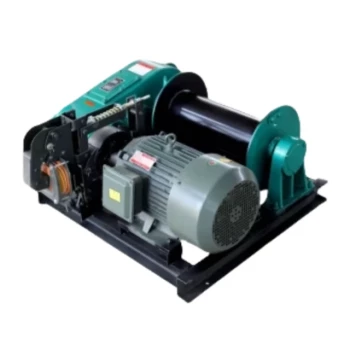
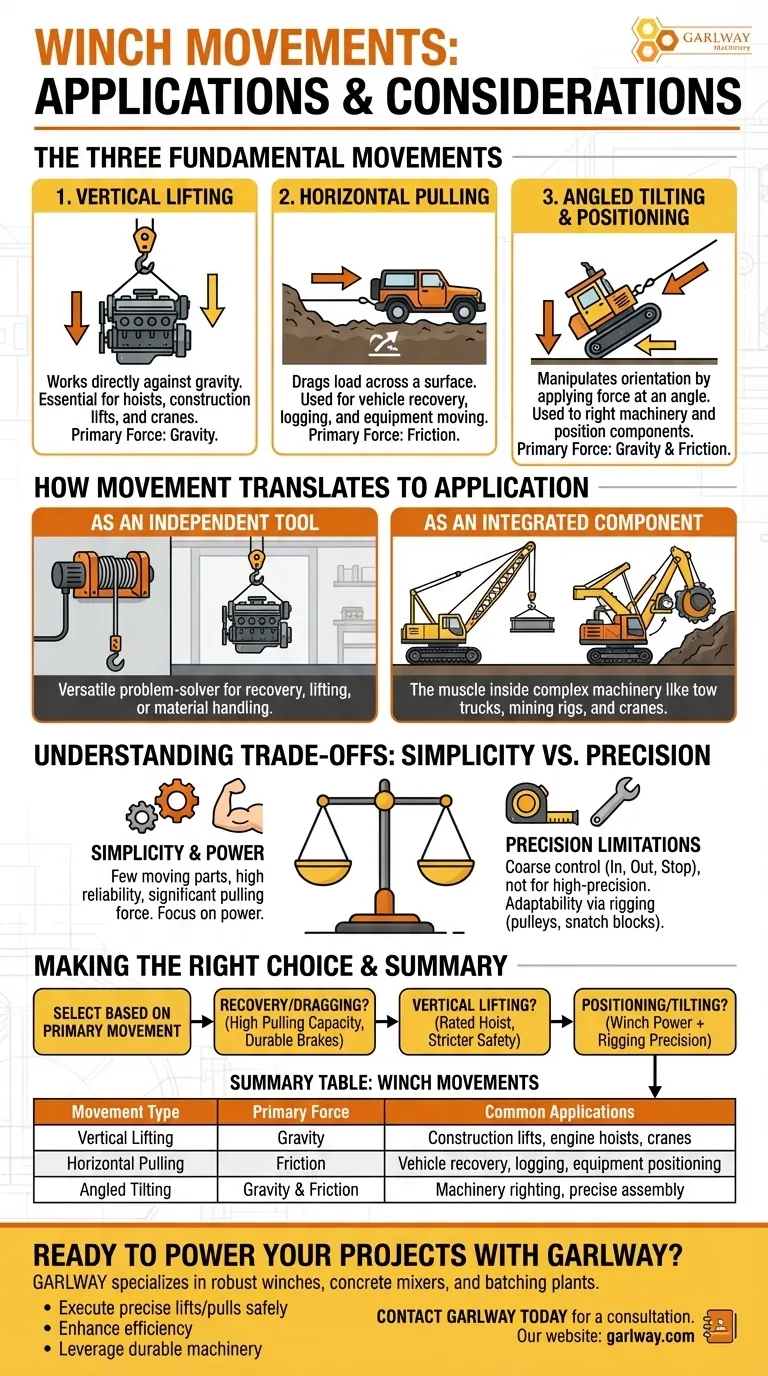
At its core, a winch is a device for applying mechanical force. It is designed to execute three fundamental movements: vertically lifting, horizontally pulling, or tilting heavy objects. These simple actions form the basis of its utility across countless applications.
While a winch only performs a few basic movements, its true value is its flexibility. Understanding that it is fundamentally a tool for pulling a cable allows you to adapt it to an incredible range of tasks by simply changing the angle of operation.
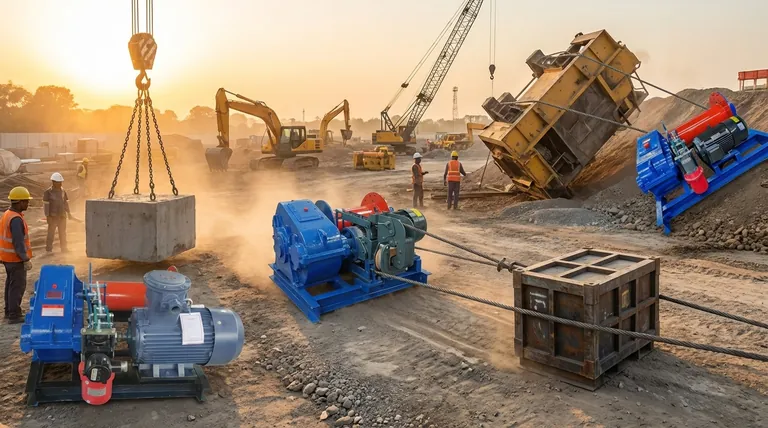
The Three Fundamental Winch Movements
A winch's operation is straightforward, revolving around winding a cable onto a drum. The orientation of the winch and the object determines which of the three primary movements is being performed.
Vertical Lifting
This is the most common hoisting action. The winch works directly against gravity to raise an object straight up.
This movement is essential in applications like construction site lifts, engine hoists in automotive shops, and as the core lifting component within larger cranes.
Horizontal Pulling
In this movement, the winch is used to drag a load across a surface. The primary force being overcome is friction, not gravity.
This is the classic movement used in off-road vehicle recovery, logging operations, or pulling heavy equipment into a workshop.
Angled Tilting and Positioning
This is a combination of lifting and pulling, used to manipulate an object's orientation. By applying force at an angle, a winch can be used to carefully tilt, right, or position a heavy item.
For example, this movement is used to right a piece of tipped machinery or to carefully guide a large component into a precise location during assembly.
How Movement Translates to Application
The simplicity of a winch is its greatest strength. These core movements can be applied either by a standalone winch or one integrated into a larger system.
As an Independent Tool
When used independently, a winch is a versatile problem-solver. It can be mounted to a vehicle for recovery, a wall for workshop lifting, or a temporary anchor for material handling.
As an Integrated Component
Winches are the muscle inside more complex machinery. The lift function of a tow truck, the main hoist on a mining rig, and the bucket drag on a piece of road construction equipment are all powered by an integrated winch system.
Understanding the Trade-offs: Simplicity vs. Precision
The winch's design prioritizes power and reliability over complex functionality. This creates a clear set of trade-offs you must consider.
The Power of a Simple Structure
A winch has few moving parts, which makes it exceptionally reliable and less prone to malfunction. Its design is focused on one thing: pulling a line with significant force.
The Limitation of Coarse Control
This simplicity means a standard winch is not a high-precision positioning device. Control is typically limited to "in," "out," and "stop." It excels at moving heavy objects, but not at placing them with millimeter-level accuracy.
Flexibility Through Rigging, Not the Winch
A winch's adaptability comes from external rigging techniques. Using pulleys and snatch blocks allows you to change the direction of the pulling force, multiply the pulling power, or create complex multi-point pulls. The winch provides the force; your rigging provides the precision.
Making the Right Choice for Your Goal
Select a winch based on the primary movement your task requires.
- If your primary focus is vehicle recovery or horizontal dragging: You need a winch built for high pulling capacity and a durable braking system.
- If your primary focus is vertical lifting: You need a tool specifically rated as a hoist, which has stricter safety standards and braking mechanisms designed to prevent catastrophic failure.
- If your primary focus is complex positioning or tilting: The winch is your source of power, but your primary investment should be in high-quality rigging and anchor points to control the direction of force.
By understanding these fundamental movements, you can leverage the simple, reliable power of a winch to solve an immense range of challenges.
Summary Table:
| Movement Type | Primary Force Overcome | Common Applications |
|---|---|---|
| Vertical Lifting | Gravity | Construction lifts, engine hoists, crane operations |
| Horizontal Pulling | Friction | Vehicle recovery, logging, equipment positioning |
| Angled Tilting | Gravity & Friction | Machinery righting, precise component assembly |
Ready to Power Your Projects with the Right Winch?
Understanding the core movements is the first step. GARLWAY specializes in providing robust and reliable winches, concrete mixers, and batching plants tailored for construction companies and contractors worldwide.
Let us help you select the perfect equipment to:
- Execute precise lifts and pulls safely.
- Enhance efficiency on your job site.
- Leverage durable machinery built for demanding applications.
Contact GARLWAY today for a consultation and discover how our solutions can drive your success.
Visual Guide
Related Products
- Warn Winch Windlass Boat Trailer Winch
- Electric and Hydraulic Winch for Heavy Duty Applications
- Small Electric Winch 120V and 240V for Compact Applications
- Quick Windlass Portable Winch for Truck and Boat Best Boat Winch
- Hydraulic Winding Engine Harbor Freight Winch
People Also Ask
- What are the main components of a boat trailer winch? A Guide to Safe & Efficient Boat Loading
- What factors should be considered when choosing a boat trailer winch? Ensure Safe and Effortless Boat Loading
- What is the purpose of boat trailer winches? Safely and Efficiently Load Your Boat
- What are the two main types of boat trailer winches? Manual vs. Electric Explained
- How often should a boat trailer winch be replaced? Your Guide to Safety and Longevity