
The four primary types of wire rope electric hoists, classified by their motor and drum configuration, are determined by the orientation of the motor's axis relative to the drum's axis and whether the motor is placed inside or outside the lifting drum. This fundamental design choice directly impacts the hoist's size, efficiency, and ease of maintenance.
The physical arrangement of a hoist's motor and drum is not just a minor detail; it is the central engineering trade-off that dictates the hoist's overall footprint, serviceability, and suitability for specific spatial constraints.
Analyzing Each Hoist Configuration
To understand the practical implications of each design, we must examine their individual characteristics, advantages, and inherent limitations.
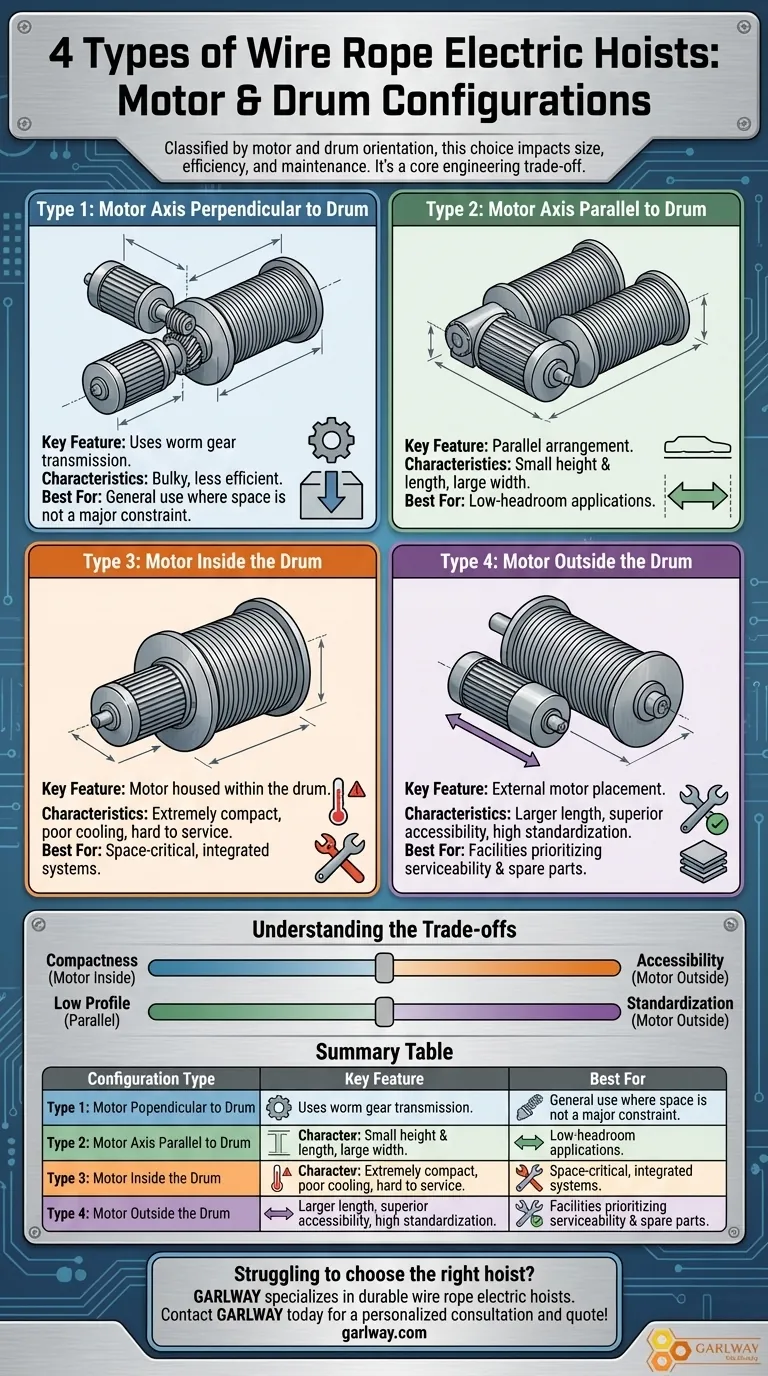
Type 1: Motor Axis Perpendicular to Drum
This configuration places the motor's axis at a right angle to the drum's axis.
It typically relies on a worm gear transmission to transfer power. This design often results in a bulky and less efficient hoist compared to more modern alternatives.
Type 2: Motor Axis Parallel to Drum
In this common design, the motor and drum axes run parallel to each other.
This layout creates a hoist with small height and length dimensions, making it suitable for applications with limited headroom. However, its primary drawback is a significantly larger width.
Type 3: Motor Inside the Drum
This is the most compact design, as the motor is housed entirely within the wire rope drum.
While this approach saves a great deal of space, it comes with significant downsides. The motor has poor cooling due to the enclosed location, and performing maintenance or repairs is considerably more difficult.
Type 4: Motor Outside the Drum
This configuration, often a variation of the parallel-axis design, places the motor externally.
This approach results in a larger overall length but offers superior accessibility. These hoists benefit from a high degree of standardization, are easier to service, and allow for simpler modifications to the lifting height.
Understanding the Trade-offs
Choosing a hoist configuration requires balancing competing priorities. No single design is universally superior; each is optimized for a different set of operational needs.
Compactness vs. Accessibility
The core conflict is often between size and serviceability.
The motor-inside-drum design achieves maximum compactness, making it ideal for extremely tight or integrated applications. Conversely, the motor-outside-drum design prioritizes easy access for installation and maintenance at the cost of a longer footprint.
Footprint and Spatial Fit
The hoist's shape must match the available space.
A parallel-axis hoist is short and low-profile but wide, fitting well in areas with low headroom but ample side-to-side clearance. The perpendicular-axis type is often bulky in multiple dimensions, requiring more generous space overall.
Standardization and Grouping
The motor-outside-drum configuration excels in environments that value standardization.
Its design allows for good grouping of components and high interchangeability, which simplifies fleet management and spare parts inventory. This is a key advantage in large industrial facilities.
Making the Right Choice for Your Application
Your primary operational goal should guide your selection.
- If your primary focus is maximum compactness: Choose the hoist with the motor inside the drum, but be prepared for more complex maintenance procedures and potential heat dissipation issues.
- If your primary focus is ease of maintenance and standardization: The hoist with the motor outside the drum is the superior choice, provided you can accommodate its longer dimensions.
- If your primary focus is fitting into a low-headroom space: The parallel-axis hoist offers a low vertical profile, but you must ensure you have sufficient width clearance.
Understanding these core designs empowers you to select a hoist based on its fundamental engineering, ensuring it meets the true needs of your application.
Summary Table:
| Configuration Type | Key Feature | Best For |
|---|---|---|
| Motor Axis Perpendicular to Drum | Uses worm gear; bulky, less efficient | General use where space is not a major constraint |
| Motor Axis Parallel to Drum | Low height & length; large width | Low-headroom applications |
| Motor Inside the Drum | Extremely compact; poor cooling, hard to service | Space-critical, integrated systems |
| Motor Outside the Drum | Easy maintenance, high standardization | Facilities prioritizing serviceability & spare parts |
Struggling to choose the right hoist for your project's space and maintenance needs? GARLWAY specializes in construction machinery, offering durable and efficient wire rope electric hoists for construction companies and contractors globally. Our experts can help you select the perfect hoist configuration to maximize your operational efficiency and safety. Contact GARLWAY today for a personalized consultation and quote!
Visual Guide
Related Products
- Electric Hoist Winch Boat Anchor Windlass for Marine Applications
- Electric and Hydraulic Winch for Heavy Duty Applications
People Also Ask
- How does an electric anchor winch work? Power, Safety, and Reliable Operation Explained
- What are the advantages of installing an electric anchor winch on a boat? Boost Safety & Ease for Boaters
- What are the operational differences between electric hoists and winches? A Guide to Safe Lifting vs. Pulling
- What are the main benefits of a boat anchor winch? Boost Safety & Efficiency for Your Vessel
- How does a boat anchor winch work? A Guide to Reliable Anchor Handling

