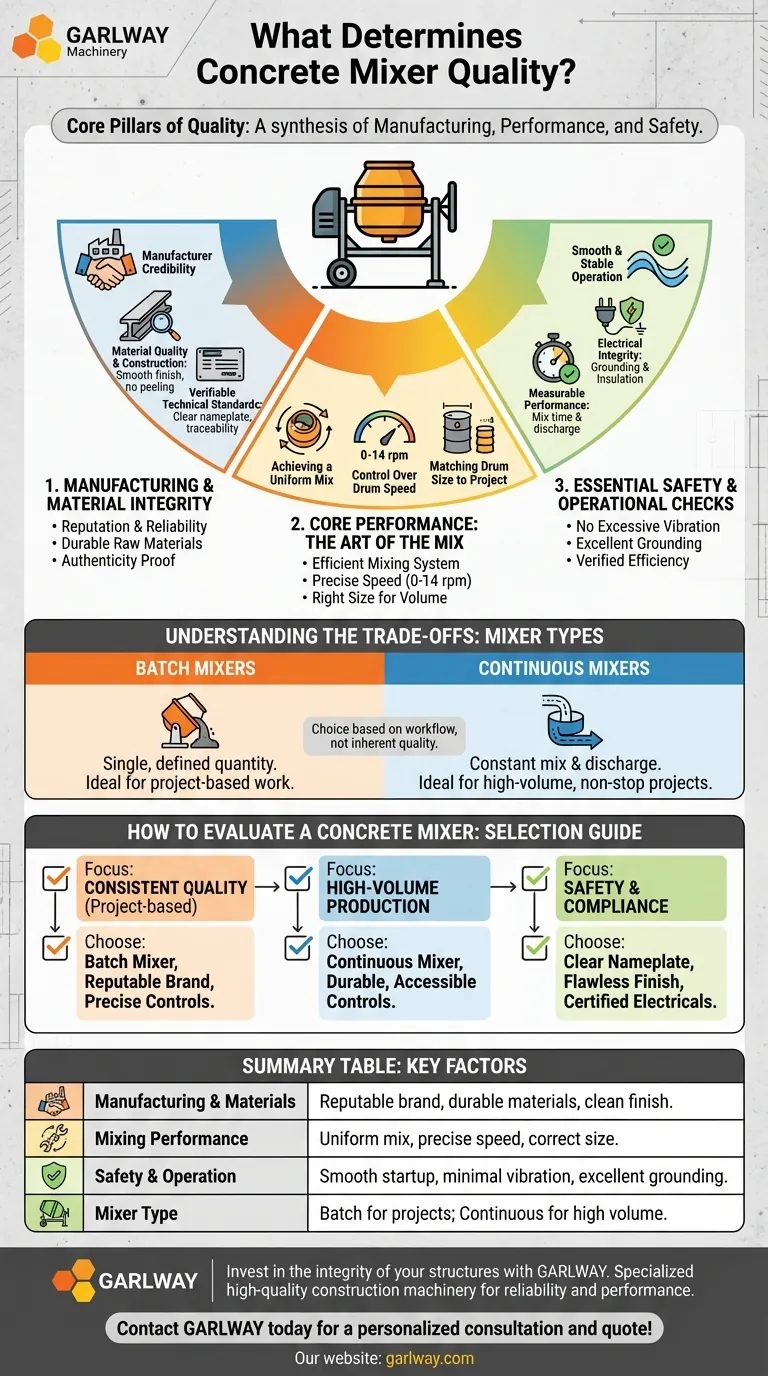
The quality of a concrete mixer is determined by a synthesis of three core areas: the integrity of its manufacturing and materials, its operational performance in creating a uniform mix, and its adherence to fundamental technical and safety standards. While factors like mixer type and capacity are important, true quality is rooted in the manufacturer's credibility, the robustness of the components, and verifiable performance metrics.
A high-quality concrete mixer is not defined by a single feature, but by a combination of durable construction, engineering that guarantees a consistent mix, and compliance with non-negotiable safety and operational standards. Choosing the right machine means evaluating these fundamentals first.
The Foundation: Manufacturing and Material Integrity
The quality of any piece of heavy equipment begins long before it reaches a job site. It starts with the manufacturer's standards and the materials they choose.
The Manufacturer's Credibility
The reputation and production conditions of the manufacturer are a primary indicator of quality. Established brands with a history of reliability are more likely to invest in superior engineering, quality control, and durable materials.
Material Quality and Construction
The cost and quality of the raw materials directly impact the mixer's lifespan and performance. Look for a machine with a smooth exterior finish, free of paint peeling, missed spots, or sharp burrs, as these details often reflect the overall standard of construction.
Verifiable Technical Standards
A professional-grade mixer must have a clean and clear nameplate. This plate should provide essential information like the manufacturer's name, model, serial number, and date of manufacture, offering traceability and proof of authenticity.
Core Performance: The Art of the Mix
A mixer's ultimate purpose is to produce high-quality, homogenous concrete. Its design and operational controls are critical to achieving this goal.
Achieving a Uniform Mix
The single most important performance factor is the efficiency of the mixing system. A superior mixer ensures the uniform distribution of cement, water, sand, and aggregates, which is essential for the strength and long-term durability of the final concrete structure.
Control Over Drum Speed
Operational efficiency depends on precise control. The ability to manage drum speed, typically within a range of 0-12 or 0-14 rotations per minute (rpm), allows operators to adjust the mixing action to suit the specific requirements of a batch.
Matching Drum Size to Project Needs
Mixers come in a wide range of drum sizes, from smaller units to those exceeding 19,000 liters. Selecting a size that aligns with your project's concrete volume needs is crucial for maintaining efficiency and avoiding waste.
Understanding the Trade-offs: Mixer Types
While the principles of quality apply universally, the type of mixer you choose should align with your specific application. The main distinction is between batch and continuous mixers.
The Role of Batch Mixers
Batch mixers, which include drum, pan, and open-top varieties, are designed to mix a single, defined quantity of concrete at a time. They can have extremely high capacities and are ideal for most construction sites where concrete is needed for specific pours.
The Purpose of Continuous Mixers
Continuous mixers, as the name implies, constantly mix and discharge concrete. They are suited for large-scale operations like dams or pavement projects that require a non-stop, high-volume supply of concrete.
The Critical Distinction
Choosing between batch and continuous is a decision based on workflow requirements, not inherent quality. A well-built batch mixer from a reputable source will always outperform a poorly made continuous mixer, regardless of the application.
Essential Safety and Operational Checks
A visual and operational inspection can reveal much about a mixer's underlying quality and safety.
Smooth and Stable Operation
The equipment should start smoothly and operate without excessive vibration or unusual noises. Any issues during startup or normal operation are significant red flags.
Electrical Integrity
Safety is paramount. The mixer must be equipped with a controller that has excellent grounding and insulation performance. This is a non-negotiable feature that protects operators and ensures reliable function.
Measurable Performance
Key performance indicators can be physically measured. The time it takes to achieve a proper mix and the time it takes to fully discharge the batch can be verified with a simple stopwatch, providing tangible data on the machine's efficiency.
How to Evaluate a Concrete Mixer
Use these points to guide your selection based on your primary objective.
- If your primary focus is consistent quality for project-based work: Choose a batch mixer from a reputable manufacturer with verifiable material integrity and precise drum speed controls.
- If your primary focus is large-scale, high-volume production: Prioritize a durable continuous mixer known for operational reliability and with easily accessible, well-insulated electrical controls.
- If your primary focus is safety and compliance: Insist on a mixer with a clear technical nameplate, flawless exterior finishing, and certified electrical components with proven grounding.
Ultimately, a quality concrete mixer is an investment in the integrity of every structure you build.
Summary Table:
| Key Factor | What to Look For |
|---|---|
| Manufacturing & Materials | Reputable brand, durable materials, clean finish, clear nameplate |
| Mixing Performance | Uniform concrete mix, precise drum speed control (0-14 rpm), correct drum size |
| Safety & Operation | Smooth startup, minimal vibration, excellent electrical grounding and insulation |
| Mixer Type | Batch mixer for project-based work; Continuous mixer for high-volume projects |
Invest in the integrity of your structures with GARLWAY.
Choosing the right concrete mixer is critical to the success and safety of your construction projects. GARLWAY specializes in high-quality construction machinery, including durable concrete mixers, winches, and batching plants designed for construction companies and contractors who demand reliability and performance.
Let us help you select the perfect equipment to ensure efficient, consistent, and safe concrete production on every job.
Contact GARLWAY today for a personalized consultation and quote!
Visual Guide
Related Products
- Portable Concrete Mixer Machine Equipment for Mixing Concrete
- Construction Products Concrete Plant Machine Mixing Concrete Mixer
- Portable Electric Concrete Mixer Machine for Cement Mixing
- JZC400 Mobile Small Concrete Mixer Cement Mixer Machine
- Hydraulic Concrete Mixer Machine Cement Mixing Equipment for Mixture Concrete
People Also Ask
- Why is it necessary to use a portable concrete mixer? Gain Total Control & Efficiency
- How much concrete can you pour with a portable mixer? Find the Perfect Fit for Your Project
- What types of projects are portable concrete mixers suitable for? Ideal for DIY & Small-Scale Construction
- How much does a portable concrete mixer hold? A Guide to Choosing the Right Capacity
- What types of portable concrete mixers exist? Find the Perfect Mixer for Your Project